Financial Advisor, Writer, Zionist, American Patriot and Conservative
A School That Notices: Inside Mizrahi Family Torah Academy’s Whole-Child Approach
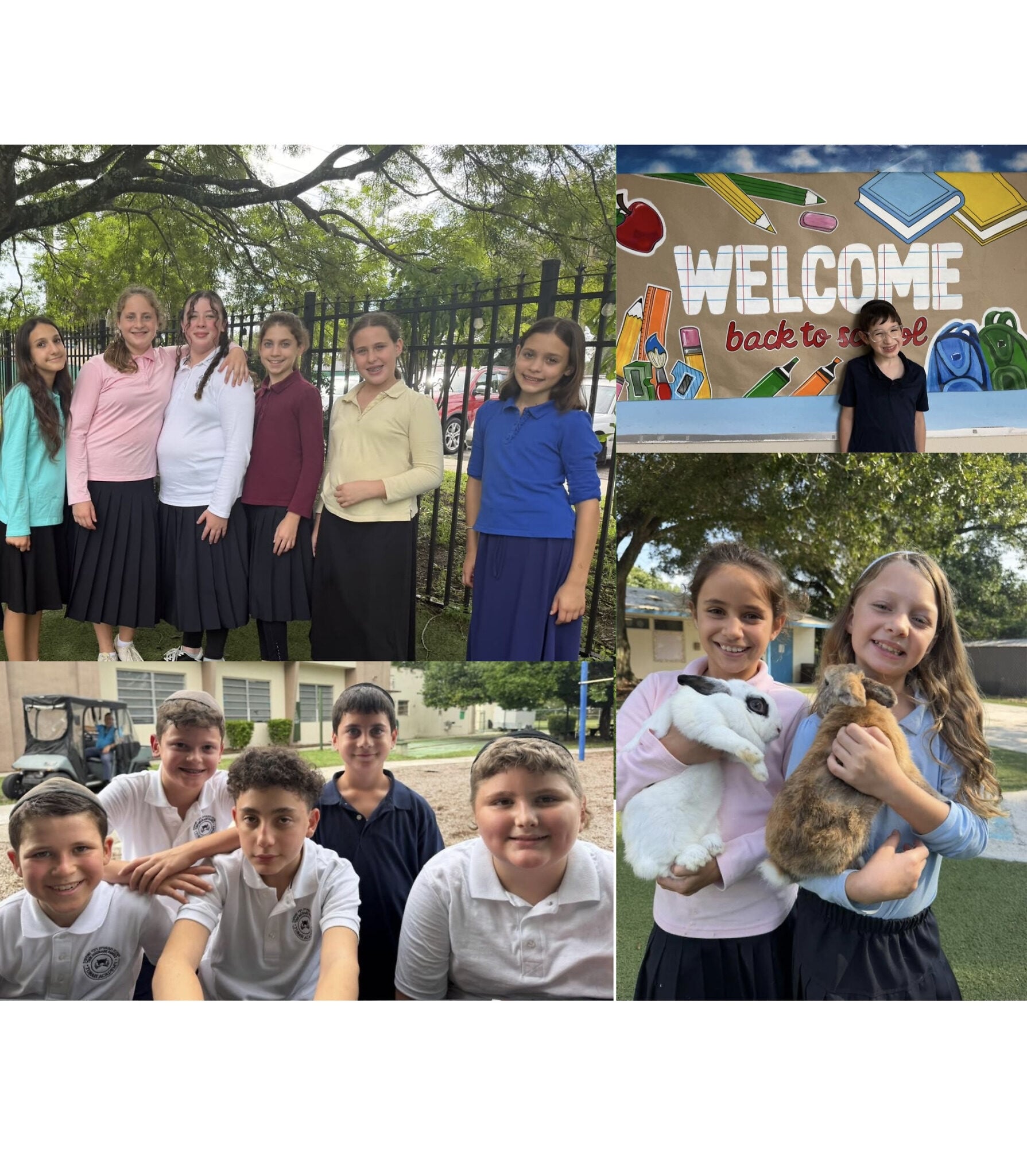
A combination of photos of students attending the Mizrahi Family Torah Academy in South Florida (photos courtesy of the Mizrahi Family Torah Academy)
As Mizrahi Family Torah Academy begins its ninth year, the school’s educational philosophy is perhaps best understood not through a mission statement, but through the ordinary moments unfolding across its campus during the opening weeks of the 2026-27 school year.
Students move from Limudei Kodesh to math, from writing to gym, from Rosh Hashana projects to the school garden. Some are working on essays. Others are learning about soil, caring for animals, creating art or discussing Teshuva and Tefillah. The variety is intentional. MTA’s model recognizes that children do not all reveal their strengths in the same way, and meaningful education requires understanding far more than a student’s academic level.
At the center of the school’s approach is a simple concept: educate the whole child.
Every student enters school with much more than reading scores, math skills and academic needs. Each child arrives with a personality, interests, sensitivities, talents, insecurities, questions and an emerging sense of identity.
“Children are not interchangeable, and education should not treat them as though they are,” said Mrs. Samantha Hirsch, MTA’s founder and Head of School. “The more deeply an educator knows a child, the better equipped that educator is to know when to support, when to challenge and sometimes when simply to notice.”
That emphasis on noticing is visible in the school’s small-class environment. Teachers notice when a student who usually participates has become quiet, when frustration is replacing confidence, or when a child is capable of more than he or she is producing.
Individualization does not mean making school easier. A student who needs support can receive it without being defined by it, while a student ready to move ahead can be pushed further. The goal is not for every child to have the same experience, but for every child to grow.
That philosophy also explains some of MTA’s more distinctive programs. Students have been working with their gardening teacher to prepare the school garden, learning about soil, plant growth, patience and responsibility. This year, two ducks, Donald and Daisy, also joined the rabbits and other animals on campus, giving students opportunities to develop responsibility, gentleness and confidence.
A child who is not the first to finish an assignment may be particularly skilled at caring for an animal, building something or creating art. Recognizing those abilities gives educators a fuller understanding of the child.
“Sometimes a child begins to see a strength in himself only after an adult sees it first,” Mrs. Hirsch said. “That can change the way a child approaches school, and sometimes the way that child sees himself.”
The whole-child philosophy is equally evident in Torah education. Around Rosh Hashana, students learned Simanim, Shofar, Teshuva, Mechila, Tefillah, Tzedakah and the halachos and minhagim of the Yamim Noraim, while teachers brought those concepts into the students’ own lives.
Students discussed small, realistic ways they could grow, whether helping more at home, being more careful with brachos or slowing down enough to concentrate while saying Asher Yatzar. The message was that growth does not have to begin with a dramatic promise to be meaningful.
Fourth-grade girls wrote personal reflections. Sixth- and seventh-grade girls studied Unesaneh Tokef and created illustrations connected to Teshuva, Tefillah and Tzedakah. Younger students incorporated the Yamim Noraim into art and STEM activities.
The projects differed because the students differed.
One child may understand an idea most deeply after writing about it. Another may need to create something with her hands. Creativity, movement and hands-on learning are not alternatives to rigor at MTA. They help students engage more deeply and become more independent learners.
The goal is for students eventually to open a siddur or sefer with confidence, ask questions because they genuinely want to understand, and develop an internal connection to Torah and mitzvos. That requires more than compliance. It requires ownership.
Some of the clearest examples of MTA’s philosophy are therefore ordinary. For example, a child excitedly showing a teacher something she wrote, a boy proud when a concept finally makes sense, children working in the garden, students caring for animals, or a teacher sitting beside a student who needs an extra explanation. Individually, none is remarkable. Together, they reveal the culture the school has built.
MTA was founded eight years ago on the belief that children should not be expected to fit neatly into a single educational mold. As it enters its ninth year, that philosophy remains rooted in seeing individual students clearly, such as the outspoken student and the quiet one, the child whose talents are immediately obvious and the child whose strengths take longer to emerge. It means noticing effort before it produces a stronger grade and recognizing potential that may never appear on a test.
Academic, emotional, social, practical and spiritual growth are not separate parts of a child’s education. They are all parts of the same child.
Nine years into its story, Mizrahi Family Torah Academy continues to operate on a simple premise: Before a school can educate a child well, it has to know the child it is educating.
And for many students, being known may be where meaningful learning begins.
Related Topics