
A Season for Renewal, and a Reckoning the Research Finally Confirms
We are in the period of the High Holidays. Each year, they give us a moment to pause and reflect on the year behind us, on how we cared for ourselves and one another, and on what we can do better in the year ahead. It is a season of renewal and recommitment to the values that matter most to us.
This year, Rosh Hashanah arrived on the 25th anniversary of September 11th and approaches the third anniversary of October 7th. These are two dates that remind us what it means to show up for one another in crisis. In the aftermath of October 7th, NATAL stepped in to lead Israel’s response and has been building shared protocols for the nation’s evolving mental health needs.
The High Holidays remind us that caring for one another is a responsibility. And responsibility increasingly means asking a harder question than “How do we respond to a crisis?” It means asking what happens after the emergency phase ends but the underlying injury hasn’t.
Showing Up Globally by Writing the Manual on Trauma
Renewal isn’t only personal. This New Year, that same responsibility where we show up for one another in crisis is being translated into something durable enough to share past Israel’s own borders: a working manual for how any community responds to trauma at scale, built from nearly three years of lived experience in the field. It’s built from real-time experience rather than theory.
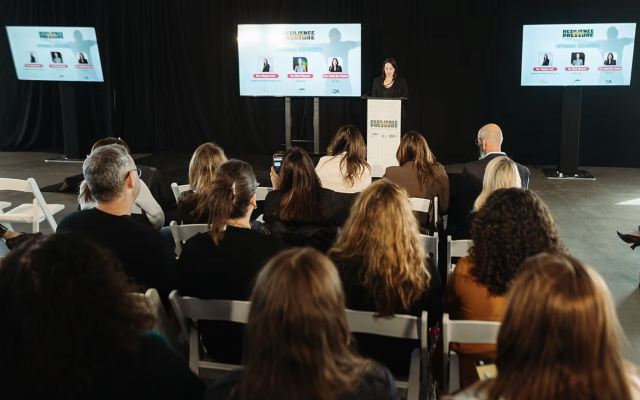
That manual is the subject of a seminar happening this month in Manhattan, hosted by American Friends of NATAL (AFN) in collaboration with Columbia University’s PTSD Research and Treatment Program. Clinicians from NATAL and researchers from Columbia are each contributing a piece of a protocol other communities, in Israel and elsewhere, can eventually put to use.
Dr. Boaz Shalgi, chief psychologist of NATAL, opens with the term he coined for the gap between looking recovered and being okay: “rolling trauma.” It’s not a single wound with a clear before-and-after, but a continuous, unresolved exposure that never gives the nervous system a long enough window to close the loop. He talks about dissociation as a mechanism that protects a person in the moment but can freeze the rest of their psychic life in place, and about mourning as the thing that unfreezes it. It is not the opposite of coping, but the bridge into it. It’s an unusual way to describe mourning, as infrastructure rather than an emotional event, but it maps onto a population that hasn’t had a clean moment to grieve in two years, because stopping was never really an option.
Prof. Yuval Neria, who runs trauma and PTSD research at Columbia’s psychiatric institute, presents the systemic argument: individual therapy alone was never going to be a sufficient response to mass, sustained exposure. What’s needed, in his research, is population-level screening and a coordinated public health response, not simply more appointment availability. Rolling trauma doesn’t stay contained to one person. It can show up secondhand, in a partner who’s stopped reaching out, a kid who won’t sleep alone, a reservist who can’t sit with his back to a door.
Focus on Family and Unspoken Challenges
A panel on family systems takes that argument into the household. NATAL’s clinical director, Riki Meiri, MSW and Columbia postdoctoral researcher Dr. Dana Katsoty are presenting on what they’re actually observing in session: intimacy that’s quietly eroded, children absorbing a hypervigilance no one explained to them directly. A separate panel, moderated by Dr. Shalgi, is built around a distinction that tends to get lost in public conversation, which is the difference between coping alone and coping together, and why isolation tends to calcify trauma while shared processing tends to loosen its hold.
Another session puts an Israeli combat paramedic and a trauma specialist who is also a widow in direct conversation with each other, translating lived experience straight into clinical insight rather than filtering it through theory first. That pairing of research alongside the people who actually lived what’s being studied is often the piece missing from these conversations.
The new research is promising. Dr. Yifat Reuveni, Director of the Research Department at NATAL, has been using AI to analyze how former hostages describe their own coping strategies, surfacing patterns that wouldn’t be audible by ear alone. A Columbia postdoctoral fellow is presenting on digital phenotyping, which uses the passive data a smartphone already collects to flag shifts in mental state before a person would think to mention them. It sounds almost invasive until you weigh it against the current default: waiting for someone to fall apart loudly enough to be noticed.
Renewal, Not Just Recovery
We must recognize that people have genuinely adapted, and adaptation is its own real evidence. It is proof that a population can keep functioning under conditions it was never built for. But adaptation and processing are not the same mechanism, and there’s a real risk in mistaking one for the other simply because adaptation is so much easier to see.
The Holidays are a reflection of how we made it through the year. The research points to the same conclusion the season does: the forward motion needs something underneath it besides momentum. Screening. Clinical infrastructure. Mourning that is treated as a step, not a detour. Care defined this response from the beginning. Making sure that holds, even after the emergency has quieted somewhat, is the responsibility this new year asks us to renew.