


A seat at the tabernacle

I grew up in Brisbane, where there are only two synagogues, neither of which can get a minyan.
They always seemed to be a few people short. You might ask, why don’t the two synagogues just merge?
Well, because then you might have to go to synagogue. And it’s too nice outside in Brisbane for that.
It’s like that classic Jewish joke about a Jew stranded on an Island. When a rescue team arrives, they notice he’s built one living space and two synagogues.
The rescue team asks the Jew why he built two synagogues, and the Jew explains “That’s the shul I go to, that’s the shul I don’t”.
Brisbane is like that, except they say, “That’s the shul I don’t go to, and that’s the shul I’d never go to”.
Like many Jews from Brisbane, I eventually moved to Melbourne. In part, because in Melbourne, you can find synagogues for every stream of Judaism.
In Melbourne, there are so many synagogues you can not go to.
There’s more synagogues in Melbourne than there are political parties in Israel. In Israel, the synagogues are full, but the Knesset is empty.
The Israeli parliament currently has two majorities, neither of which can form a government. It’s harder to form a government in Israel than it is to get a minyun in Brisbane.
Religiously we may be monotheistic, but politically we’re pagan. The Knesset may be unicameral, but the country is bipolar.
Elections in a Westminster democracy deliver a government and an opposition. Elections in a Jewish democracy deliver two oppositions and another election.
Now that’s value!
As the old adage goes, two Jews, three opinions. But a single Israeli can produce three all on their own: the party they would sit with, the party they would not sit with, and the party they will never sit with.
As a result, Israel has had six elections in the last seven years, with an eighth on the horizon, which would almost certainly leave the country with another hung parliament.
As can be expected, there are increasing calls for a unity government to break this cycle, with the side that has spent a decade stoking division suddenly calling to sit together – underneath them. A cynic might view this less as a commitment to unity, and more as an expression of chutzpah.
Chutzpah, like Israel’s government, is abstract, and therefore hard to define. The great Yiddish writer Leo Rosten described it as “That quality enshrined in a man who, having murdered his parents, pleads for the court’s mercy, as recent events have left him an orphan.”
But I recently heard a more concise definition in Hebrew, “ani achrai, zu le ashamti.” (אני האחראי זו לא אשמתי), which roughly translates to, “I’m in charge, it’s not my fault.”
Which was more or less Netanyahu’s election slogan.
Eisenkot may lack Netanyahu’s penchant for prose, but he is more than capable of pursuing actual unity. In the days after the election, a group of Netanyahu supporters made headlines for protesting outside of Eisenkot’s home, where one took to the megaphone to accuse Eisenkot, a bereaved father and uncle, of murdering his own son and nephews.
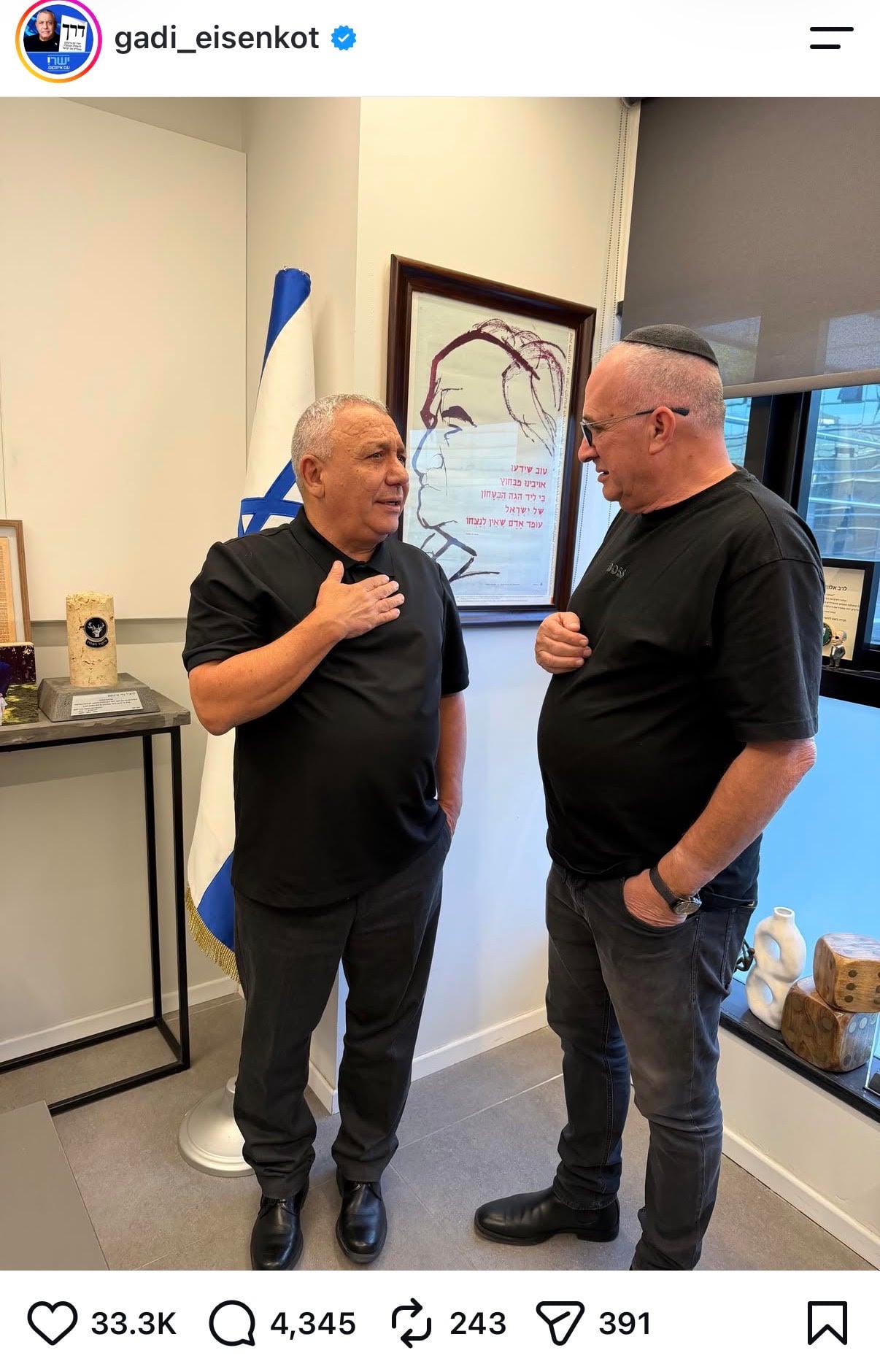
Resisting the urge to contribute to the cycle of pain and division, Eisenkot welcomed the man and his wife, who had also lost a son in the war, into his home. Afterwards, he said, “The harsh words directed at Hannah and me, especially the references to our late son Gal, were deeply painful. But I knew that behind those words was a bereaved father carrying profound, unimaginable pain… That is why it was important for me to meet with Yossi and remind us all: We are brothers. Even when we disagree, we have a duty to listen… The path to healing lies not in glossing over our differences or trying to defeat one another, but in our ability to listen, respect each other’s pain and preserve what binds us together as a people.”
This generosity may be the path to genuine unity, but the path to stable government can only be achieved if it is extended to Palestinian-Israeli parties as well. In doing so, Eisenkot would have a chance to prove that Israel is indeed a unique democracy in the region, a place where all citizens, regardless of race, not only get a seat at the table, but can sit together.