

A Synagogue Is Not a Stage for Self-Expression
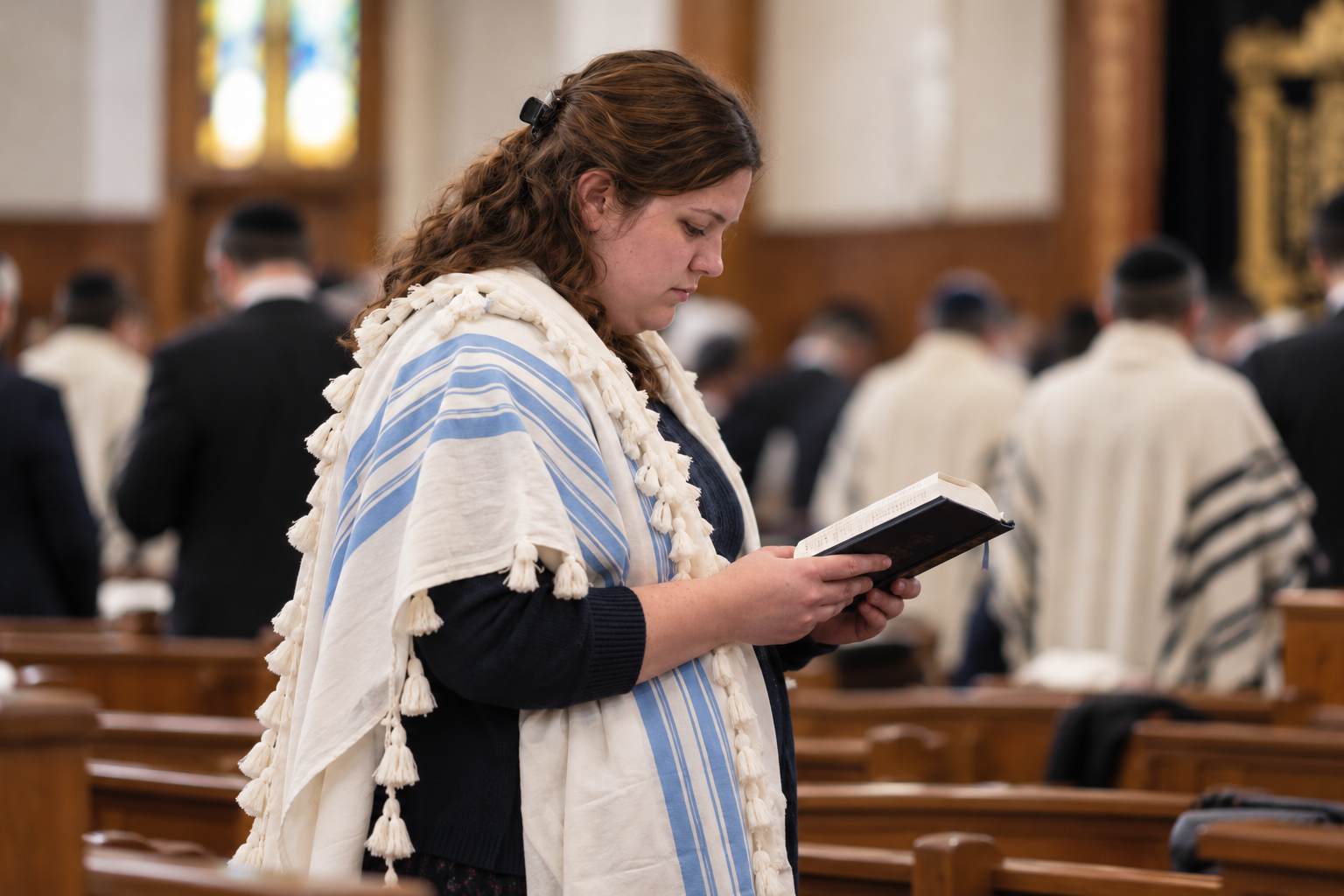
Over the first days of Sukkos, our shul in the leafy Washington suburb of Kemp Mill, Maryland, happily welcomed many guests and visitors. Hardly a seat was available on either side of the mechitza. One of these guests, a young woman, came to services—sitting in the front row, no less—wearing a tallis. She is not a regular attendee. She was a visitor who chose to introduce into our sanctuary a practice strikingly at odds with the religious norms of the community she was visiting.
I found this such a jarring departure from the halakhic norms of our synagogue (and to those which I am personally comfortable) that I ultimately left shul in the middle of the davening. Others were deeply uncomfortable as well. A place where we had come to stand quietly before our Creator had suddenly become the setting for an unwanted dispute about the boundaries of Orthodox practice.
The question is not simply whether a woman may, under some set of halakhic circumstances, wear a tallis. There is halakhic literature on that question, and this essay is not an attempt to adjudicate that issue.
The larger—and, I believe, more urgent—question is why contemporary religious discourse so often begins and ends with what an individual is permitted to do.
Judaism asks another question: What do I owe the community around me?
The Torah commands, “Lo sisgodedu,” latterly translated as “You shall not cut yourselves” (Deuteronomy 14:1). The Talmud famously reads those words more broadly: “Lo ta’asu agudos agudos” — do not divide yourselves into separate factions. Whatever the precise halakhic parameters of that prohibition, it reflects something fundamental about Jewish religious life. A Jewish community requires shared norms—and some willingness to subordinate personal preference to communal coherence.
And even before we arrive at lo sisgodedu, there is something more basic: the cardinal requirement of derech eretz.
Judaism asks us to notice other people and their needs. It demands modesty not only in dress, but in ego and action. It requires us to consider whether exercising a claimed right is worth the disruption it causes others.
In ordinary life, we understand this instinctively. A guest does not rearrange his host’s dining room because he prefers the chairs facing another direction. Entering someone else’s space—whether private or communal—entails deference.
Why should a synagogue and its membership command any less respect?
The irony is that the modern language of inclusion can sometimes become remarkably indifferent to the people already in the room. We make space for the person who wishes to depart from communal convention. But who makes space for the congregant who has prayed according to that convention for 60 years? Who considers the sensibilities of the person for whom the synagogue is one of the last refuges from the ideological battles raging everywhere else?
In a world already fractured by politics, culture, and competing identities, we should not make the hallowed space of the sanctuary one more arena of conflict. A synagogue should strive to be a place where Jews can pray together without every contested social question being reenacted between Barchu and Aleinu.
But intellectual honesty requires acknowledging something else.
Behavior that dramatically challenges a synagogue’s norms rarely occurs in a vacuum. People test boundaries when they perceive that boundaries are uncertain. If a synagogue describes itself as Orthodox but becomes too loose about articulating its own religious standards, it should not be surprised when congregants—or visitors—conclude those standards are negotiable.
The overwhelming responsibility of this travesty belongs, in my view, to the individual who chose to depart publicly from the established practice of the community and its messora. But our shul should engage in some introspection as well.
Have we been sufficiently clear about what we believe? Have we confused warmth with ambiguity? Have we become so anxious about appearing judgmental that we hesitate to articulate the standards that make an Orthodox synagogue Orthodox?
A welcoming synagogue need not be a doctrinally amorphous one. Genuine hospitality depends upon clarity. People should know what kind of community they are entering, just as the community should treat every person who enters it with dignity.
This matters especially within the social-religious world and culture of Modern Orthodoxy.
Modern Orthodoxy has always attempted something difficult: fidelity to halakha while engaging seriously with the modern world. But engagement cannot mean importing modernity’s assumption that personal authenticity possesses an automatic moral claim over inherited communal norms.
Sometimes Judaism asks precisely the opposite of us.
The grammar of Judaism is not, “What fulfills me?” It is better expressed as, “What is required of me?” Sometimes that requirement is halakhic. Sometimes it is communal. And sometimes it is simply to recognize that my religious experience is not the only one that matters.
There may be occasions when conscience requires someone to defy convention despite the discomfort of others. But surely every personal religious preference cannot rise to that level. Sometimes holiness lies not in insisting upon the religious experience we want, but in relinquishing it for the sake of someone else.
And sometimes a synagogue must have enough confidence in itself to say so.