Jerusalem Mixed Grill: A Slice of Life
A Tale of Two Futures: Comparing New Beginnings
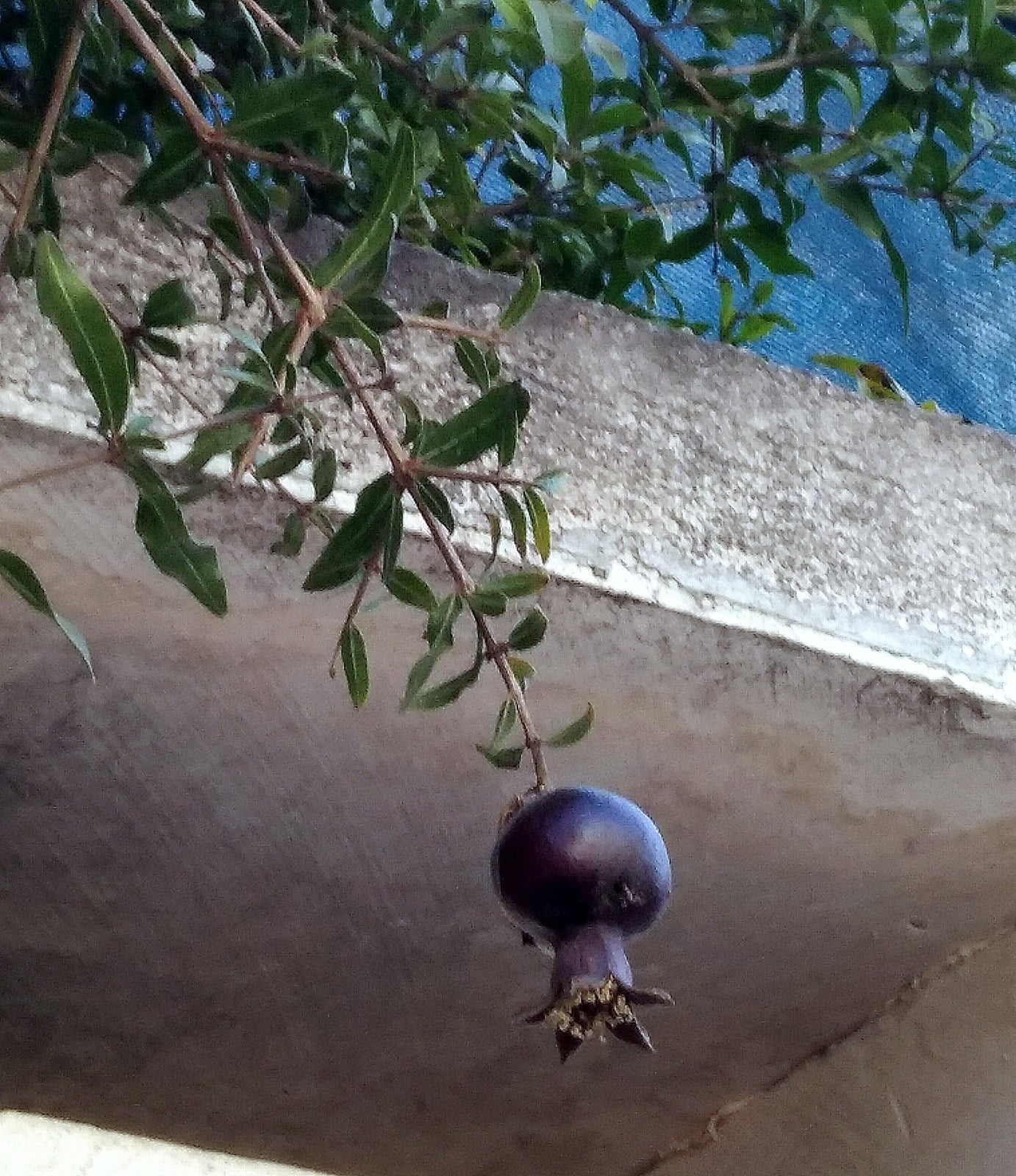
Pomegranate I for the Tishrei Holidays 2026 by Heddy Breuer Abramowitz
First morning sounds in Jerusalem include songbirds gently piercing through the darkness as daylight breaks. This is a transition we understand. It goes back to the first dawn, that of the Israelites and we will soon be reading it as we renew the cycle of the Torah, in Bereshit, (Genesis 1:3). We could never live in the chaos of darkness. And it was good.
Other than the slits of light from the street lamps through the shades, I see little as I am also just awakening. I notice the rumble of garbage trucks that shake the recycling offerings into their vehicles. Interwoven with this noise is that of a lower rumbling that is hard to notice or even distinguish anymore: Airplane noise is so common. It is a sort of backdrop.
I also hear the pleasant but quiet wind chimes on the balcony being moved by the cooling temperatures of the early day as it is fully coming into its own. A cloudy morning has established its presence, and the end-of-summer grey puffy clouds have softened the day with their lower-keyed palette and matching the less blazing light even as compared with just yesterday. And, of course, before the New Year, the shofar will also declare its presence. (I live on a street with no less than six synagogues and a yeshiva).
Every school in my limited knowledge warmly welcomes first graders. Our synagogue makes celebrities out of them and dedicates a Shabbat Kiddush to give them a send-off, their faces are festooned overhead, the rabbi welcomes them to the bimah to receive a present and they are feted and kvelled over. Most, if not all schools, put up a welcoming balloon arch and the whole school sings or dances them to their classroom. Politicians may visit the school. (It’s never too early…)
President Herzog and his wife Michal visited the Gvanim Elementary School in the Mateh Asher Regional Council and anounced “Teaching is a glorious profession, when I finish my term, I intend to be a teacher.” There is more to some of our politicians than a slick photo op.
In short, nothing like what my vague memories could pull up from long ago. My thoughts went back to my original American experience of being a first grader. I came up with pretty much nothing. An American public school, at least in 1960, was a building with big people called teachers, and a voice over the loudspeaker and a lot of desks and chairs. We arrived a little worried and confused.
And sadly, in this world of constant reserve duty, difficult on everyone from the woman who often is herself a reservist, to her reservist spouse, to the grandparents, and certainly for the children of the fathers (or even mothers) who fell in combat, the loss is hard and long. There are stories of the comrades and brothers-in-arms who gather and see to it that no child goes alone to first grade. Not one.
This says so much about who we are and who we want to be. Our children learn to love their native tongue of Hebrew and soon will be reading away. By Hanukkah the great majority will get it. By the spring, they will be getting their first Bible (Humash of the five books of Moses) and will be celebrated again. Nothing compares to living in your land and speaking the same language as ancestors from three millennia ago, the same language as King David spoke.
But what if your child is not one of the bright ones? What if your child is on a different spectrum altogether, say your child is on the Autistic Spectrum. Expectations change and so does the range of what can be achieved.
My former colleague and friend, Hannah Brown, who shares with Lihi Lapid, the wife of the head of the opposition, many similarities, including being the mother of an autistic adult, wrote about that as well.
In my very unscientific personal review of my acquaintances over many years, I know of several friends whose siblings were what was then called retarded, but who are now called special needs children who, in the 1950’s were placed in pretty awful institutions and were hidden away. It seems shameful, but then it was the norm. So it was for young girls to disappear when pregnant and other perceived family embarrassments.
And yet, there were the trailblazers who kept their children home, who singlehandedly hired teachers to help raise their child to whatever level they could: they were an inspiration to all. (Picture The Miracle Worker, with Anne Bancroft and Patty Duke playing Anne Sullivan and Helen Keller.)
In my own life, I have friends who admirably created fully funded programs for their children, those with “rare” genetic deformities, the one-in-a million conditions that happened to fall on their own children. The devotion is total, and they who visit their siblings and display great love towards them.
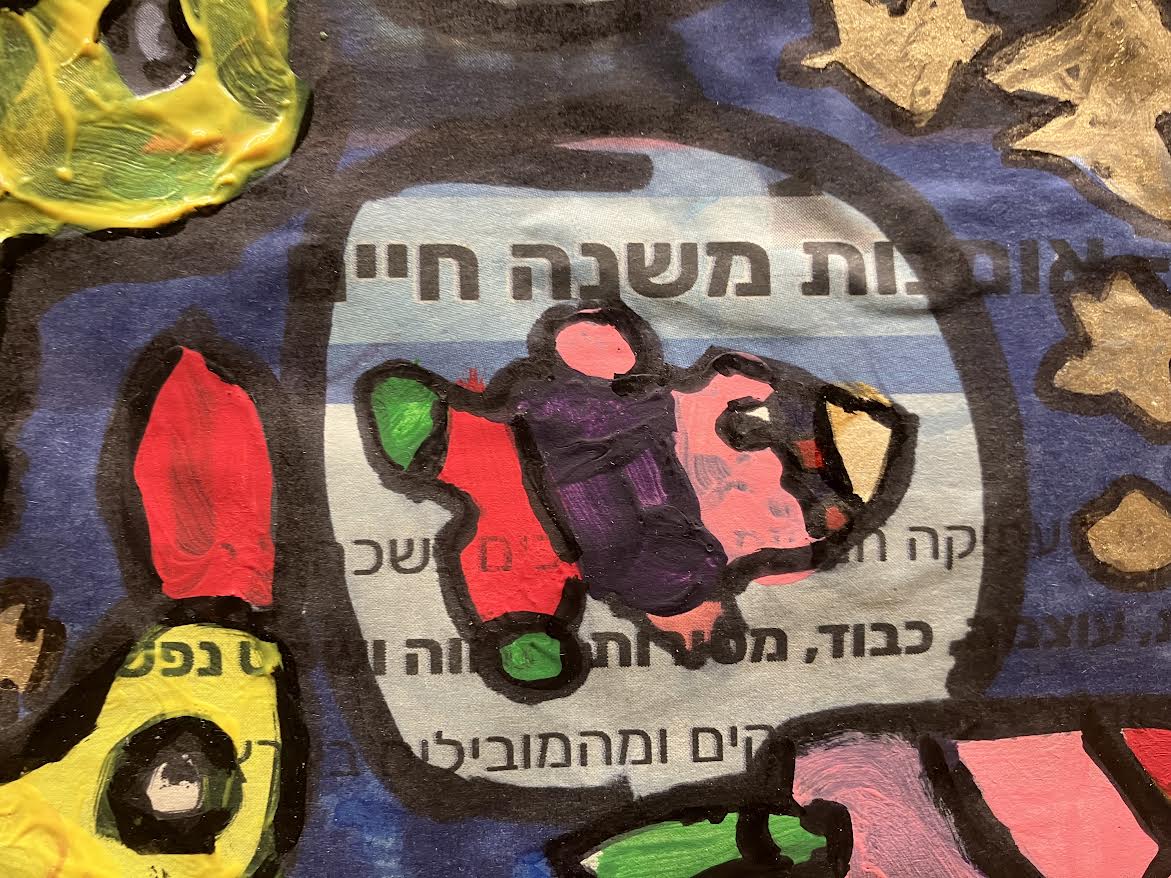
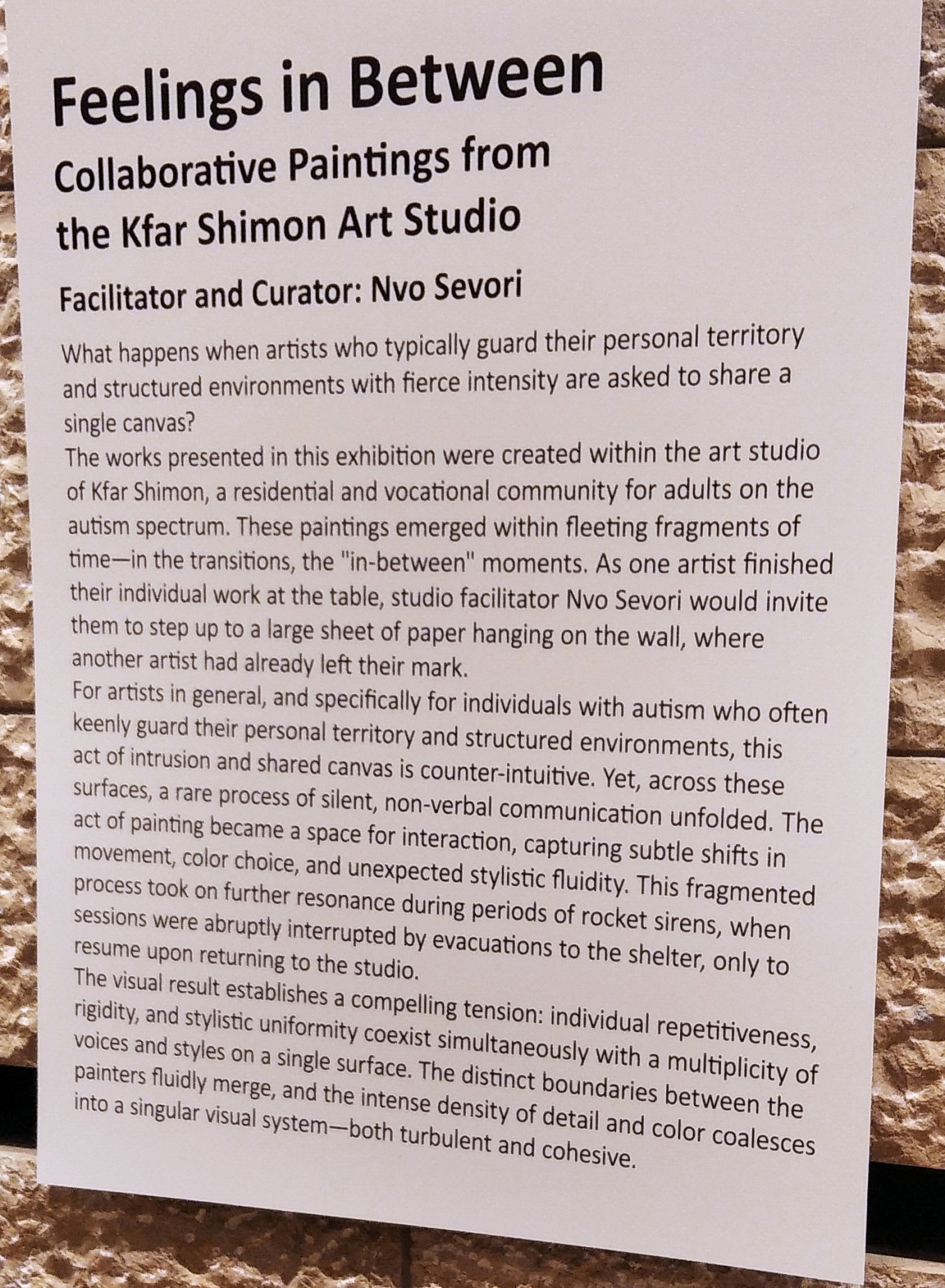
Recently, I was invited to the gallery talk of an unusual exhibit of artists of a different sort. They are young adults who live at Kfar Shimon and created collaborative art that was just exhibited in Feelings in Between at The Jerusalem Theatre. The talk was led by up-and-coming artist and teacher Shai Azoulay from the Fine Arts Department at the Bezalel Academy of Arts and Design.
Typically, exhibits are the culmination of a body of work carefully created and signed by a single artist. This is an exhibit deliberately created jointly and the same page may go through several actions and responses involved in its layers of creation. The facilitator and artist/curator is Nvo Sevori and the director of the village is Oded Korati.
Azoulay points out that there was a notion of collaborative work in the Renaissance times and earlier because artists of repute painted in what we might call a factory today, but has become known as “The School of…” The known artist might have multiple assistants who specialize in their expertise to create the trees, the water, the clothing, etc.
Today we know this is still the way a known artist can reproduce multiple works in less time. Popular culture artist of balloon animals, Jeff Koons comes to mind as does glass artist Dale Chihuly, both of whom have taken on managerial roles, but own their art.
In the case of the artists of Feelings in Between, the same sheet of paper can start with newsprint, and with prompts from Sevori, he could follow their suggestions, or hand the page over to the proponent of the art to create whatever he or she wants. The results are quite impressive, ranging from brilliant color to areas obliterated with whitish gouache, used as a unifying color.
If at first it is hard to distinguish the artists from the invitees, in a few minutes, one can sort out the differences. There is no question that there is considerable talent in the room and on the walls.
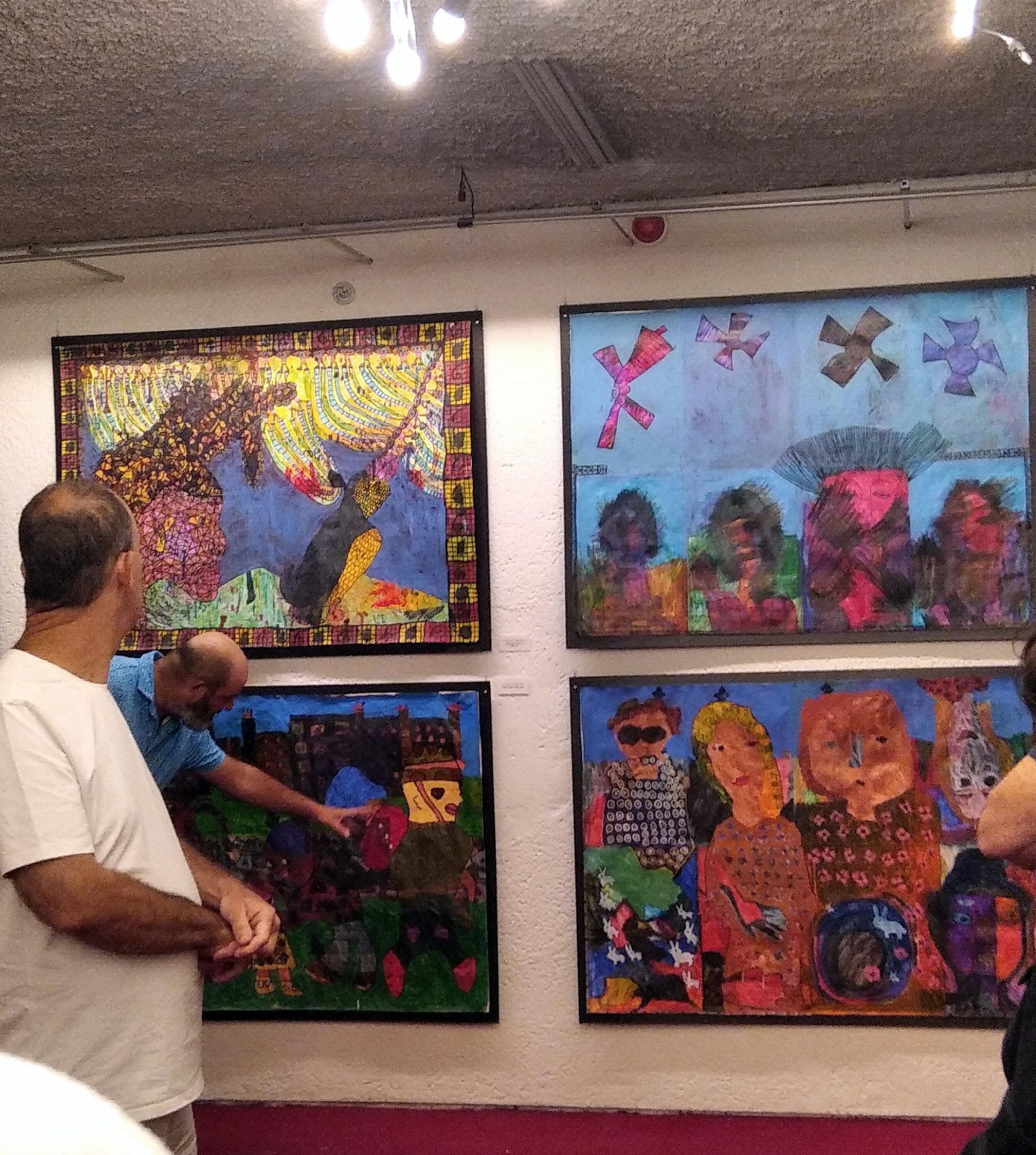 Danny Yovell is fascinated by ceiling fans, and he and his fellow artist Nir Aloni go back and forth both creating and erasing or marking over the previous renditions. Sevori asks them what to do next and so they work together to the next state. They may not know how it will look when they next see it.
There are some intricate borders and I am not so sure that a non-autistic person could have the patience to obsessively produce the fine finishes. You can see the results of the many marks over the faces, the multiple rapidograph pens drawn in patiently line after line.
There is also a female artist whose works stand out. Nir Aloni, Noga Eitan and Michael Zalmanov share credit for this collaborative effort of colorful swirls.
The Kfar Shimon Art Studio residents will soon be showing in Tel Aviv. I will add the information here.
Related Topics