Be the change you wish to see in the world.
A Time to Build
“To everything there is a season, and a time to every purpose under heaven.”
These words from Ecclesiastes are millennia old, yet they have never really left us. In 1965, The Byrds set them to music in “Turn! Turn! Turn!,” bringing an ancient reflection to a new generation: a time to plant, a time to heal, a time to build, a time for peace. Life moves through seasons, and each moment asks something different of us. But the words also leave us with a question that feels especially urgent today: Who gets to be part of those seasons?
For people with disabilities and older adults, the answer has too often depended on whether someone else remembered to make room. Sometimes exclusion is obvious. A holiday gathering is held upstairs with no elevator. A notice is sent in a format someone cannot read. A shelter has a ramp at the entrance but no accessible bathroom inside. Other barriers remain invisible until something goes wrong. An evacuation plan tells everyone to leave the building, yet offers no way out for a person using a wheelchair, no effective warning for someone who cannot hear the alarm, and no one designated to help a person who needs assistance. We can identify these gaps and close them before a crisis.
That time is now.
Inclusion is more than an invitation. It is what happens after the invitation is accepted: a person can enter, participate, contribute, make choices, and belong, with dignity and independence intact. Accessibility makes that possible. It is a door everyone can enter, information people can understand and use, transportation they can actually board, and an environment that does not quietly tell some people it was designed without them in mind.
Universal design takes this one step further. It asks us to consider the widest range of people from the very beginning instead of repairing what we forgot afterward. A clear sign helps someone who is hard of hearing, a child still learning to read, a visitor who does not speak the language fluently, or anyone too frightened or stressed to process complicated instructions. A ramp helps a wheelchair user, a parent pushing a stroller, a traveler pulling a suitcase, and a grandmother who no longer trusts her knees on the stairs. Designing for human differences improves the experience for everyone.
Perhaps that is one of the deeper lessons of Ecclesiastes. Our seasons change. The person offering assistance today may need assistance tomorrow. Disability may be lifelong, acquired in an instant, temporary, invisible, or simply part of growing older. Our strength, hearing, vision, mobility, and independence can change over time. We do not need to experience every one of these realities ourselves to understand that building communities in which everyone can participate is a responsibility we share.
That responsibility becomes most urgent when disaster strikes. Fires, wars, earthquakes, floods, and other emergencies do not wait for us to discover, in the middle of chaos, whose needs were overlooked. Someone may require an accessible vehicle to evacuate. Another person may depend on dialysis, oxygen, medication, electricity, or medical equipment. Someone may need instructions communicated differently, while a person experiencing fear or trauma may simply need a calm voice and someone who knows how to help. Older adults may need additional time to understand a warning, reach the door, gather essential medication and equipment, or find accessible transportation.
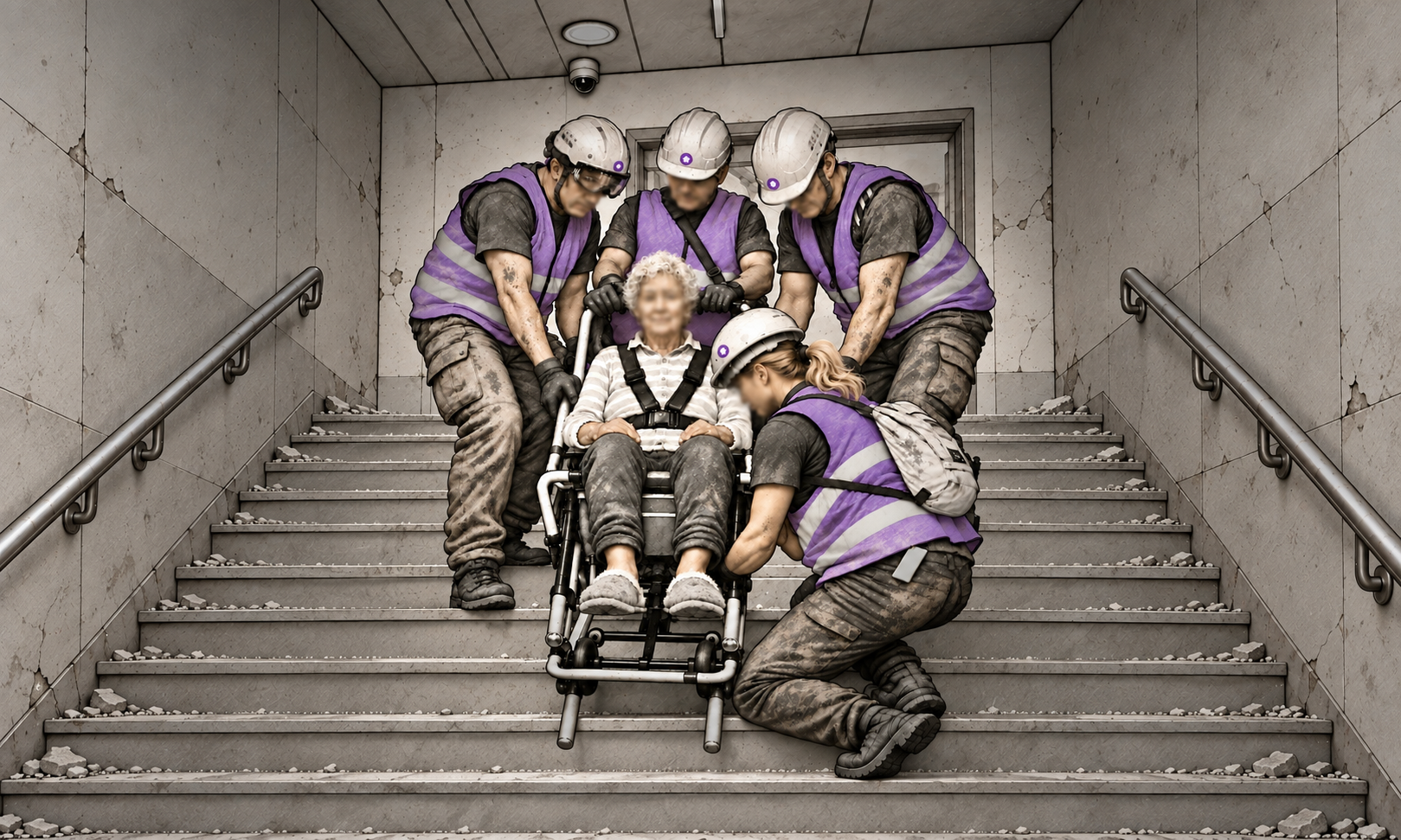
This is where Access Israel’s Purple Vest Mission, a collaborative partner of mine, comes in. Its internationally proven work rests on a simple but essential principle: people with disabilities and older adults must never be an afterthought in an emergency. Their needs, experience, knowledge, and voices must shape how we prepare long before a crisis begins.
The Purple Vest Mission is an established global leader in inclusive emergency preparedness and response, with hands-on experience in natural disasters, sustained work in Poland evacuating Ukrainian refugees, ongoing operations in Israel, and preparedness training delivered around the world. Over the next two weeks, I am excited to spend time in my partners’ offices, and motivated to receive updated and enhanced Purple Vest Mission training, and learn from fellow Purple Vest volunteers.
The purple vest itself is visible. Much of the work behind it is not. It happens when people with lived experience are heard, assumptions are challenged, and communities prepare together. The goal is for accessibility to become a fundamental part of how a responsible community takes care of its people. Dignity cannot depend on luck, and safety cannot depend on whether the right person happens to be standing nearby.
More than sixty years after The Byrds gave the words of Ecclesiastes a melody, the song still asks us to recognize what this moment requires. We have the knowledge to listen, redesign, train, and act. We can make room for everyone.
Let us look at our own schools, synagogues, houses of worship, workplaces, community centers, apartment buildings, municipalities, and emergency services, and ask now, before an emergency: Who is missing from our planning? What barriers have we overlooked? Whose voice have we not yet heard? Then let us make the changes those answers demand. We need to do this work before the alarm sounds, so that safety never depends on how quickly someone can move, how well someone can hear or see, or how independently someone can respond.
A community reveals its character most clearly in its hardest moments. Ecclesiastes reminds us that there is a time for every purpose under heaven. Our time to build is now. “Leave No One Behind” cannot be a promise made only in a crisis. It must guide the plans we make today, with the people who will depend on them at the table from the beginning.
Related Topics
Related Posts