A Tiny Plot of the Land of Israel
On Shabbat, the day I led the Musaf prayers, I read a chapter from a new book called DMC, co-written by my friend and neighbour Rabbi Doron Perez and Rabbi Kozowsky.
Something Rav Doron wrote suddenly unlocked a memory I had almost completely forgotten. He wrote about how every synagogue outside Israel is, in a sense, an outpost of Israel. A mini-Israel.
“I was a teenager in London, being shown around Shomrei Hadath by one of its devoted founders. The synagogue would become a very important part of my life, as would his family.
It was not a grand synagogue. It was relatively small but incredibly warm and friendly, filled with wonderful people. Enormous thought had gone into its details.
One of them fascinated me.
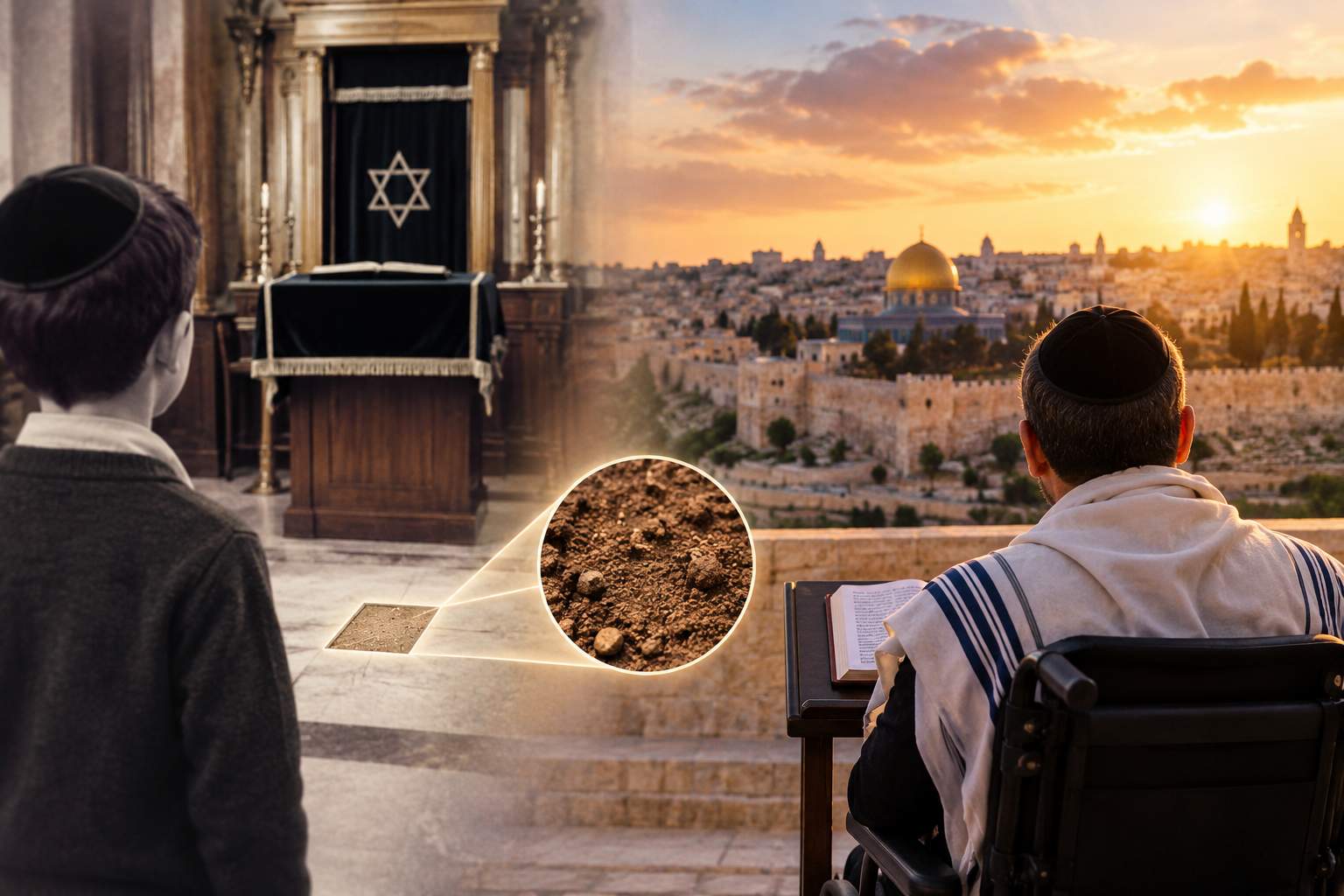
Under the place where the shaliach tzibur, the prayer leader, stood was a small rectangular section containing earth brought from the Land of Israel.
The idea was beautifully simple. When the shaliach tzibur stood before the congregation to pray, he was standing, symbolically at least, on a tiny piece of Eretz Yisrael.
I hadn’t thought about that little rectangle of earth for decades.
Then, on Shabbat, it came back to me.
Later that day, I was leading Musaf myself, only this time I was thousands of miles from that little synagogue in London. I was sitting in my wheelchair in a synagogue in Israel. I have PSP, and I had fought hard simply to be able to lead the prayers this year.
No tiny imported plot of earth was necessary. I was on the real thing, surrounded by much of my immediate family.
There is something particularly beautiful about this connection. For thousands of years, Jews outside Israel have prayed facing towards the Land of Israel and Jerusalem. The Talmud describes Jews in different places directing themselves towards the same place.
Perhaps that little patch of earth was simply a thoughtful architectural detail.
Or perhaps not.
I have no idea what combination of experiences brought me from the teenager I was in London to the 51-year-old man I am today, living in Israel.
Life doesn’t provide footnotes explaining which childhood experiences mattered.
But I would like to think that little rectangle mattered.
A family and community had cared enough, when building a synagogue thousands of miles away, to place a tiny piece of the Land of Israel beneath the feet of the person leading the prayers.
A teenager noticed it. He forgot about it. And decades later, while leading those same prayers, he remembered.
Only this time, the Land of Israel wasn’t underneath a small rectangle of the synagogue floor.
It was underneath everything.