

Rabbi, mohel, misader kiddushin, beit din member
A turkey in the Promised Land
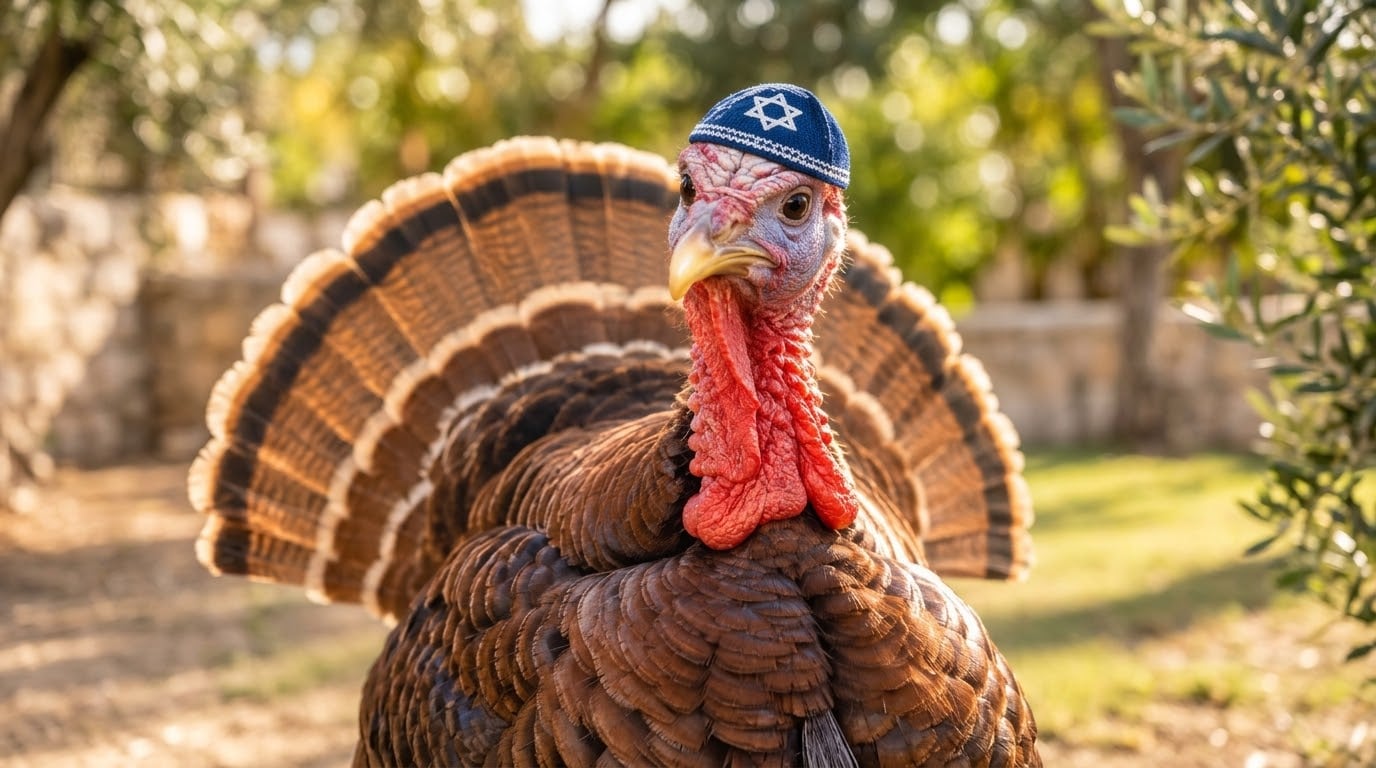
Photo: AI
As I clutched the massive bird’s talons in my friend’s yard, I wondered how this had come to be. Trying to keep it steady, no matter how uneasy it made me feel, I understood the value of what we often take for granted. It wasn’t the first time I’d been involved in shechitah (ritual slaughter). Years prior, I’d assisted in the preparation for a Mesorah Dinner — an event my Brit Milah teacher routinely organizes to ensure the Jewish people don’t lose the tradition of eating things such as cow’s udder and locusts. But this was the first time I was involved in the preparation of turkeys for Thanksgiving — in Israel no less.
When I first made Aliyah in 2009, I viewed all things American as bad. The most notable distinction was car sizes. Israeli automobiles tend to come from the European market and therefore have a much smaller footprint. The vast majority barely even have a trunk. I recall riding with my father on the New Jersey Turnpike during one visit, self-righteously asking, “Why are American cars so enormous?” Of course, this was well before I had a family and desperately needed the space.
However, it wasn’t just automotive distinctions. Everything in America felt different — all the way down to the bathrooms. Israeli toilets have two buttons: small and large. They have different purposes, using less and more water depending on the needs. From an environmental and desert-living perspective, it’s a better system. I almost felt guilty flushing on trips to America without the option.
My initial reaction is not surprising. When you leave your birthplace, you feel the need to rationalize the decision. Moving far from your family and friends feels irrational, and if you can show, at least to yourself, that your new home is superior, then you made the right choice. But somewhere along the way, you realize that not everything from the “old country” is bad and you long for what you left behind.
The first dent in my armor was Thanksgiving. My journey to become a rabbi is what brought me to Israel. I was learning in a yeshiva just outside of Efrat. For the uninitiated, yeshiva food can be rough at times. Lunch is the main meal of the day and dinner is more of a snack. For Thanksgiving dinner, cheesy potatoes were served. I felt very far from my roots.
As time went on, I met and married my wife, who’s also an expat, having grown up in Manhattan. We spent the first thirteen years of our marriage in Jerusalem and then relocated to our present home in Efrat. The town is close to half Anglo and half Israeli. This statistic is the natural progression since Rabbi Shlomo Riskin founded the yishuv with his congregants from Lincoln Square Synagogue in the 1980s.
At this point in my life, many American things are incorporated in our daily lives. Technology has played a major role in this reality. We have access to so much via the internet that it sometimes feels like we never left. Music, food, and visual entertainment all stem from across the globe.
But there are still differences — some small, some large, and they extend well beyond the bathroom.
Our weekly schedule has no “Sunday.” The work week revolves around Shabbat. Friday is a day off, which is used to prepare for the day of rest, and then it’s back to work just after its completion. This has some implications. First, Thanksgiving is usually pushed off to Shabbat dinner. The menu has all the traditional fixings: turkey, stuffing, cranberry sauce, even sweet potatoes with marshmallows. But the event is rarely on Thursday night. Second, our lack of Sunday makes vacations few and far between. Not only are there no long holidayless weekends, it generally feels like there isn’t even a weekend.
When we do take time off, we try to take full advantage of it. Our last family vacation was to Eilat. For those who’ve never been, it’s the most southern point in Israel with a warmer climate and less taxation. It was a perfect combination for a family like ours who loves to swim and has teenage girls who love to shop.
My wife scored a reasonably priced hotel at the end of the winter, towards the end of the most recent Iran war. There was most likely a correlation between the two. Rocket attacks were so regular at the time, we almost canceled our reservation, but after all they’d been through, we couldn’t let our kids down. So we prayed for the best as we headed south.
During our stay, there were multiple sirens in the middle of the night, causing mad dashes down four flights to the basement in our pajamas (a necessity when crowded with hundreds of other families). The experience was akin to the midnight flight from Tel Aviv to New York; children moaning and exhausted, strewn all over the floor. If that weren’t enough, the rains began to fall. When it rains to the north of Eilat, flash floods close the only access road.
For fear of being trapped there indefinitely with no place to stay, we left early the final morning when there was a break in the storm. Our journey led us through areas we normally wouldn’t have driven because floods had closed the more secure route. We breathed a sigh of relief upon our safe arrival home. Believe it or not, this is what we call a vacation during times like these.
This year, as Thanksgiving approaches and we make arrangements with new friends who’ve recently made Aliyah, we know what we’re thankful for. As the possibility of the Iran war resuming looms, we are still thankful to live here, even if it means more time in our bomb shelters. As crazy as it is to make a life, we are thankful for the moments of peace and security. We’re thankful to be part of the Jewish project because it’s more vital now than it’s ever been. And when we’re called to do so, we’re even thankful to hold the turkey’s talons to ensure we have a feast to enjoy.