
A Vote That Settles Nothing
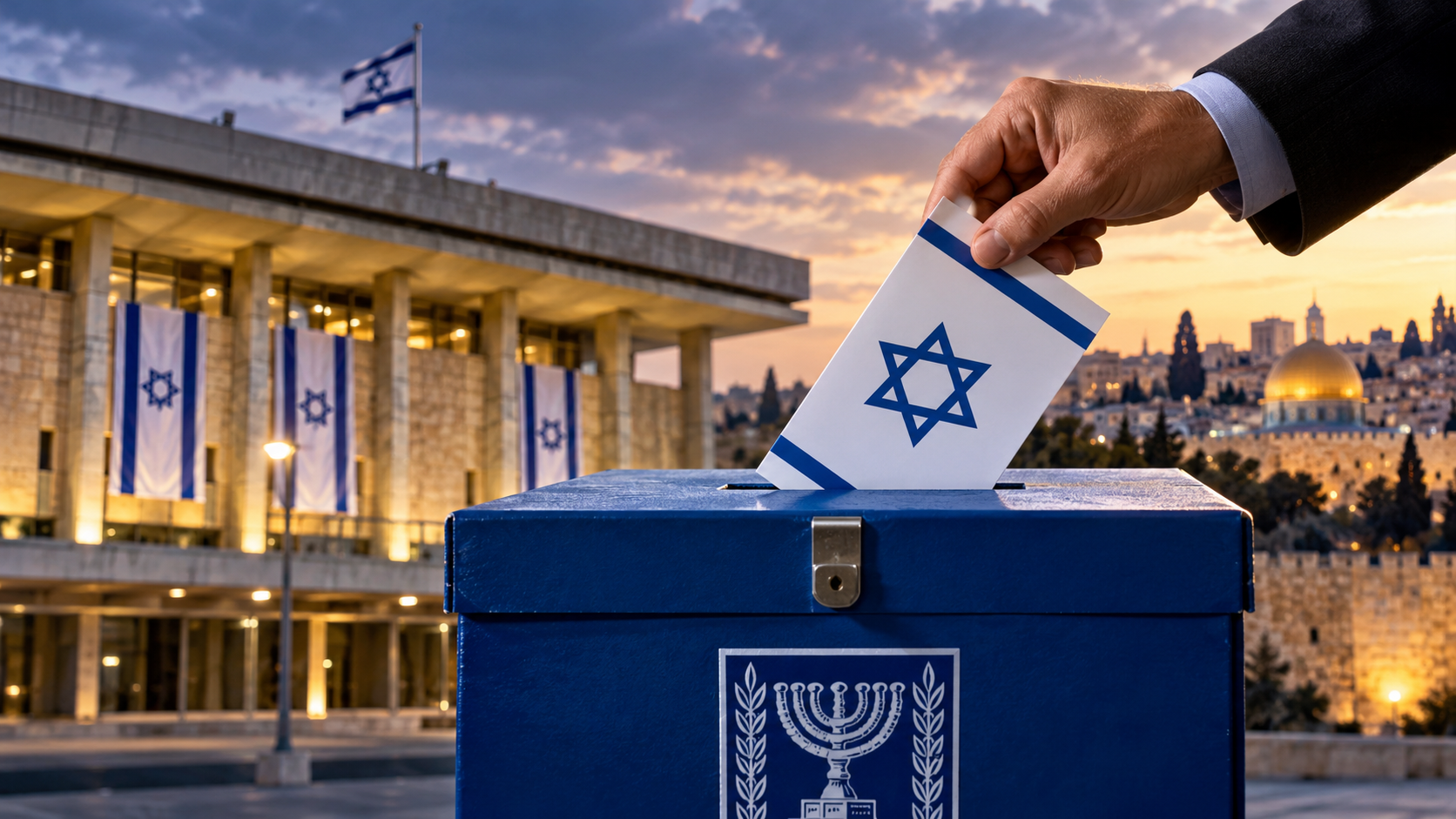
Neither bloc will reach 61 seats tomorrow, and the government that eventually forms will depend on which leader is first to abandon a campaign pledge.
The final television polls, published Friday before the blackout, put Gadi Eisenkot’s opposition bloc at 52 to 56 seats and Netanyahu’s coalition at around 50, with the Arab-majority lists at 14 to 16. Maariv’s Lazar poll showed 54 and 48, and across 248 surveys this year the five parties of the outgoing government have averaged 51.6 seats. One house, Direct Polls for i24 News, puts the coalition near 57 or 58, and it does so by giving Likud 25 to 27 seats when every other pollster in the same table has the party between 18 and 21. I treat it as an outlier. The 2022 result is the reminder of how a bloc can outrun its vote: Netanyahu took 64 seats on 48.4 percent, because only around 56,000 of his supporters’ votes went to lists below the threshold. Wasted ballots are the mechanism to watch tomorrow, and this time they fall on both sides.
My own estimate is Yashar 23, Likud 21, Together (Bennett and Lapid) 13, the Democrats 9, Yisrael Beytenu 8, Otzma Yehudit 8, Shas 8, United Torah Judaism 7, Religious Zionism 5, the Arab lists 14, and the Reservists-Economic Party 4. That gives Netanyahu’s bloc 49 and the four Zionist opposition parties 53. I put Yashar first at three chances in four. The two-seat margin over Likud sits inside the error of every poll behind it, and it matters less than it appears.
Three lists stand at or below the line. Ofer Winter’s People of Israel polls near 3 percent against a 3.25 percent threshold, and since Gantz left the race, Foreign Minister Sa’ar and Smotrich have pressed right-wing parties near the threshold to follow his example. Gantz himself withdrew eight days before the vote, yet Blue and White remains on the ballot and will collect votes that count for nothing. Yoaz Hendel’s Reservists-Economic Party is the least reliable call I am making: among the three television polls only Kan’s put it in the Knesset. I expect Winter to fall short and the Reservists to scrape in at four. If they do not, Maariv’s model moves the blocs to 50 and 56, which changes the margin and leaves the question untouched. Hendel has no seats to give either camp in any case. He has vowed to boycott the Haredi parties and ruled out any coalition that includes the Arab lists.
Those Arab lists are the arithmetic pivot, and their voters appear to know it. Maariv found that the share of Arab party supporters certain to vote rose from 74 percent to 81 percent in a fortnight. Both camps have pledged to keep them out of government. The Joint List has said it will help a coalition that can topple Netanyahu, and Eisenkot has proposed a minority government that would widen after it was sworn in. But Liberman has rejected any minority government, even a temporary one, and Bennett opposes relying on Arab-party support. By my numbers, Eisenkot’s four parties plus the Arab lists reach 67. Remove Liberman’s eight and they reach 59.
Between April 2019 and June 2021 Israel held four elections because one bloc could not reach 61 and the other would not assemble the missing seats from parties it had sworn to exclude. The deadlock ended twice, and each time a leader broke a pledge. Gantz joined Netanyahu in 2020 after campaigning against it, and his party never recovered; he left this race last week below the threshold. Bennett formed a government with Ra’am in 2021 after months of ruling it out and paid with the career he is now trying to resume. Every leader in this election has read that record, which is why each will hold his pledge for as long as the calendar allows.
The analogy fits in one respect and fails in two others. It fits because the structure is the same: personal vetoes, a closed arithmetic, and a pivot bloc that both sides have promised to ignore. It fails because this time the exit exists inside Likud. Liberman has named a Likud without Netanyahu as a potential partner, and Eisenkot has left that door open, 60 percent of respondents favor a unity government, and a Religious Zionism MK has said the chances of unity are high because the coalition would welcome Eisenkot. It also fails because in 2019 one man held the veto and could be bargained with. Today four party leaders hold it, each with a campaign built on it, while Netanyahu’s camp has made the claim that the change camp cannot win without Arab support its central message. A pledge that is the whole campaign is more expensive to break than one that is a footnote.
Whatever emerges inherits the same external pressures, among them the international isolation that Eisenkot’s interviewers keep raising, and the election alters who perceives those pressures and what the coalition can extract from society in response. The one policy where the two meet directly is Haredi conscription. A government that includes Shas and United Torah Judaism will not legislate it, and a government without them has to be assembled from parties that cannot sit together.
On the sequence, I expect President Herzog to give the first mandate to Eisenkot, at three chances in four, on recommendations that include the Arab lists, and I expect Eisenkot to fail to convert it within the 28 days the law allows. Netanyahu will remain prime minister of a caretaker government throughout, because he can stay in office without forming a new government if every arrangement fails. I put the odds of a government that includes Likud under someone other than Netanyahu, formed by spring, at one in three, and the odds of a second election by early summer at somewhat better than that. The remaining third divides between a government resting on Arab-party votes and a Netanyahu return built on defections, and I would not put either above one in six. The chance that Netanyahu’s bloc itself reaches 61 is under one in ten.
Tomorrow night, watch the wasted vote on the right. Winter’s party and the others below the line hold perhaps three seats’ worth of ballots. Had they landed with Likud and its partners, the bloc would stand near 52, which is still nine short.