Middle East Analyst
Able Danger – Story of the 9/11 Fail
By author (AI)
In late May 2000, an Army major named Erik Kleinsmith sat in his office at the Army Intelligence and Security Command (INSCOM) with a chief warrant officer named Terri Stephens, weighing two options. Delete the data his team had spent a year assembling on al Qaeda’s global network, or go to jail. Kleinsmith and Stephens had mapped the organization across the Maghreb, the Balkans, the Far East, the Middle East — and into New Jersey, with a thread running back to Kleinsmith’s own hometown of Plymouth, Michigan. They had names, camp imagery, front businesses, a communications architecture their small team had mapped faster and more completely than several agencies many times their size and budget. On the orders of Army JAG lawyers enforcing a regulation written for a different era of intelligence collection, they deleted all of it. Sixteen months later, some of what they had mapped walked onto four airplanes.
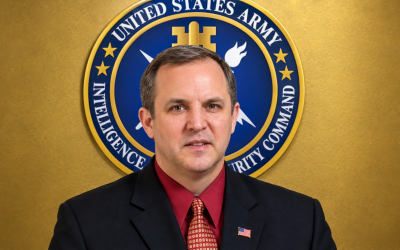
Kleinsmith has been on the public record about that day for two decades. He testified to the Senate Judiciary Committee about the destruction order in September 2005, and again before the House Armed Services Committee the following February, describing an order that was “not hostile or aggressive,” just policy. What he offered this week, marking the 25th anniversary of September 11, was not a new set of facts so much as new candor: the conversation with Stephens about hiding the tapes rather than destroying them, the idea of relabeling the files, the phone call to the United States Special Operations Command (SOCOM) and the silence that followed it, the analyst who asked to be pulled off the team out of fear of prosecution. Twenty years of testimony had given the public the fact. Only now has he given it the room. He remains, by every account of people who know him, an unusually restrained man about where to place blame — he calls what happened “a parade of errors,” not a conspiracy, and reaches for the Titanic rather than a single villain. That restraint is itself worth noting, because the explanation he’s willing to offer in public — an outdated oversight regulation, applied at the worst possible moment, by people who were not obviously wrong on the law — is almost certainly not the whole story. It’s the part he can prove.
What follows is a hypothesis, held with moderate confidence, not a settled account — a plausible reading of an event whose full record remains classified. The regulatory shutdown of Able Danger is real and well documented: the retention limits on US-persons data, tighter than the ninety days allowed for data on foreign nationals, trace back to post-Church Committee reforms and were a genuine legal constraint, not an invented one. But a program built explicitly as the military’s answer to the CIA’s own al Qaeda unit, run out of an Army facility at a fraction of the Agency’s budget, that was demonstrably outperforming the CIA at its own mission — that is not a neutral fact in a town that runs on jurisdiction and appropriations. It is the kind of embarrassment that creates motive. A few months before the shutdown, Congressman Curt Weldon had already begun making exactly that comparison publicly, to the Agency’s visible discomfort. The more plausible reading may be that the retention limit was a real rule that could have been worked — extended, waived, litigated — given the significance of what INSCOM had found, and was instead applied as a blunt instrument, at the moment it was most convenient to apply it, by an institutional environment with every incentive to see a rival shop taken off the board. That confidence should not be overstated. But it fits the incentives better than “outdated regulation” fits alone, and incentives are usually the more honest witness.
Whatever combination of law and rivalry actually produced that decision, the aftermath is a matter of record. The interagency stovepiping that let a domestic-collection statute override a live counterterrorism lead — without any mechanism to resolve the conflict short of destroying the intelligence — became one of the central diagnoses of the 9/11 Commission. It led, eventually, to the creation of the Director of National Intelligence in 2004, an office built specifically to sit above the CIA-Pentagon turf line and force exactly the kind of resolution that never happened for Able Danger. It is not a perfect fix. Nothing bureaucratic ever fully resolves institutional self-interest. But it was, at least, an acknowledgment that the failure mode was structural — that good tools built by capable people can be destroyed not by bad intentions but by the absence of any authority positioned to adjudicate between competing, legitimate-sounding claims fast enough to matter.
That acknowledgment has not yet been made for artificial intelligence, and the clock is worse.
Able Danger’s data-mining tools were, by the standards of 2026, primitive — powerful within a narrow domain, but slow enough that a room full of lawyers could plausibly review, icon by icon, what an analyst was permitted to click on. That constraint was absurd and it crippled the program, but it was at least physically possible to attempt. It assumed a world where human oversight, however clumsy, could still keep pace with the system being overseen.
That assumption is the one now failing. Frontier AI systems are advancing in speed and compounding complexity to a point where meaningful human review of what they are actually doing, in real time, is moving from difficult toward structurally impossible — not because the people doing the reviewing are less capable than Kleinsmith’s JAG lawyers, but because the thing being reviewed now operates on timescales and through reasoning chains no human committee can trace before the decision has already propagated. Able Danger’s oversight problem was a mismatch between an old law and a fast program. The AI oversight problem is a mismatch between the permanent, irreducible speed of human deliberation and a technology whose entire value proposition is that it does not wait for human deliberation. The first mismatch could in principle be fixed by writing a better law. The second cannot be fixed by writing a better law, because the law will always be adjudicated by minds running at human clock speed, and the systems it is meant to govern will not be.
Layer the institutional-rivalry hypothesis on top of that, and the picture gets worse, not better. If Able Danger’s shutdown really was accelerated by a threatened institution using a genuine legal ambiguity as cover to remove a rival, the current environment offers far more actors with far more at stake: national governments racing each other, frontier labs racing each other, and a defense-and-intelligence establishment that will not sit out a capability race it believes an adversary is already running. Where INSCOM had one CIA to contend with, the next Able Danger-scale decision — pause a model, restrict a capability, share a warning across an institutional boundary — will be made inside a field of competing actors, each with a plausible-sounding legal or safety rationale, and each with an institutional incentive to see the decision go a particular way. A DNI-style solution — a single authority positioned above the rivalry, empowered to force resolution — worked, imperfectly, when the actors were a known, finite set of American agencies operating on human timescales. It is not obvious that an equivalent structure exists, or could exist fast enough, when the actors span governments and companies and the systems in question are evolving faster than any charter could be drafted to govern them.
Kleinsmith says he still turns over the what-ifs every September. What he and Stephens were actually forced to weigh in May 2000 was never really “the data or jail.” It was a choice between a system that could see the threat and an oversight structure with no gear between full authorization and total destruction — no capacity for graduated, reversible constraint. That is precisely the choice now facing everyone building, deploying, or attempting to govern advanced AI, except the tool involved no longer waits politely in a database for the lawyers to finish arguing. Able Danger’s data sat inert on a tape deck for a month before it was destroyed. Nothing about the systems we are building today will sit still that long.
Related Topics
Related Posts