About Taiwan: Answers to three key questions Israeli friends need to know
Since taking up the post in Israel more than half a year ago, I have deeply felt the enthusiasm of our Israeli friends for exchanges and cooperation with China, and have also noticed some of them hold several misunderstandings on the Taiwan question. Taking this opportunity, I would like to introduce three important Taiwan-related questions combining historical and contemporary perspectives.
I. Why is Taiwan not a country?
Taiwan is an inalienable part of China. The only reference to the Taiwan region in the United Nations is “Taiwan, Province of China”. Taiwan is never a country, and will never be a country. In history, the imperial central governments of China all set up administrative bodies in Taiwan. In 1895, Japan forced China to cede Taiwan, resulting in Taiwan being occupied by foreigners for half a century. In 1945, the victory in the Chinese People’s War of Resistance Against Japanese Aggression put Taiwan back under China’s sovereign jurisdiction. Both the Cairo Declaration and the Potsdam Proclamation stated in explicit terms that Taiwan is a territory that Japan had stolen from the Chinese, and shall be restored to China. Japan also accepted terms of the Potsdam Proclamation and announced its unconditional surrender. In 1949, the Central People’s Government of the People’s Republic of China was founded and became the only legitimate government of the whole of China. The government replaced the previous regime in a situation where China, as a subject under international law, did not change and China’s sovereignty and inherent territory did not change. Taiwan’s status as a province of China did not change and has remained the same to this day.
II. What is the status quo of the Taiwan Strait?
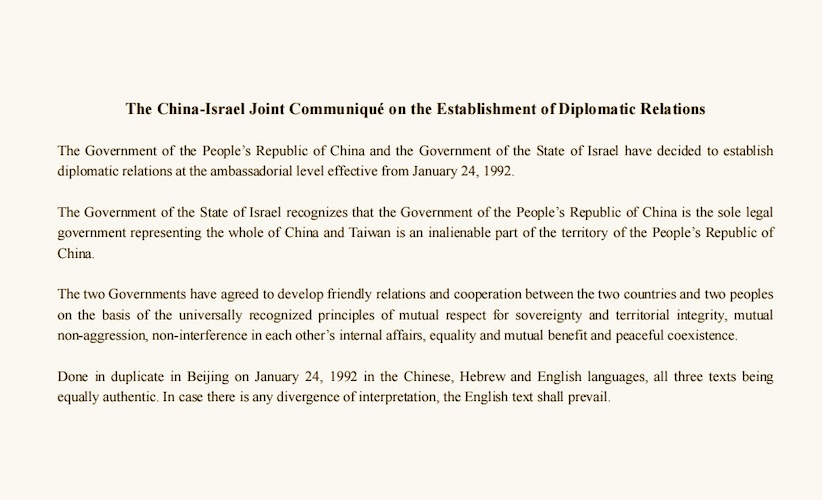
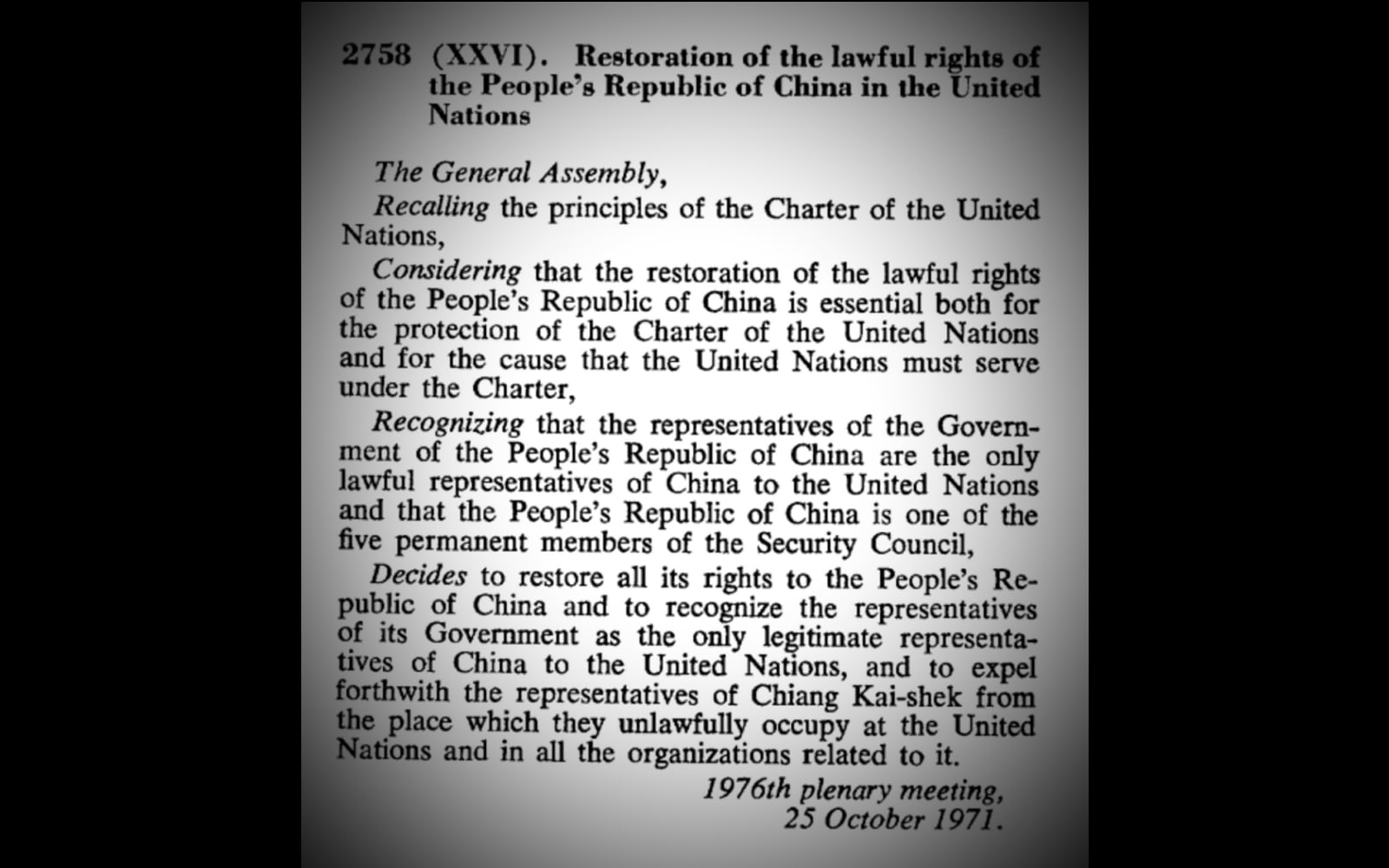
The real status quo of the Taiwan Strait is that, both sides of the Taiwan Strait undoubtedly belong to one and the same China, although they have fallen into a long-term special situation of political confrontation due to the legacy of China’s civil war and interference from external forces. During the decades after 1949, the Taiwan authorities adhered to the position that Taiwan is a part of China. In 1971, the 26th Session of the General Assembly of the United Nations (UNGA) adopted Resolution 2758 with an overwhelming majority (Israel cast an affirmative vote). This resolution confirms that Taiwan is a part of China and precludes the possibility of “two Chinas” or “one China, one Taiwan”. A total of 183 countries in the world, including Israel, have already established and developed diplomatic relations with China on the basis of the one-China principle. The China-lsrael Joint Communiqué on the Establishment of Diplomatic Relations clearly states that “the Government of the State of Israel recognizes that the Government of the People’s Republic of China is the sole legal government representing the whole of China and Taiwan is an inalienable part of the territory of the People’s Republic of China.” The fact that there is only one China is widely recognized by the international community as the real status quo of the Taiwan Strait, which proves that the one-China principle is an irresistible trend and is in line with the principle of righteousness and the common aspiration of the people.
III. What is the biggest threat to peace and stability in the Taiwan Strait?
The biggest threat to peace and stability in the Taiwan Strait comes from the “Taiwan independence” separatist activities and the connivance and support of external forces. Since assuming power, the Democratic Progressive Party (DPP) authorities in Taiwan have been pursuing the “Taiwan independence” agenda, using unscrupulous methods and seriously jeopardizing the interests and wellbeing of Taiwan compatriots. Still lost in delusions of hegemony and trapped in a Cold War mindset, certain countries do their utmost to undermine and suppress China, using the Taiwan question to contain China. This poses a significant threat to regional and global peace and is the fundamental reason for the continued tension in the Taiwan Strait and the long-standing unresolved nature of the Taiwan question.
The Taiwan question is an internal affair of China, which should be resolved by the 1.4 billion Chinese people across the Taiwan Strait themselves. To support “Taiwan independence” is to interfere in China’s internal affairs, and to connive at “Taiwan independence” is to undermine the stability of the Taiwan Strait. China’s adherence to the one-China principle, its opposition to and containment of “Taiwan independence”, and its pursuit of national reunification are the righteous moves to safeguard the post-World War II international order and defend the basic norms of international relations. We will continue to strive for peaceful reunification with the greatest sincerity and the utmost effort, but will never ever allow anyone or any forces to separate Taiwan from China or interfere in China’s internal affairs under the pretext of so-called peace.
I believe that our Israeli friends will distinguish right from wrong and see the historical trend clearly. I also hope that you will stay alert to and resolutely oppose “Taiwan independence” in any form, and that you will understand and support the Chinese government’s efforts to realize national reunification.
* * *