


Former member of Audience Measurement Steering Committees
About Watching NAZA and the GAZA Casualty Data Published by the WHO
Preliminary “self-critical” note. Watching NAZA is a perfect litmus test for our own “confirmation bias,” and for that very reason, along with a “paradoxical” effect, I recommend that everyone watch the original documentary. Many people here in Italy, where I live, and probably the vast majority, went to see it already convinced: already certain that Israel has committed genocide, they went to watch a film presented as a self-denunciation of the IDF’s genocidal intent. And they left the cinema having noticed every single element that confirmed their prior judgment. Moreover, the fact that authoritative scholars (such as Omer Bartov and Eyal Weizman) and even Nobel laureate Navi Pillay (a Nobel richly deserved, for everything she has done over her career) endorse it can only have strengthened that prior judgment, confirmed by all the details of NAZA that they were able to see and chose to notice.
I too watched NAZA, and I must admit I watched it burdened by an equally serious bias: before viewing it, I believed that Liliana Segre (Senator for life here in Italy and a survivor of the Shoah) was right to distinguish between war crimes and genocide. So what I am submitting to your critical judgment is the evidence, internal to NAZA and complementary to it, that struck me because it “confirmed” my cognitive bias.
I am therefore raising a serious caveat against myself and against what I am writing here.
I want to conclude this preliminary note by clarifying that, unlike other critics of NAZA, I do not challenge at all the film’s “credibility” of witnesses, nor the procedure by which, as is standard in investigative journalism, the subject of the investigation, namely the IDF, was not involved. I consider the testimonies credible, and I see the lack of confrontation with the IDF as a minor and understandable shortcoming.
That said, and with the caveat noted, I believe NAZA raises extremely grave questions about possible war crimes in Gaza. Yet it presents, in my view, paradoxically, at least three elements that wholly contradict the thesis of genocidal intent, even though the two authors, Yuval Abraham and Rachel Szor, embrace that thesis.
Two of the three elements are internal to the testimonies in NAZA, and the third is a manifest statistical contradiction between a key testimony, on one side, and the data provided by Hamas (by Hamas, not by Israel!!!), on the other side.
1) None of the testimonies reports a single case (not even one!!!) in which the strikes lacked a precise military objective. One of the most tragic cases recounted by a witness (the Hamas militant who forgets his mobile phone at home, the bombing is approved, the militant survives, while his two little girls die) is presented by the witness himself as a “total failure,” and the same witness reports the anger of the commanders over this failure, which they called “serious.” It is reasonable to infer that the NAZA calculation was not the calculation of a target, but of a limit for authorizing an action against a target that remained a military objective. This does not in any way exclude that accepting a number of NAZA disproportionate to the military value of the target may have constituted a war crime. But it does exclude that, as would be the case with genocidal intent, the civilian population was itself the target.
2) The testimonies indicate a model in which empirical data extracted from phones (texts and photographs) are combined with an artificial intelligence data-analysis model (Lavender) capable of identifying military targets with high precision. The witnesses speak of an 85% accuracy rate, verified ex post, a value very similar to the one Yuval Abraham himself had identified in his earlier investigation for +972 and Local Call: 90% precision. Even the chilling statement of one witness, who said Gaza had become a “target factory,” confirms that the activity of the IDF unit in charge was the identification of specific military targets. What genocidal actor would spend resources, analysis, procedures, and time to identify precise military targets within the population it wants to exterminate?
3) Finally, there is a huge statistical tension between one testimony (and the overall narrative of NAZA) on one hand, and the data provided by Hamas on casualties on the other hand: the hypothesis that ratios of around 20 civilians per military target represented a widespread standard of Israeli operations (as a witness stated in response to a precise question from Yuval Abraham about what the “average” was). A 20:1 ratio in fact implies 95.2% civilian casualties and, given thousands of strikes involving tens of thousands of civilians, presupposes a substantially even distribution of victims across the population of Gaza. I know this is an inappropriate example in the face of the tragedy of victims of a brutal war, but from a statistical standpoint it is as if one had conducted thousands (the IDF says 65,000) of “sample” draws from the population of Gaza with a standard rate of 95% civilians drawn.
The data from the Gaza Ministry of Health, reported by OCHA-OPT and WHO as of 4 November 2026 (a source I will return to below: see https://www.ochaopt.org/content/reported-impact-snapshot-gaza-strip-4-november-2026), show instead, out of 74,237 victims identified as of 7 October 2026, a strong demographic asymmetry: 35,555 men aged 18 to 59, 21,976 minors aged 0 to 17, 11,301 adult women aged 18 to 59, and 5,405 elderly people aged 60 and over. According to these data, men aged 18 to 59, who make up 24.6% of Gazans according to the Palestinian Central Bureau of Statistics (PCBS), would instead be 47.9% of the victims, with a very high concentration index of 195. The concentration indices are instead 63 for minors (even a single innocent minor is one too many, and 21.976 minors is a tragedy, but 63 is statistically a very strong underrepresentation among victims relative to the population) and also 63 for adult women (a very strong underrepresentation).
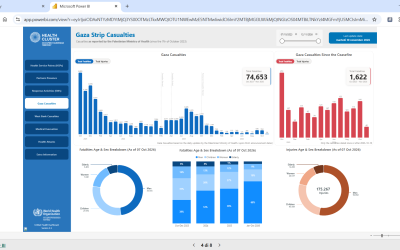
As we will see below, OCHA-OPT and WHO themselves, again based on MOH Gaza data, publish contemporaneous but slightly different figures (see the Health Cluster – Gaza Casualties dashboard: https://app.powerbi.com/view?r=eyJrIjoiODAxNTYzMDYtMjQ3YS00OTMzLTkxMWQtOTU1NWEwMzE5NTMwIiwidCI6ImY2MTBjMGI3LWJkMjQtNGIzOS04MTBiLTNkYzI4MGFmYjU5MCIsImMiOjh9), which not only confirm but accentuate the underrepresentation of minors aged 0-17 and women aged 18-59 (at 61 and 59 concentration indices, respectively) and the overrepresentation of men aged 18 to 59, at 204 concentration index!!! The latter is the profile most compatible with militants of Hamas and Palestinian Islamic Jihad.
This does not, of course, prove that all men aged 18 to 59 among the victims were combatants, and there may be important selection biases that explain these enormous discrepancies. But if ratios such as 20:1 had been systematic, as the NAZA witness claimed, this striking selectivity would at least require an explanation, which NAZA does not provide at all.
And why is this a decisive point?
Because single attacks with extreme ratios on one hand, and their representativeness of the entire campaign on the other hand (and the latter is precisely the narrative of NAZA: according to the documentary 20 NAZA per militant would represent a standard, an average, and not extreme cases), are not only statistically distinct questions but two completely different realities, certainly from a legal standpoint.
The first reality is compatible with individual war crimes, grave and punishable under Israeli justice or, failing that, by the International Criminal Court.
The second reality would instead be more compatible with genocidal intent, but is in apparent inconsistency with the casualty data provided by…Hamas!!!
This is precisely the distinction between War Crimes and Genocide drawn here in Italy by Liliana Segre.
Finally, there is a closing note on the reliability of the data produced by the WHO and the United Nations (through OCHA) on the basis of data provided by the Gaza MOH, that is, by Hamas.
Here too, I do not wish to challenge overall the credibility of the data provided by Hamas, which many observers, and, as the Times of Israel reported, the IDF itself, consider reliable ON THE WHOLE.
I want to underline how superficial appears at least the check of the INTERNAL CONSISTENCY of the data produced and uncritically reported by the WHO and the United Nations through OCHA.
If you take the trouble to compare the figures in the donut chart with the figures in the histograms at the top and bottom of the “Health Cluster – Gaza Casualties” site cited above, it is easy to see that absolute values and compositions by socio-demographic cluster emerge that are different and mutually incompatible:
- Absolute values, men aged 18–59: 37,265 (histograms) vs. 35,555 (donut chart)
- Absolute values, children aged 0–17: 21,329 (histograms) vs. 21,976 (donut chart)
- Absolute values, women aged 18–59: 10,594 (histograms) vs. 11,301 (donut chart)
- Absolute values, elderly aged 60+: 5,049 (histograms) vs. 5,405 (donut chart)
- Percentage, men aged 18–59: 50.2% (histograms) vs. 47.9% (donut chart)
- Percentage, children aged 0–17: 28.7% (histograms) vs. 29.6% (donut chart)
- Percentage, women aged 18–59: 14.3% (histograms) vs. 15.2% (donut chart)
- Percentage, elderly aged 60+: 6.8% (histograms) vs. 7.3% (donut chart)
And although at first glance the differences may seem contained, the inconsistency that emerges does not in fact appear at all “neutral” for the pro-Palestinian narrative. The figure in the donut chart, which is the only one reproduced in the OCHA and WHO reports mainly used by journalistic and academic sources, is consistent with a narrative in which most of the victims of the war in Gaza are women, children, and the elderly. The figure in the histograms contradicts that narrative: most victims are men between 18 and 59, the profile most corresponding to the militant cluster of Hamas and Palestinian Islamic Jihad.
I repeat and want to stress that with this I do NOT at all claim that ALL male victims aged 18 to 59 were militants (the IDF itself, according by TOI reports, estimates the militants killed at 20,000 to 24,000, that is fewer than the 37,265 men aged 18 to 59 that emerge from the histograms).
I am making a different and much more banal claim: that the attribution of deaths by sex and age class coming from the Gaza MOH data, that is, from Hamas, could be in all probability “somewhat manipulated” to make it more consistent with a narrative aligned with Hamas’s political objectives.
And that the WHO has not carried out even a basic check of internal consistency on the data it publishes.
This seems to me both reprehensible and indicative of the gross negligence with which data of Hamas origin are received and accepted.