The views expressed herein are solely mine.
Abrahamic NATO: Iron Dome to Mutual Pact
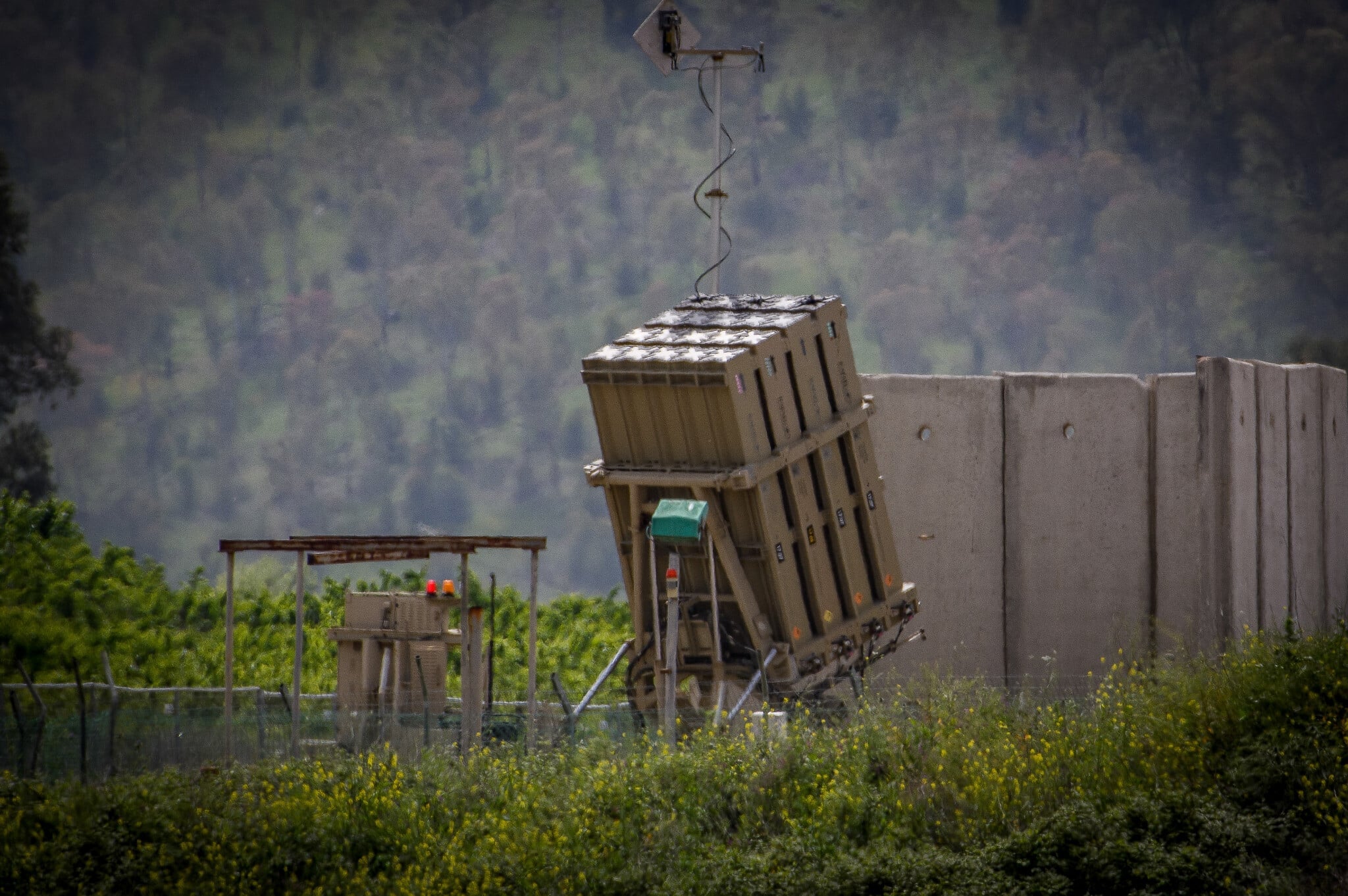
Illustrative: An Iron Dome anti-missile system near the border with Lebanon, in northern Israel, April 7, 2023. (Ayal Margolin/Flash90).
Iranian missiles hammered the United Arab Emirates in April 2026. Facing saturation attacks, Abu Dhabi turned not only to Washington but also to Jerusalem. Prime Minister Benjamin Netanyahu responded immediately, dispatching an Iron Dome battery, dozens of interceptors, and several dozen IDF operators to Emirati territory. The system went to work at once, downing dozens of incoming projectiles during ‘Operation Roaring Lion’.
This first-ever deployment of the Iron Dome shield abroad marks a decisive shift from normalization to an operational military alliance against Iran.
The episode laid bare core geopolitical and geostrategic realities. Iran has built a vast arsenal of ballistic missiles, cruise missiles, and drones explicitly designed to overwhelm air defenses and strike Gulf energy infrastructure.
The Strait of Hormuz carries 20.9 million barrels of oil per day — roughly 20 percent of global petroleum liquids consumption. A sustained disruption would send energy prices skyrocketing and trigger cascading shocks across Asian, European, and American economies. The 2026 Iranian barrages pushed existing Gulf defenses to their limit. Israel’s rapid intervention provided the decisive additional layer.
Five years after the Abraham Accords, the foundation for deeper integration already existed. Israel and the United Arab Emirates already exchange early warning data and coordinate air defense operations. The Iron Dome mission in Abu Dhabi converted ad hoc cooperation into a proven battlefield partnership. The logical next step is a formal mutual defense pact between Israel and the United Arab Emirates: joint command centers, pre-positioned systems on Emirati soil, and clear consultation mechanisms in times of crisis.
Expanding this pact to other willing Sunni Arab states would establish an ‘Abrahamic NATO’ stretching from the Persian Gulf to the Mediterranean. Such an alliance would integrate early warning networks, counter-drone capabilities, special operations forces, and multilayered missile defenses to deter and defeat Iranian proxies across Yemen, Lebanon, Iraq, and Syria.
For Israel, the strategic and economic benefits are compelling. Defense exports reached 14.8 billion dollars in 2024, nearly half from air and missile defense systems. Establishing co-production facilities in the United Arab Emirates and other Gulf states would localize the manufacturing of interceptors, radars, and drones. This expands Israeli industrial capacity and generates independent revenue.
Bilateral trade with the United Arab Emirates already exceeds 3.25 billion dollars annually. These flows position Israel to gradually reduce dependence on the 3.8 billion dollars in yearly United States military aid without eroding its qualitative military edge. The transition would end repeated congressional battles over funding and bury conspiracy narratives from both political extremes that have distorted the relationship for years.
Geostrategically, the pact would reshape the balance of power. It denies Iran the ability to pick off targets sequentially and secures vital maritime chokepoints that supply one-fifth of the world’s oil. It counters deepening Chinese and Russian influence gained through arms sales and infrastructure deals across the Gulf.
For the United States, the arrangement offers genuine burden sharing at a time when American resources are stretched across the Indo-Pacific and Europe. A militarily self-reliant Israel anchored in a Sunni-led defense network stabilizes energy markets and reduces pressure for permanent United States forward presence.
While Saudi Arabia remains cautious, largely due to the Palestinian issue, the raw pressure of the Iranian threat increasingly overrides old grievances. The Iron Dome’s successful mission in Abu Dhabi proved what is possible when survival trumps history.
Indeed, a formal mutual defense pact between Israel and the United Arab Emirates is the immediate priority to strengthen a key military alliance for the Jewish State but also vitalize Jerusalem’s critical minerals competitiveness (a market the UAE has a huge influence on) and its regional diplomatic relevance. Expanding it into a full Abrahamic NATO converts emergency aid into an enduring strategy. The numbers are unambiguous: 14.8 billion dollars in defense exports, 3.8 billion dollars in current United States aid, 20.9 million barrels daily through the Strait of Hormuz, and interception rates exceeding 90 percent in live combat.
Iran’s aggression has redrawn the regional map. Israel and its Abraham Accords partners -the potential ones- must now codify the new reality before the next crisis arrives. The path is pragmatic, evidence-based, and overdue.
Related Topics
Related Posts