
Foreign Policy Analyst | India, Israel & Middle East
After October 7: What Israel Learned and What India Must Remember
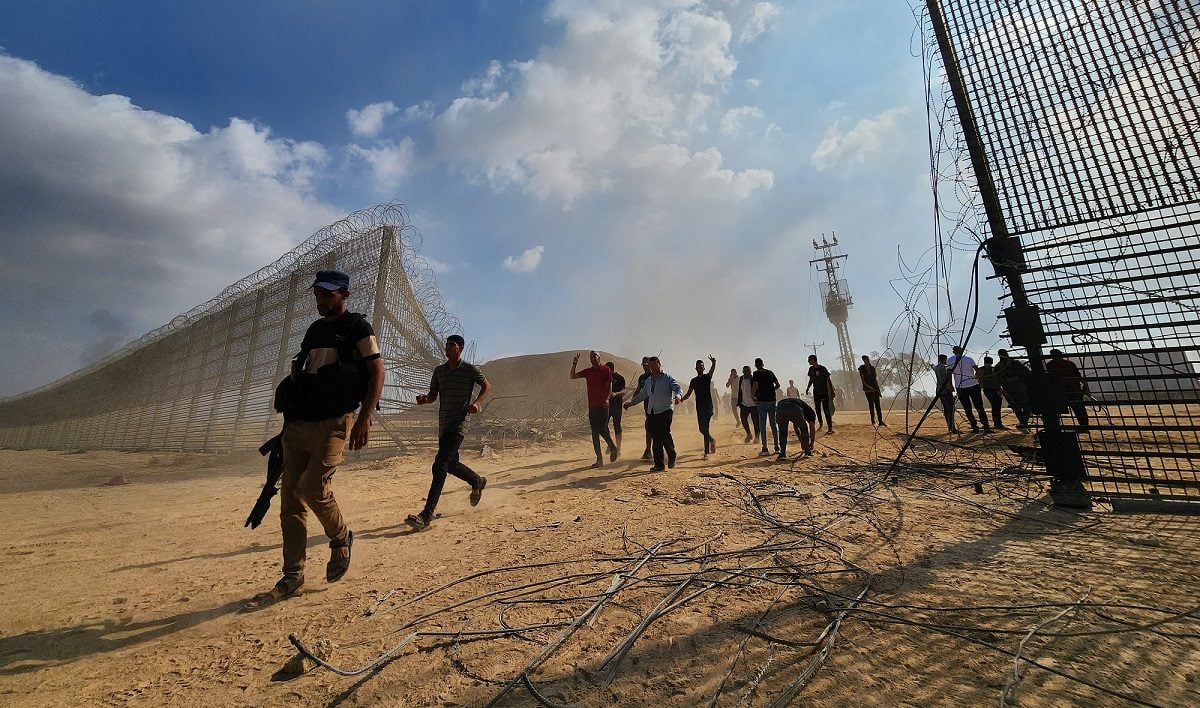
Photo: Hani Alshaer/Anadolu Agency
Three years after October 7, 2023, the date remains more than a moment in Israel’s modern history. It represents a dividing line between the Israel that existed before the attack and the country that emerged from it. On that morning, Hamas and other armed groups launched a coordinated assault into southern Israel by land, sea, and air, while thousands of rockets were fired toward Israeli communities. More than 1,200 people were killed and 251 were abducted and taken to Gaza. The scale and coordination of the assault exposed vulnerabilities that Israel had long believed its intelligence capabilities, military strength, and technological superiority could largely contain.
The human consequences were immediate and devastating. Families were attacked inside their homes, communities were overrun, and young people attending music festivals suddenly found themselves fighting for survival. Beyond the immediate loss of life, the attack demonstrated how quickly a localized security threat could develop into a national crisis when military forces, intelligence agencies, and civilian authorities are unable to respond with the speed required by a rapidly evolving assault. For Israel, October 7 was therefore not simply another terrorist attack. It became a profound test of the assumptions on which the country’s security architecture had been built and forced a reassessment of how intelligence, deterrence, preparedness, and national resilience should operate in an increasingly complex security environment.
The Intelligence Failure That Changed Israel
Perhaps the most important strategic lesson from October 7 concerns intelligence rather than weapons. Israel possessed sophisticated surveillance systems, extensive human intelligence capabilities, electronic monitoring, and one of the world’s most advanced military establishments. Yet these capabilities did not prevent Hamas from achieving strategic surprise. The attack therefore raised a fundamental question for modern intelligence organisations about whether technological superiority and extensive information collection can provide meaningful warning when an adversary’s intentions are misunderstood.
A 2024 analysis of the intelligence failures surrounding October 7 found that warning indicators existed before the attack, including repeated Hamas military exercises, changes in the intensity of those exercises, and preparations that resembled the eventual assault. Analysts and border personnel had raised concerns, but these warnings were not sufficiently incorporated into the broader assessment of Hamas’s intentions. This distinction is critical because intelligence failure does not necessarily mean that information was completely absent. In many cases, relevant information exists but is interpreted through an established assumption that prevents decision makers from recognising its significance.
Before October 7, the prevailing assessment of Hamas appears to have underestimated its willingness and ability to launch a large-scale offensive. The problem was therefore not simply intelligence collection, but also interpretation, communication, and decision making. For intelligence organisations everywhere, the lesson is uncomfortable but important. Possessing more information does not automatically produce better warning if institutions become too confident in their existing assessment of an adversary and fail to reconsider that assessment when new evidence emerges.
October 7 consequently demonstrated the danger of cognitive bias within intelligence assessments. When an organisation becomes convinced that an adversary is deterred, economically constrained, or incapable of conducting a sophisticated operation, contradictory evidence can be treated as background noise rather than as a potential warning. The analysis found that junior analysts and border personnel had identified important changes in Hamas’s behaviour, yet their assessments struggled to overcome the established strategic understanding. The lesson extends well beyond Israel. India, like every major security establishment, must constantly question whether its understanding of an adversary reflects the adversary’s actual intentions or merely the assumptions that have accumulated over time.
Israel’s Response: An Intelligence Transformation
Israel’s response after October 7 was therefore not limited to military operations. It also involved a significant shift in how intelligence was used to identify individuals, networks, and operational structures associated with the attack. Israel’s intelligence efforts have also increasingly focused on tracking those involved in the October 7 assault through a combination of intercepted communications, facial recognition, location data, social media activity, and information obtained from detainees. The objective has not been simply to identify individual perpetrators, but to reconstruct the networks that enabled the assault and develop a clearer understanding of how Hamas planned, organised, and executed the operation.
This represented a broader shift from traditional target identification toward an effort to map the wider ecosystem behind a terrorist attack. Modern terrorist organisations rarely operate through isolated individuals. Their operations can involve planners, financiers, recruiters, facilitators, weapons suppliers, digital operators, and local supporters who may never appear on a conventional battlefield but can still play important roles in enabling an attack. The intelligence challenge is therefore not only to collect information on individual actors, but to connect seemingly unrelated pieces of information and determine whether they form part of a larger operational picture.
Israel’s experience since October 7 demonstrates why intelligence agencies must be capable of moving continuously between tactical information and strategic assessment. A single communication, financial transaction, movement pattern, or online interaction may appear insignificant when examined in isolation but can acquire greater importance when connected to other intelligence. The broader lesson is that effective intelligence requires not only sophisticated collection capabilities, but also the analytical capacity to identify relationships, recognise emerging patterns, and reassess established assumptions. This approach can help security institutions detect not only who is preparing an attack, but also the networks and enabling structures that make such an attack possible.
The Human Cost Did Not End When the Fighting Began
The security lessons of October 7 cannot be separated from its human consequences. The attack left survivors, families of those killed, communities near Gaza, festival attendees, and former hostages dealing with trauma long after the immediate violence had ended. Israel’s Ministry of Health has established dedicated mental health and rehabilitation mechanisms for survivors of October 7, while former hostages and their families have received specialized medical and psychological support. Specific support programs have also been established for survivors of the music festivals, recognising the lasting psychological effects of the violence, displacement, and prolonged uncertainty they experienced.
This dimension is important because national resilience is itself a component of national security. A state can strengthen its borders, improve surveillance, and acquire sophisticated weapons, but it must also be capable of helping its population recover when prevention fails and an attack occurs. The experience of October 7 shows that terrorism produces consequences that extend far beyond the immediate number of casualties, as trauma can affect individuals, families, communities, and institutions for years. Psychological support, rehabilitation, and social resilience must therefore form part of a comprehensive counter terrorism strategy. Israel’s experience offers India an important lesson that is sometimes overlooked in security debates: protecting citizens is not only about preventing an attack, but also about ensuring that society has the capacity to recover when prevention fails.
The Threat Has Continued to Evolve
The changing nature of the threat was again illustrated only days before the third anniversary. On September 30, 2026, a Flydubai flight travelling from Dubai toward Tel Aviv became the target of a terrorist attack when the co pilot attacked the captain inside the cockpit, causing the aircraft to enter a rapid descent before passengers and crew intervened. The aircraft was subsequently diverted to Saudi Arabia, where it made an emergency landing, preventing what could have become a catastrophic aviation disaster. The incident highlights how terrorist threats can exploit trusted positions and highly secure systems, while also raising important questions about personnel screening, information sharing, and the ability of security agencies to identify potential threats before they reach critical positions
The broader lesson is that terrorist threats are increasingly capable of exploiting unexpected vulnerabilities rather than relying only on conventional methods of attack. October 7 demonstrated how an adversary could combine surprise, coordination, and multiple modes of assault to overwhelm established security assumptions, while the Flydubai incident illustrates how a single individual can exploit an existing system from within. These cases are fundamentally different in scale and nature, but both underline the need for security institutions to continuously reassess their assumptions and prepare for threats that may emerge in forms they have not previously encountered. For Israel and for countries such as India, the challenge is therefore not only to strengthen existing security measures, but also to develop the institutional flexibility needed to recognise and respond to evolving methods of terrorism.
Why India Cannot Look Away
India’s connection to October 7 is both strategic and deeply human. On the day of the attack, Prime Minister Narendra Modi expressed shock at the terrorist attacks and said that India stood in solidarity with Israel. A few days later, after speaking with Israeli Prime Minister Benjamin Netanyahu, Modi again condemned terrorism and affirmed India’s support for Israel during the crisis. India’s response reflected a relationship that has developed beyond diplomatic symbolism into a broader strategic partnership encompassing defence, technology, security, and counter terrorism. For India, therefore, October 7 is not only a tragedy that occurred in another country but also a case study with important implications for its own national security.
India does not face the same security environment as Israel, and an October 7 style attack cannot simply be replicated in the Indian context. Yet India faces its own combination of terrorist organisations, cross border networks, radicalisation, drones, cyber vulnerabilities, attacks against crowded civilian spaces, and attempts to exploit gaps between intelligence and security institutions. The greater concern is how these threats could be combined to create confusion and overwhelm conventional responses. October 7 therefore offers India a strategic lesson in preparedness, reminding security institutions that future terrorist threats may not resemble previous attacks and that effective prevention requires the ability to anticipate how different vulnerabilities can be exploited together.
Intelligence Must Connect the Dots
For India, one of the clearest lessons from October 7 is the need for continuous intelligence fusion. Information from human sources, communications monitoring, financial investigations, cyber systems, open sources, border agencies, and local police becomes far more valuable when analysed together rather than remaining within institutional silos. A warning that appears insignificant to one agency may become highly significant when combined with information held elsewhere. The objective should therefore not simply be to collect more intelligence, but to ensure that relevant information is connected, interpreted, and reaches those capable of acting on it before an emerging threat develops into an attack.
India’s newly established PRAHAAR National Counter Terrorism Policy and Strategy moves in this direction. The Ministry of Home Affairs describes PRAHAAR as India’s first comprehensive national counter terrorism policy and strategy, built around prevention, rapid response, intelligence led action, coordination across government, counter radicalisation, international cooperation, and recovery and resilience. Its emphasis on real time intelligence sharing through the Multi Agency Centre, protection of critical infrastructure, and coordinated action between central and state security agencies reflects the broader lesson of October 7. The effectiveness of such a framework, however, will ultimately depend on implementation and institutional culture, particularly the willingness to challenge established assumptions and take emerging warnings seriously. The most dangerous intelligence failure is not always the absence of information, but the failure to recognise its significance when the warning is already there. The importance of PRAHAAR will ultimately depend on implementation. Policies can establish structures, but intelligence failures often occur because information is not interpreted correctly, warnings are not taken seriously, or agencies do not communicate effectively. India’s challenge is therefore to build a security culture in which dissenting assessments are not automatically dismissed and where analysts are encouraged to challenge prevailing assumptions. October 7 demonstrated that the most dangerous intelligence failure can occur not when an agency knows nothing, but when it knows enough to raise concern and still fails to act.
Conclusion
Three years later, October 7 should not become just another date in the history of Middle Eastern conflict. More than 1,200 people were killed and 251 were abducted, leaving families and communities permanently changed. Beyond the human tragedy, the attack exposed serious vulnerabilities in Israel’s intelligence and security assumptions and forced the country to reassess how it understands and responds to evolving threats. Yet October 7 is also a story of resilience and adaptation. Israel has spent the years since the attack supporting survivors, rebuilding communities, investigating the intelligence failures, and reassessing its security architecture. For India, the most important lesson is the need for intelligence humility, continuous reassessment, stronger intelligence fusion, and the ability to recognise unfamiliar combinations of threats before they become strategic surprises.
The India-Israel partnership can play an important role in this process by combining Israeli experience with India’s own security expertise and requirements. October 7 should therefore be remembered not only as a tragedy, but as a lasting reminder that technological superiority cannot replace vigilance, institutional accountability, adaptability, and the willingness to question established assumptions.
Related Topics
Related Posts