
After the Midterms, Democrats Must Lead on Iran!
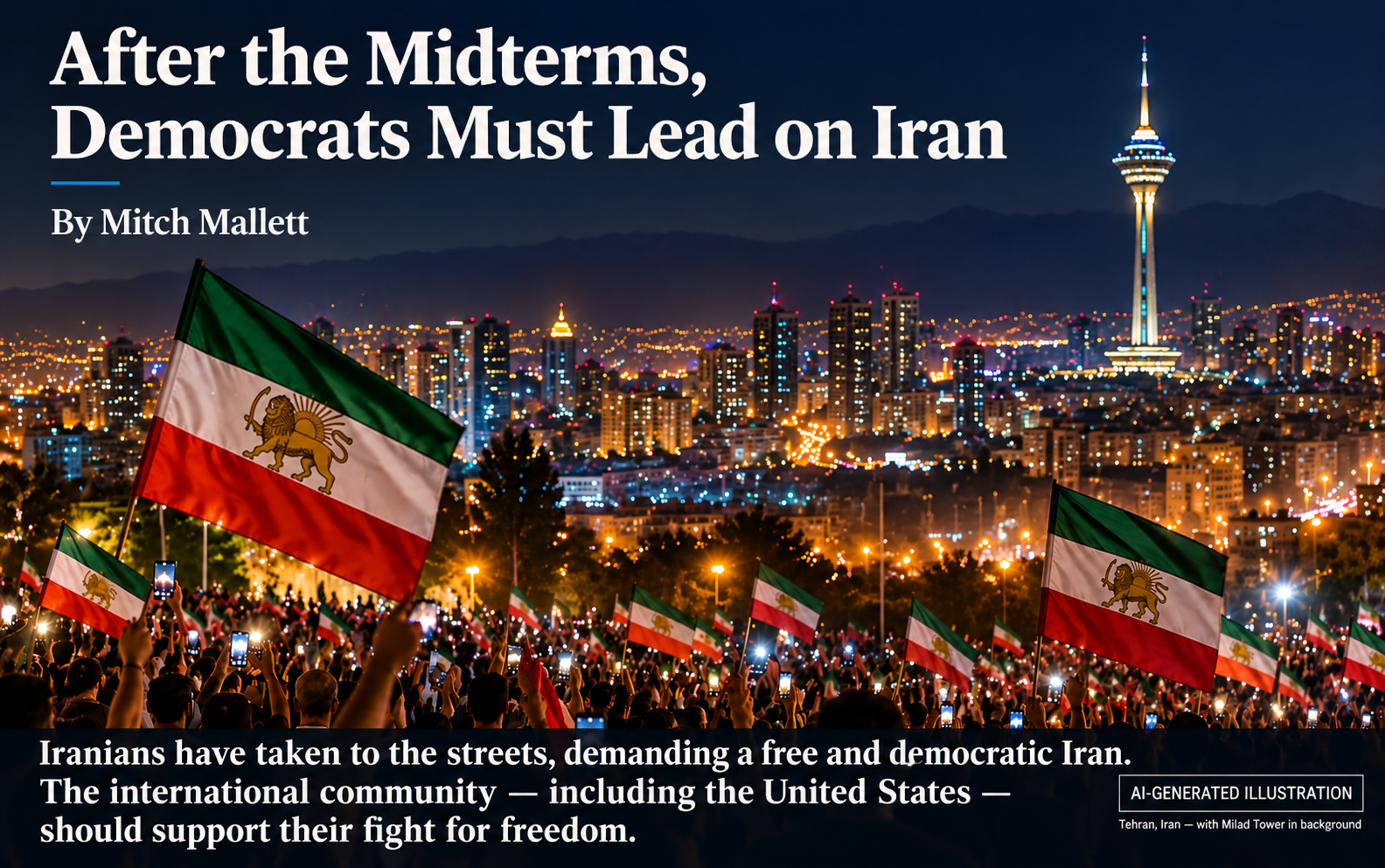
Nearly 50 years after Iran’s Islamic Revolution, an opportunity may be emerging to change the future of the Middle East. Military action alone will not accomplish that. It is time for American political leadership, bipartisan cooperation, and an international coalition committed to helping the Iranian people achieve freedom.
A Revolution That Changed My Adult Life
In 1979, I graduated from Rutgers University. I was 23 years old, beginning my adult life with the optimism of a young American who believed the world was moving toward greater freedom, democracy, and opportunity.
That same year, another historic event was unfolding thousands of miles away.
Iran was undergoing a revolution.
What began as a broad movement against the Shah’s authoritarian rule ultimately produced a new authoritarian system under Ayatollah Ruhollah Khomeini.
The Islamic Republic consolidated power, restricted political freedoms, and fundamentally changed Iran’s relationship with the world.
I am now 70 years old.
For virtually my entire adult life, the Middle East has lived with the consequences of that revolution.
Today, following months of military confrontation involving the United States, Israel, and Iran, I find myself asking a question that deserves far more attention than it is receiving:
Are we going to emerge from this conflict with a more peaceful Middle East, or are we going to allow the conditions that produced decades of violence to continue?
We cannot change the nearly 50 years behind us. But we can influence the next 50 years in front of us.
And I believe the time to begin that effort is now.
Nearly Half a Century of Conflict
Since 1979, the Islamic Republic has pursued a regional strategy involving armed militant organizations, ideological confrontation, and military threats against its neighbors.
For decades, Tehran has financed, armed, trained, and supported Hezbollah in Lebanon, Hamas and Palestinian Islamic Jihad in Gaza, and the Houthis in Yemen.
These Iranian-backed organizations have fueled regional conflicts, threatened Israel and neighboring Arab countries, and prolonged instability throughout the Middle East.
Without the Iranian regime’s financial and military assistance, these organizations would be significantly weakened. They have independent resources and local support, but ending Iranian sponsorship could fundamentally change the region’s security landscape.
Consider what nearly half a century of these policies has cost.
Countless lives lost, families displaced, infrastructure destroyed, and resources diverted from education, medicine, housing, and economic development into military confrontation.
Lebanon has endured devastating conflict. Yemen has suffered a humanitarian catastrophe. Iraq and Syria have experienced years of violence involving armed groups supported by Tehran.
Throughout these decades, Israel has faced persistent threats from organizations committed to attacking its population.
Iran is not responsible for every conflict in the Middle East. The region’s problems cannot be attributed to a single government.
Nevertheless, Iran’s leadership has played a substantial role in sustaining armed organizations and undermining regional stability.
Imagine how different the Middle East might have become had Iran’s enormous natural resources, educated population, and technological capabilities been directed toward peaceful development rather than confrontation.
That opportunity was largely squandered.
But the possibility of a different future remains.
The Iranian People Are Not the Iranian Regime
One of the most important distinctions we must make is between the government of Iran and the Iranian people.
Iran is home to more than 90 million people.
They are not collectively responsible for their government’s actions.
They include doctors, teachers, engineers, scientists, students, entrepreneurs, artists, parents, and children.
Like people everywhere, they want opportunities for themselves and their families, economic security, personal freedom, and the ability to shape their own futures.
Yet for decades, millions have lived under a government that restricts political expression, suppresses dissent, and imposes severe limitations on fundamental rights.
Iranian women have demonstrated extraordinary courage in challenging those restrictions.
The Woman, Life, Freedom movement, which emerged in 2022 following the death of Mahsa Amini in police custody, became an international symbol of resistance to government repression.
Then came the nationwide protests beginning in December 2025.
What initially emerged amid worsening economic conditions developed into a broader challenge to the Islamic Republic.
The government’s response was brutal.
Security forces opened fire on protesters. Thousands were reportedly killed, with some estimates considerably higher. Human rights organizations documented mass killings, arbitrary arrests, and the extensive use of lethal force. Government restrictions on communications made independently determining the full number of victims exceptionally difficult.
These were Iranian citizens demanding fundamental rights.
Their government answered with violence.
Opposing the Islamic Republic does not mean opposing Iran. Supporting the Iranian people does not mean supporting their government.
The Iranian regime is not the innocent victim in this conflict. Its own people have been among its greatest victims.
Military Pressure Has Created an Opportunity, Not a Solution
On February 28, 2026, the United States and Israel launched military operations against Iran.
The resulting conflict significantly damaged Iranian military capabilities and demonstrated the vulnerability of a regime that has spent decades threatening other countries.
I recognize the security concerns that led to those operations.
Iran’s nuclear activities, ballistic missiles, and support for armed organizations have presented serious challenges to Israel, the United States, and neighboring Arab countries.
But military success and political success are not the same thing.
Destroying missile launchers, military installations, or command centers does not automatically produce peace.
An authoritarian government can lose substantial military capabilities while retaining control over its population. It can also exploit foreign military action to encourage nationalism and rally citizens who might otherwise oppose its leadership.
The Iranian regime has suffered significant military setbacks. Its people have demonstrated their willingness to challenge its authority, and many governments have compelling reasons to support a less confrontational Iran.
The challenge is to transform military pressure into an international strategy that creates an opportunity for lasting political change.
Continuing airstrikes indefinitely will not accomplish that. Nor will another series of statements condemning Iranian repression.
What is needed is a coordinated effort with clear objectives, meaningful commitments, and a willingness to support the Iranian people’s aspirations.
Regime collapse does not guarantee democracy. A poorly planned transition could produce instability, factional violence, or another authoritarian government.
Those are reasons to develop a serious strategy, not reasons to abandon the objective of supporting freedom.
A Democrat Who Refuses to Make This About Donald Trump
I have been actively involved in Democratic politics for decades.
I am a committed liberal and a committed Zionist.
I believe in reproductive freedom, LGBTQ rights, universal health care, economic opportunity, a strong minimum wage, organized labor, and the protection of democratic institutions.
I have never believed that supporting Israel required abandoning those principles.
Nor do I believe that opposition to Donald Trump requires automatically opposing every foreign policy objective pursued by his administration.
I have serious disagreements with President Trump and Israeli Prime Minister Benjamin Netanyahu.
But neither man’s political future should determine how I evaluate the threat posed by the Iranian regime.
Israel’s security is not synonymous with Netanyahu’s political interests. And opposition to authoritarianism abroad should not depend on which party occupies the White House.
I can oppose Trump, reject Netanyahu’s leadership, support Israel’s security, and stand with the Iranian people seeking freedom.
These positions are not contradictory.
I can also recognize that military pressure may create diplomatic opportunities while questioning the tactics used to achieve it.
The question is what we do with those opportunities.
That brings me to the American midterm elections.
After the Midterms, Democrats Must Lead
On November 3, Americans will elect a new House of Representatives and determine which senators will serve in the next Congress.
I intend to vote a straight Democratic ticket.
My commitment to the Democratic Party and to liberal values has not changed.
I am not writing this article because I am following a political trend or because my position is particularly popular within my party.
It isn’t.
I am writing it because I believe it is the right thing to do.
I call upon mainstream Democratic congressional leadership, immediately following the midterm elections, to reach across the aisle to Republican colleagues and begin building a bipartisan initiative supporting the Iranian people’s pursuit of freedom.
This should begin with congressional resolutions calling for a coordinated international effort involving the United States, Israel, European democracies, and Arab nations, particularly those participating in the Abraham Accords.
The resolutions should establish clear objectives and encourage diplomatic, humanitarian, economic, and other appropriate assistance.
Congress cannot independently conduct American foreign policy. The Trump administration retains the executive branch’s constitutional responsibilities.
But Congress possesses significant authority involving legislation, appropriations, oversight, and international engagement.
Democratic and Republican leaders can work together to establish priorities and encourage cooperation with America’s international partners.
I believe there are Republicans willing to put principle and America’s long-term interests ahead of loyalty to Donald Trump. Democrats should welcome their cooperation.
I have serious doubts about the Trump administration’s ability to assemble and sustain the broad international coalition I believe is necessary.
But those doubts should not become an excuse for inaction.
Democratic congressional leadership could play an important role in bringing European governments into such an initiative. A credible bipartisan American proposal, grounded in shared security interests and democratic principles, could provide a foundation for meaningful cooperation.
This is not about endorsing President Trump’s continued military tactics against Iran. It is about developing a strategy that moves beyond them.
Mainstream Democrats should lead this effort without turning it into another ideological battle within our party.
Those associated with the Democratic Socialists of America should also be welcome to support these objectives and participate in building a more peaceful and prosperous future.
The question for DSA members is straightforward: Will they stand with the Iranian people seeking freedom and self-determination creating a progressive democracy, or defend the repression of the Islamic Republic?
This is not a test of loyalty to Israel or Benjamin Netanyahu.
It is a question of whether we can unite in opposing the authoritarian Islamic Republic in Tehran while supporting the Iranian people’s right to freedom and self-determination.
The larger objective must remain more important than internal political disagreements.
Building an International Coalition
The United States and Israel cannot accomplish this alone.
A successful initiative must bring together nations with different political traditions but a shared interest in a more peaceful Middle East.
The Abraham Accords provide a starting point.
The United Arab Emirates, Bahrain, and Morocco established or restored diplomatic relationships with Israel through that framework, demonstrating that cooperation is possible when governments recognize common interests.
Other countries, including Saudi Arabia, should be invited to participate.
European democracies must also play a central role.
France, Germany, the United Kingdom, and other European governments possess diplomatic influence, economic resources, intelligence capabilities, and international credibility.
European nations and the United States also face security threats stemming from activities supported by the Islamic Republic, including threats within our own borders.
They share substantial interests in preventing Iranian nuclear proliferation, protecting international commerce, and promoting regional security.
Imagine representatives of the United States, Israel, European democracies, and participating Arab governments standing together to issue a declaration addressed directly to the Iranian people.
Not simply another condemnation of the regime or announcement of sanctions.
But a declaration recognizing the Iranian people’s right to determine their political future and committing participating nations to meaningful assistance.
Imagine that message reaching Iranian households, universities, businesses, and communities:
The world recognizes your struggle. We support your fundamental rights and your freedom to determine your own government. We are prepared to help you pursue a different future.
Such a declaration could be enormously significant.
But it must be followed by action.
What International Support Should Include
There are numerous ways the international community can support the Iranian people without placing foreign armies on Iranian soil.
A coalition could provide secure communications technology to counter government efforts to isolate citizens from the outside world.
It could support independent journalism, document human rights abuses, and coordinate targeted sanctions against officials responsible for repression.
It could expand humanitarian assistance, educational opportunities, and support for civil society organizations committed to democratic principles.
It could also establish diplomatic channels with credible representatives of Iran’s diverse political movements.
These efforts should reflect the aspirations of the Iranian people rather than impose a political model designed in Washington, Jerusalem, or European capitals.
The international community must also prepare for the possibility that the Iranian regime will again respond to peaceful demonstrations with mass violence.
I believe the coalition should examine every lawful and responsible option for protecting civilians, including military assistance and, in extraordinary circumstances, targeted air support where necessary and legally justified to prevent mass atrocities.
I am not a military strategist, and I would not pretend to know precisely how such operations should be conducted.
Providing carefully controlled military assistance to credible Iranian opposition forces may ultimately be necessary to protect civilians from the regime’s brutality.
Such assistance carries serious risks, including weapons reaching unintended recipients, civilian casualties, and prolonged internal conflict.
Military intervention would require reliable intelligence, a lawful basis, clear objectives, and careful assessment of whether it would protect civilians or increase their suffering.
But these questions should be examined before another massacre occurs, not improvised afterward.
I do not advocate an American invasion or foreign occupation of Iran. I do not support putting American or allied ground troops into another prolonged Middle Eastern conflict.
I believe Iranians seeking freedom should be supported in creating their own political future. I believe that when they see such a coalition of support they will have the courage to rise up.
My hope is that the result will be a secular democracy protecting religious freedom, individual rights, free enterprise, and equal treatment under the law.
But the Iranian people must determine their government through their own political choices.
The responsibility of the international community should be to help create conditions in which they can exercise that right without fear of persecution or mass violence.
The Consequences Extend Beyond Iran
Iran’s future is not simply an Israeli or American concern.
The conflict has demonstrated how closely Middle Eastern security is connected to the global economy.
Consider the Strait of Hormuz, one of the world’s most important routes for transporting energy.
Disruptions affect international shipping, energy prices, and economies thousands of miles away.
The conflict and disputes over the strait have raised serious concerns about sanctions, security, international commerce, and Iran’s nuclear program.
Disruptions have also threatened fertilizer shipments, raising concerns about agricultural production and food security far beyond the Middle East.
These developments demonstrate why regional stability requires international cooperation.
Arab countries have themselves faced Iranian attacks and have legitimate security concerns. European governments have economic and strategic interests. Israel faces threats from Iranian missiles and Iranian-backed organizations.
The United States has a substantial interest in preventing nuclear proliferation, protecting international commerce, and reducing the likelihood of future wars.
A free Iran could take its rightful place among the democratic nations of the world, replacing decades of confrontation with an opportunity for cooperation and peace.
That would not automatically resolve every regional conflict.
But it could make lasting peace considerably more attainable.
Imagine a Different Iran
Imagine an Iran where women enjoy equal rights and personal freedom, journalists can criticize their government without risking imprisonment, and citizens choose their political leaders through free elections.
Imagine a country whose considerable natural resources, educated population, and technological abilities are directed toward peaceful development.
An Iran that maintains constructive relationships with Israel and its Arab neighbors.
Iran possesses enormous human talent, a rich cultural heritage, extraordinary economic potential, and a history of cooperation with Israel that predates the Islamic Revolution.
Its scientists, engineers, physicians, entrepreneurs, artists, and students have contributed to the world despite decades of political restrictions and international conflict.
Imagine Iranian and Israeli scientists working together on medicine, water conservation, renewable energy, and agriculture.
Imagine Iranian businesses trading freely with neighboring Arab countries.
Imagine universities developing international partnerships, entrepreneurs building new industries, and Iranian families enjoying the opportunities of an open society.
And imagine Iran participating in regional peace agreements rather than financing organizations dedicated to violent confrontation.
With the Islamic Republic no longer financing and arming organizations committed to Israel’s destruction, the prospects for lasting peace between Israelis and Palestinians could improve dramatically.
Consider what such a transformation could mean for Palestinians, Israelis, Lebanese, Syrians, Iraqis, Yemenis, and others whose lives have been shaped by regional conflict.
Children could grow up with greater opportunities for education, prosperity, and peace rather than the constant threat of war.
Peace becomes possible.
The Next 50 Years Must Be Different
The Iranian people must have the opportunity to replace the Islamic Republic with a democratic government.
Their courage deserves more than international sympathy. It deserves meaningful support.
Military pressure has weakened the regime, but military success alone will not create lasting peace.
The objective should be to transform that pressure into an opportunity for political freedom, regional security, and international cooperation.
This is not about Democrats defeating Republicans.
It is not about supporting Donald Trump or Benjamin Netanyahu.
And it is certainly not about punishing the Iranian people for the actions of their government.
It is about recognizing an extraordinary opportunity to help the Iranian people determine their own future.
I was 23 years old when the Islamic Republic came to power in 1979.
Today, at 70, I have witnessed nearly half a century of the consequences.
We cannot recover the lives lost, undo the suffering, or reclaim the economic and human opportunities squandered during those decades.
But we can help create a different future.
A future in which a free Iran lives peacefully alongside Israel and its Arab neighbors, contributes to regional prosperity, and helps create the conditions for lasting Israeli-Palestinian peace.
The next generation deserves something different from the conflicts that have defined so much of my adult life.
We have already lived through almost 50 years of this nightmare. We should not accept another 50 years of the same.
And that is why, immediately following the November midterm elections, I am calling upon Democratic congressional leadership to reach across the aisle, build a bipartisan initiative, and help lead an international coalition supporting the Iranian people’s struggle for freedom.