
After the Midterms, Three Things American Jews Need to Know
If Tuesday’s midterm results weren’t dramatic enough on their face, they also capped a year of seismic shifts in the US-Israel relationship and the politics that surround it.
Consider how much the ground has moved in a single year. Calls for an arms embargo, once confined to the activist fringe, found voices among some on the far left. On the far right, figures who long treated the alliance as untouchable began openly asking whether it serves American interests at all. And in the mainstream, serious, reasonable lawmakers advanced legislation to bring US aid in line with democratic values and American interests, a step that would have been hard to imagine on Capitol Hill not long ago.
On Tuesday, many candidates who backed some combination of those positions won their races. And Election Day opened with President Trump’s surprise announcement–that would have been a bombshell in any other news cycle–that he intends to end US aid to Israel at year’s end.
Those who have spent years insisting that Democrats are abandoning Israel and the Jewish community will try to spin all of this into panic. American Jews shouldn’t take the bait. Yes, change is coming, and here are three things we know right now:
First, the Democratic Party is still the political home for the majority of American Jews.
That relationship is a two-way street. The Democratic caucus in the new Congress will include more than 30 Jewish members across the House and Senate, from top leadership to incoming freshmen. That’s a slight uptick from the current Congress and amounts to at least ten percent of the caucus, if not more depending on final election results.
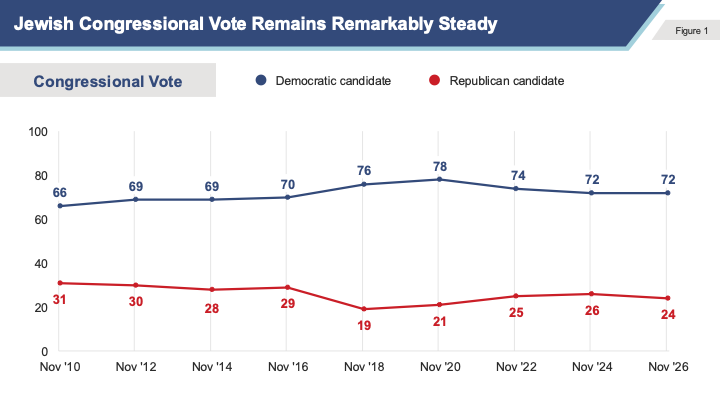
Jewish voters, meanwhile, keep defying the perennial predictions of a rightward stampede. Cycle after cycle, American Jews have backed Democrats by more than two to one. A J Street poll of Jewish voters on Election Day found that the pattern held again in 2026, with 72 percent supporting Democrats. That isn’t just habit. It’s a considered judgment that the Democratic Party champions the values at the heart of Jewish life in America: democracy, pluralism, civil rights and the rule of law.
Second, support for Israel in American politics is not disappearing. What it looks like is changing–and it should.
A very small handful of lawmakers oppose Israel’s existence as a Jewish state. They will draw disproportionate attention, and Republicans and others will lift them up as the face of Democrats. They aren’t. The overwhelming majority of Democrats, most of them JStreetPAC endorsees, reject that view and remain committed to Israel’s security and its future as a Jewish and democratic state.
What is over is the era of unconditional support. There is now bipartisan backing for sunsetting US financial subsidies to Israel. Gone is the idea that any Israeli government or any other ally is owed a blank check with no questions asked. In its place, a recalibration is underway toward a US policy on Israel that tracks with our democratic values and our national interests. That isn’t abandonment. It’s what an honest friendship between two democracies looks like. With 70 percent of American Jews being opposed to unconditional aid to Israel, this change should be welcomed.
Nowhere is this clearer than in the West Bank, where the occupation grinds on and Jewish settler extremists have waged a campaign of terror against Palestinian civilians, too often with the tolerance of the Israeli government. The West Bank Violence Prevention Act, led by Rep. Jerry Nadler and Sen. Cory Booker, is one example of this new approach that would authorize targeted sanctions, including asset freezes and visa bans, on anyone who commits or enables violence against civilians there. Forty-four senators and 174 House members have signed on as cosponsors thus far. That is mainstream Democratic thinking, not the fringe.
Expect this approach to sharpen. Opposition to the occupation and to settler violence will become more central to how Democrats talk about Israel, because that violence endangers Palestinians, endangers Israelis and erodes prospects for a peaceful, prosperous future for both peoples that is the only path to lasting security. All of this serves the vision of a secure, Jewish, democratic Israel and a US-Israel relationship strong enough to endure for generations.
Third, differences on Israel policy will remain. Among our elected officials, they are rarely antisemitic.
Antisemitism is real. It is rising, and it demands a serious response. That is exactly why the charge must not be cheapened. Antisemitism is hostility, prejudice and discrimination aimed at Jews: conspiracy theories about Jewish power, holding Jews collectively responsible for Israel’s actions, denying Jews alone the right to self-determination. Those lines matter, and we should enforce them without hesitation.
But opposition to Israeli policies and nonviolent political action aimed at its government are not antisemitic by default. Even sharp, strident criticism is not illegitimate. Weaponizing accusations of antisemitism to shut down policy debate is dangerous. It pulls attention away from genuine Jew-hatred, chills free speech, and makes the constructive discourse our community needs harder to have.
For Jewish constituencies who still find themselves at odds with their representatives on Israel, the answer is not to walk away. A member of Congress who votes differently than you would on arms sales may be your strongest ally on security funding for synagogues and Jewish institutions, on confronting white nationalist violence, on defending religious freedom, and on fighting antisemitism on campuses and in our streets. Disagreement on one issue is no reason to forfeit a working relationship on all the others. Our community is stronger when we show up, make our case and build partnerships, not when we write off allies over a single difference.
The story of 2026 isn’t that American Jews lost their political home or that Democrats turned on Israel. It’s that a more honest, values-driven politics on Israel is taking shape, and American Jews are helping lead it. Those selling fear about that shift have it backwards. We should embrace it.