
Writing Where Intelligence Meets Strategy
After the Pilot
AI
For more than a century, military aviation has rested on a simple assumption: the aircraft is the combat system, and the pilot is its center of gravity.
That assumption may now be running out of usefulness.
The next revolution in air power will not be defined simply by a faster fighter, a smaller radar signature or a more powerful engine. Nor will it be defined by placing a handful of unmanned aircraft under the control of a human pilot.
The deeper change is architectural.
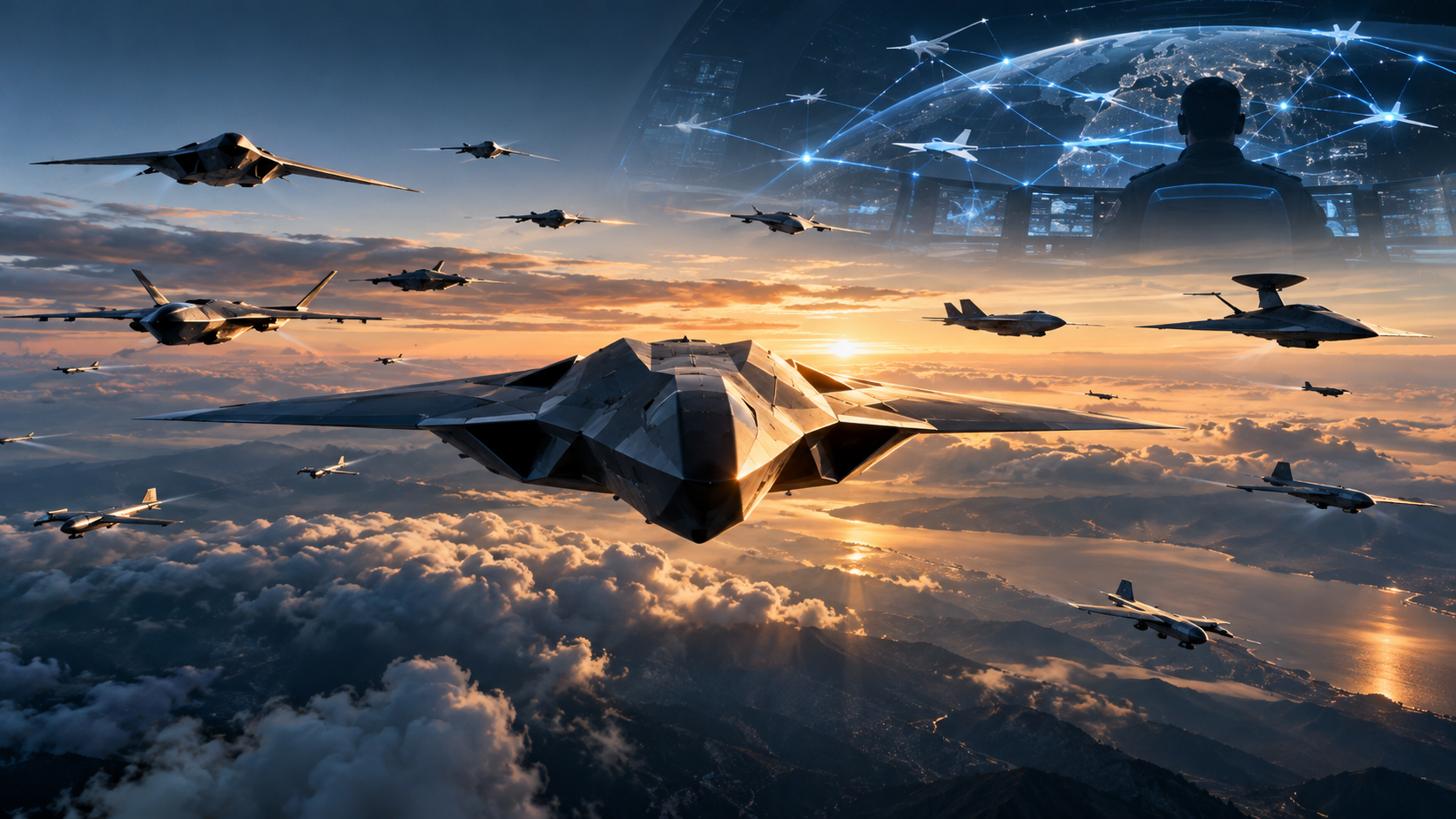
Autonomy, distributed communications and artificial intelligence are creating the possibility of an air force in which the combat platform no longer needs to carry a human being at all. The human will remain in the system, but increasingly at the level of command, mission design and strategic judgment rather than direct tactical control.
The future may not be a fighter without a pilot.
It may be an air force that no longer requires pilots inside combat aircraft.
The Manned Fighter May Be a Transitional Form
Today’s sixth-generation programs still place a manned aircraft at the center of the force. The U.S. F-47 is intended to operate as part of a broader family of systems alongside Collaborative Combat Aircraft. European programs follow a similar logic, combining a next-generation fighter with unmanned platforms, remote carriers and increasingly connected sensor networks.
That is a logical first step.
Military institutions rarely leap directly from one operational model to another. New technologies are usually introduced inside familiar structures before those structures are eventually transformed by them.
The first phase of the autonomous air-power revolution therefore looks reassuringly familiar: a human pilot remains in command, while unmanned aircraft extend reach, carry weapons, collect intelligence or absorb risk.
But this arrangement may not endure.
Once an unmanned aircraft can navigate independently, understand its environment, share information, cooperate with other platforms and adapt its mission in real time, the question becomes unavoidable: why must there still be a manned aircraft at the center of the formation?
From Aircraft to Network
The instinctive way to imagine an unmanned fighter is to picture an existing combat aircraft with the pilot removed.
That is probably the wrong starting point.
A platform designed from the outset without a human crew does not need to resemble a conventional fighter, and it does not need to perform every mission traditionally assigned to one.
A future combat force could instead consist of dozens of specialized platforms. One might carry a high-power radar. Another might operate almost entirely passively. A third could carry long-range weapons. A fourth could conduct electronic warfare. A fifth could serve as a communications relay. Others could be inexpensive enough to act as decoys, scouts or expendable penetrators.
No single platform would need to see everything, carry everything or survive every mission.
The force would fight collectively.
That is the real transition: from the aircraft as the basic unit of air combat to the network as the basic unit of air combat.
The Network Will Organize the Fight
Current concepts still assume hierarchy. The manned aircraft leads; the unmanned aircraft supports.
That distinction becomes less compelling as autonomy improves.
A future formation might detect an enemy radar with one platform, confirm it with another, jam it with a third and attack it with a fourth. The platform carrying the weapon would not necessarily be the one that found the target, and the platform closest to the threat would not necessarily be the one making the decision.
The network would assign roles dynamically.
If one aircraft were destroyed, its task could be redistributed. If one communications path were jammed, another could be used. If a key sensor were lost, information from multiple remaining nodes could be fused to rebuild the operational picture.
This is why true autonomy requires more than remote control.
A force that stops functioning when its satellite link disappears is not autonomous.
A future combat network must be able to continue operating when communications are degraded, navigation is disrupted and individual nodes are lost.
In structural terms, the air force of the future may resemble a resilient distributed network more than a traditional squadron.
The Human Remains, but at a Different Level
Removing the pilot from the aircraft does not require removing the human from warfare.
Human commanders can still define the objective, the operational boundaries, the permitted target sets and the rules under which force may be used. In some missions, humans may retain direct authority over weapons release.
But there is a critical distinction between command and control.
Humans can define what a system is meant to achieve without controlling how every platform flies, senses or maneuvers.
Indeed, beyond a certain level of complexity, direct control may become counterproductive. A network processing thousands of inputs and adjusting its behavior multiple times per second will eventually operate faster than any individual human can supervise tactically.
At that point, the human is no longer the indispensable decision-maker inside the machine.
The human becomes the bottleneck.
Once the Pilot Leaves, the Aircraft Changes
The removal of the pilot has consequences far beyond G-force tolerance.
A combat aircraft without a human crew does not need a canopy, ejection seat, oxygen system, cockpit pressurization or an airframe shaped around human visibility and ergonomics. It no longer needs to return because a crew is fatigued, and it can be sent into missions that would be politically or operationally unacceptable for a manned aircraft.
The platform can be designed around the mission rather than the person.
That can mean less internal volume, different geometry, more fuel, larger sensors or a different balance between survivability and cost.
It also changes how risk is distributed.
A manned fighter is designed with the assumption that loss must be avoided almost at any price. An autonomous platform can occupy a different part of the risk spectrum. Some may be extremely expensive and highly survivable. Others may be deliberately affordable enough to lose.
That distinction alone could reshape force structure.
Hypersonics Will Be a Layer, Not the Whole Force
The same logic applies to hypersonic flight.
The future is unlikely to consist of every combat aircraft flying at Mach 5. In a distributed system, platforms do not need identical performance.
One may remain airborne for a day. Another may carry large weapons loads. A third may be optimized for electronic warfare. A fourth may accelerate to very high speed for a short period when time-sensitive targets appear.
This is the opposite of the multirole-fighter philosophy.
For decades, air forces have tried to build a single aircraft capable of performing many missions well enough.
Autonomous networks may allow the opposite approach: build specialized platforms, then use software and connectivity to combine them into a single combat organism.
In that model, a hypersonic aircraft is not the future of air power.
It is one component of it.
Decision Speed May Matter More Than Aircraft Speed
Traditional measures of air superiority are familiar: speed, altitude, range, payload and climb rate.they will continue to matter.
But the decisive variable may increasingly be something else: decision speed.
A Mach 3 aircraft is not necessarily superior to a slower force in which one platform detects a target, another confirms it and a third launches a weapon within seconds.
The force that sees first, understands first and acts first may win before opposing aircraft ever come within visual range of one another.
This changes the meaning of speed.
The key metric is no longer simply how fast an aircraft moves through the atmosphere.
It is how fast the system moves from detection to effect.
The Future Fight Will Be Between Networks
This is where the transformation becomes most profound.
When two autonomous combat networks meet, destroying individual aircraft may no longer be the primary objective.
The more important target may be the adversary’s ability to understand the battlefield.
Jamming communications, deceiving sensors, injecting false tracks, disrupting data flows or causing an autonomous system to build the wrong operational picture could become as important as shooting down aircraft.
The center of gravity shifts from the platform to the cognition of the network.
The future dogfight may therefore not be a contest between two machines.
It may be a contest between two systems attempting to perceive reality faster, more accurately and more coherently than the other.
Beyond the “Sixth Generation”
The traditional language of fighter generations may eventually become inadequate.
Generations have historically been defined by aircraft characteristics: propulsion, avionics, radar, stealth and weapons integration.
But if the aircraft itself ceases to be the fundamental unit of combat, the concept begins to lose precision.
A future “generation” may be defined less by the shape of a wing or the performance of an engine and more by the degree of autonomy, connectivity and collective decision-making across the force.
One generation may share data.
The next may allocate tasks autonomously.
A later generation may no longer require humans inside combat aircraft at all.
Seen this way, the transition now underway is not merely from fifth- to sixth-generation fighters.
It is a shift from platform-centric warfare to autonomous network-centric warfare.
The F-47 May Be One of the Last Great Manned Fighters
That conclusion sounds radical precisely because the United States, Europe and Japan are investing heavily in new manned aircraft.
Yet major defense programs reflect not only what technology can do, but also what institutions are prepared to accept.
The F-47 may become an extraordinary aircraft. It may achieve unprecedented levels of stealth, range, sensing and connectivity.
But its historical significance may ultimately prove different from what is expected today.
Rather than being remembered only as the first fighter of a new era, it may one day be seen as one of the final and most sophisticated products of the manned-fighter age.
Technological systems often reach their highest level of refinement shortly before the logic underlying them changes.
The most advanced manned fighter ever built could therefore arrive at precisely the moment when placing a human inside the aircraft begins to make progressively less operational sense.
After the Pilot
For the first century of military aviation, the pilot had to be inside the aircraft because only a human being could perceive the environment, interpret it and decide what to do next.
That is no longer self-evidently true.
Sensors can already see farther than the pilot.
Computers can already fly with greater precision.
Algorithms are beginning to make certain decisions faster than humans can.
The next step may therefore not be to build a robotic version of the pilot and place it metaphorically in the same cockpit.
The next step may be to eliminate the cockpit as a requirement.
The future of air warfare may not be defined by a single faster, stealthier or more intelligent aircraft. It may be defined by a combat system capable of sensing, deciding and acting collectively across dozens or hundreds of distributed platforms.
Humans will still decide why force is used, what objectives are legitimate and where the limits of military action lie.
But inside the combat platforms themselves, they may no longer be necessary.
The future is not an aircraft without a pilot. The future is an air force that no longer needs pilots inside its combat platforms.
If that transition occurs, the revolution now beginning will not merely produce the next generation of fighter aircraft.
It will begin the era that comes after the fighter as we have known it.
Related Topics