
Grammy and Emmy nominated singer-songwriter, author, essayist
After the Slogan: What People Chanting ‘From the River to the Sea’ Must Explain
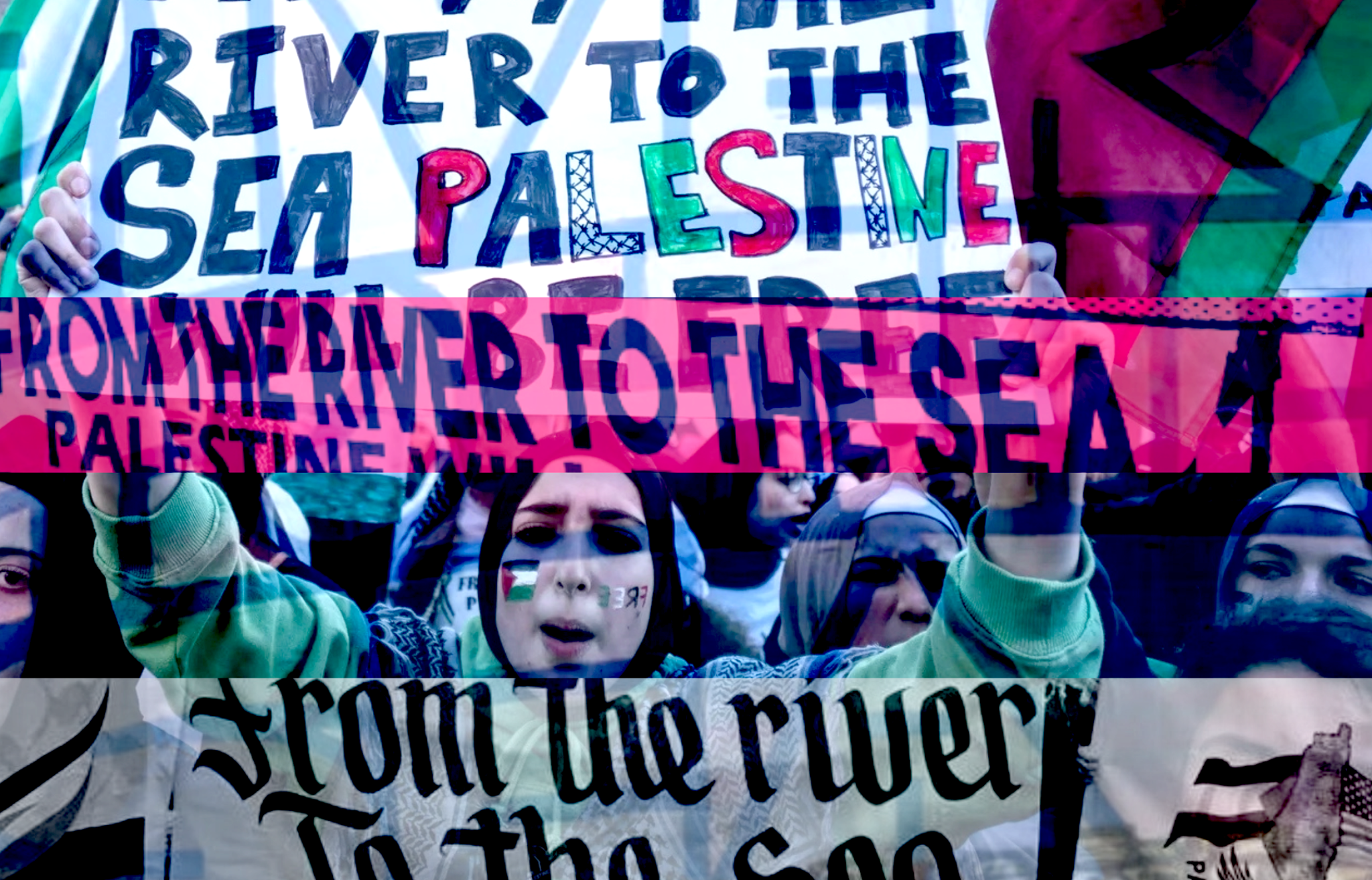
Collage by the author
Calls for the dismantling of Israel have become increasingly common. What was once confined to the ideological fringes is now chanted openly in the streets, printed on placards, repeated on campuses, amplified online, and spoken aloud by activists, academics, artists, musicians, and political commentators with an air of growing moral certainty.
“From the river to the sea, Palestine will be free.”
Like all slogans, it possesses a kind of emotional efficiency. It conveys grievance, aspiration, outrage, solidarity, resistance. But slogans, however emotionally satisfying, are not plans. And when slogans concern the dismantling of an existing nation-state, one populated by millions of human beings, they eventually require elaboration. I would suggest that time has come.
What exactly is being proposed here?
I ask this not rhetorically, nor as some partisan trick. For many years now, I have asked versions of this question to friends, acquaintances, activists, and anti-Zionist commentators whose views differ sharply from my own. What, specifically, do you propose? Not merely what you oppose. Not what you denounce. Not what fills you with anguish or anger. What do you propose should happen next?
Recently, after raising this question online, I received the following response from a woman I’ll call M. Her answer was not unusual. In fact, it reflected, in distilled form, a sentiment I have encountered repeatedly:
“Open the vote to all people living in lands occupied by Israel, elect a representative government, free the innocent, imprison the violent extremists, take down the illegal settlements…”
I do not believe M. is a monster. I suspect she is sincere. I suspect she is compassionate, horrified by bloodshed, and desirous of peace. Perhaps she believes deeply in universalism and sees herself as advocating for justice and equality. But sincerity, while admirable, does not relieve one of the burden of specificity, especially when proposing the dissolution or radical transformation of a state surrounded by enemies, saturated with historical trauma, armed to the teeth, and populated by millions of people who do not wish to die.
So I would ask M. a few follow-up questions, not to corner her, but because these questions matter. Where would this process begin? Who would oversee the transition? How would security be guaranteed for both Jews and Arabs during such a transformation? Who would command Israel’s military, intelligence infrastructure, cyber capabilities, air force, and nuclear ambiguity during this process? What mechanisms would prevent immediate civil war? Who would disarm Hamas, Islamic Jihad, or the various Iranian proxies that openly call for Israel’s destruction? Who would protect Israeli civilians if violence erupted on a massive scale — as history strongly suggests it might? Who would oversee the courts, banks, borders, infrastructure, energy systems, ports, airports, hospitals, and telecommunications networks? Would Jews remain a protected minority in this new arrangement? By whom? Under what constitution? Under what guarantees? Enforced by whom?
And perhaps most importantly: what historical precedent gives confidence that such an undertaking would result in peace rather than catastrophe?
These are not minor details. They are the details.
And this, I think, is where many of these conversations begin to dissolve into a kind of moribund and dangerous vagueness. Because it is one thing to call a nation immoral. It is another thing entirely to dismantle one, especially when that nation is populated by over seven million Jews, many descended from refugees expelled from Arab lands, Holocaust survivors, victims of Soviet persecution, or generations of statelessness and vulnerability that culminated, not accidentally, in the creation of Israel itself: a repatriation of the Jewish people to their ancestral homeland, and a reuniting with Jews who had lived continuously in that land for thousands of years.
One begins to sense that many people chanting for liberation have never truly imagined the transitional period between the slogan and the supposed utopia beyond it. Or worse still, that some have imagined it, and do not find the likely consequences for the seven million Jews living there particularly troubling.
These are not unreasonable questions. They are human questions.
I, too, want peace. Deeply. I pray for it every day. I pray for an end to bloodshed, for wisdom among leaders, for mercy, for some path forward that does not condemn another generation to hatred and burial. But wanting peace and engineering peace are not the same thing.
The modern world is filled with people eager to diagnose injustice. Fewer are willing to assume responsibility for what follows the collapse of existing systems. History, unfortunately, contains no shortage of revolutions whose promised liberation ended in sectarian violence, authoritarianism, ethnic cleansing, or mass death. Human beings are not rearranged as easily as slogans.
And perhaps that is the deeper issue here. I increasingly suspect that many who call for the disappearance of Israel understand what such a thing would likely entail. Which is why discussions often remain suspended in the realm of poetry, morality, symbolism, and chant. Because specificity introduces accountability. Once actual mechanisms are discussed — armies, borders, militias, constitutions, policing, sectarianism, history, theology, revenge, bloodshed on the most horrific scale— the moral simplicity begins to evaporate.
This is why I continue asking the same question I have asked for decades now: what exactly do you propose?
If the destruction or dissolution of a nation is being advocated, then those advocating for it bear some responsibility for explaining what comes next. Human beings live there. Families live there. Children live there. Jews live there. Christians live there. Arabs live there. And slogans, however righteous they may sound when shouted in crowds, are not governing philosophies.
Last question: Are you seeking peace, or concealing a dagger inside an abstraction?
Related Topics
Related Posts