
Is AI Good for the Jews?
AI and the ‘Just Asking Questions’ Pipeline
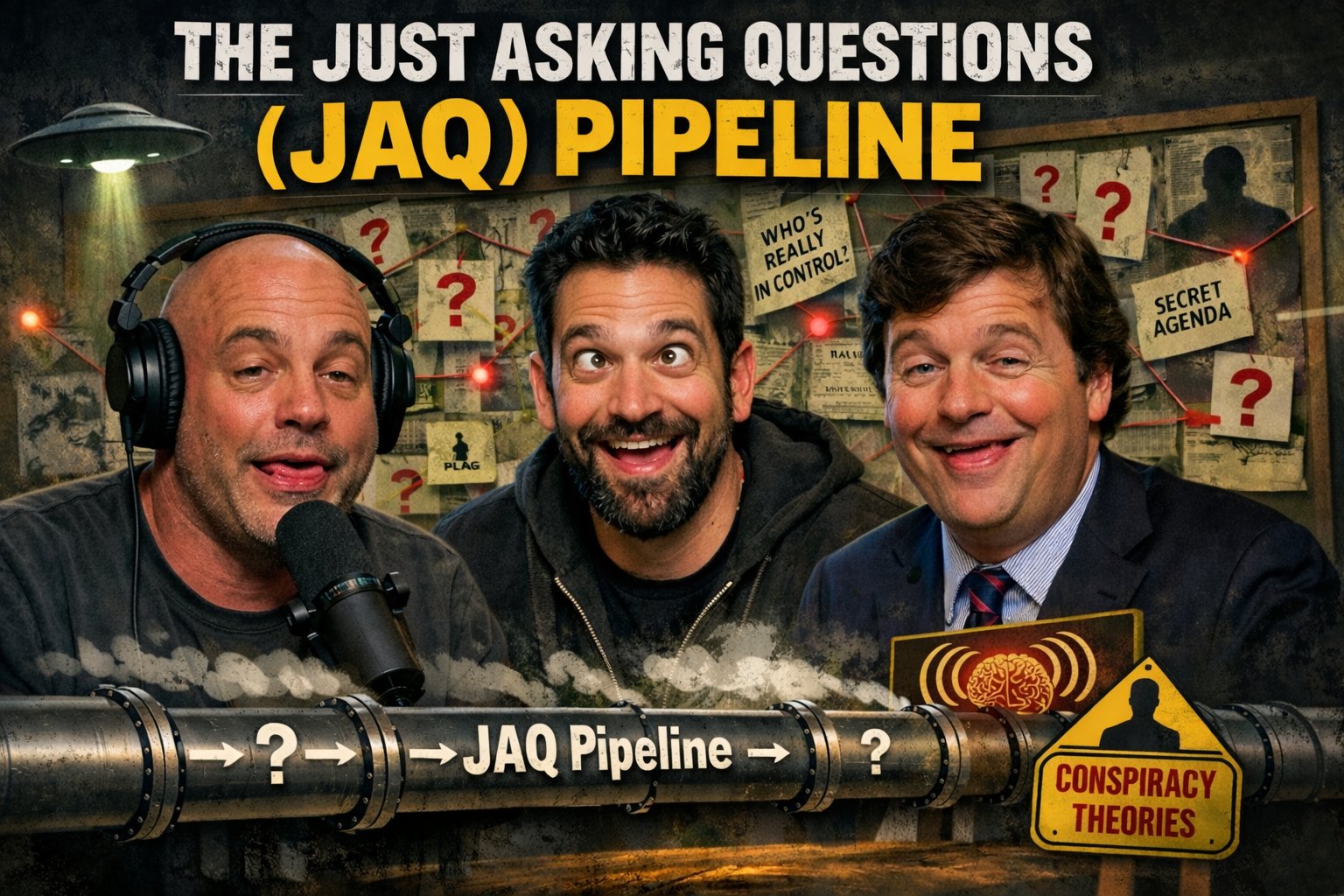
There’s a moment that shows up again and again in modern media in a quiet, almost polite manner. It sounds like someone clearing their throat before a serious conversation. Then they tell us that they’re not saying the outrageous topic they’re discussing is in any way true, they’re just asking questions. That sentence, my friends, is the tap on the shoulder that precedes the shove.
Because in the real world, especially in Jewish life, questions are not a gimmick. Questions are how you learn. They’re how you debate leshem shamayim (for the sake of heaven). They’re how you test an idea, pressure it, refine it, and discard it if it doesn’t hold.
But online and podcasts, Just Asking Questions (JAQ) has become a rhetorical technology. A way to smuggle suspicion into the room while keeping your fingerprints off the weapon. After October 7, when the internet’s moral compass completely inverted at high speed, the JAQ move became one of the most efficient delivery systems for the anti-Zionist narrative and classic antisemitism.
Behind the Just Asking Questions (JAQ) Commenter
Prominent practitioners of the JAQ style tend to share a set of recognizable habits and rhetorical moves, regardless of their delivery platform (i.e. podcast, YouTube, Reddit). They present themselves as independent thinkers or truth-seekers who are bravely questioning orthodoxy, often positioning curiosity as a moral virtue and certainty as a sign of corruption or naivety. Their style emphasizes skepticism without taking a position, so questions accumulate, but answers are perpetually deferred, allowing doubt to linger without ever being tested or closed.
They are highly selective about skepticism. Official statements, mainstream journalism, academic consensus, or firsthand testimony from victims are treated as inherently suspect, while anonymous sources, screenshots, alleged leaks, or fringe interpretations are granted outsized credibility. When challenged, they retreat to tone rather than substance, insisting they never claimed anything, only asked reasonable questions, while the cumulative effect of those questions has already guided the audience toward a specific conclusion.
Prominent JAQ practitioners are also adept at audience calibration. They repackage the same insinuation in different moral languages: civil liberties for libertarians, trauma discourse for wellness communities, anti-imperialism for activists, prophecy or persecution narratives for religious audiences. Across all of this runs a consistent pattern of plausible deniability, aesthetic seriousness, and rhetorical asymmetry, placing the burden of proof on reality itself while treating suspicion as self-justifying. The result is commentary that feels rigorous and open-minded, but functions primarily to erode trust, suspend moral judgment, and launder conclusions that would be harder to defend if stated plainly.
JAQ’s Advantages
The JAQ style has four built-in advantages: First, it avoids accountability. If challenged, the speaker can retreat having never actually said what is being insinuated. Second, it recruits the listener as co-author. People trust conclusions they think they discovered themselves. The audience becomes the engine. Third, it borrows the moral halo of inquiry. Curiosity is virtuous, while accusation is risky. JAQ lets them accuse while sounding like good citizens. Finally, it performs well. Questions generate comments, comments generate engagement., and engagement generates recommendations. The machine loves the rhetorical shrug.
So when a massive platform normalizes this cadence, when it trains millions of listeners that serious thinking is an endless posture of insinuation, what it’s really doing is creating an on-ramp to suspicion.
The Rogan Problem Isn’t That He’s Dumb, It’s That He’s Huge
Joe Rogan’s show is often described like it’s a bar conversation with microphones. That’s the brand: relaxed, curious, with an I’m just a guy talking vibe. And that’s a neat trick because scale isn’t a bar, scale is an institution.
When Rogan hosts someone like Dave Smith, who is very good at the libertarian art of sounding like he’s merely interrogating power, what the audience gets is not a seminar but a vibe. The atmosphere is enveloped in certainty that institutions lie, the mainstream has been captured, official narratives are suspect, and the courageous person is the one willing to entertain the forbidden explanation.
Dave Smith is useful to the pipeline precisely because he is not a foaming extremist. He makes radical suspicion feel like reasonable skepticism. He turns a worldview into a series of questions that always seem to lean in one direction.
Rogan and Smith’s post-October 7 conversation with Douglas Murray made this exact tension explicit. Murray’s argument was essentially that they don’t understand the informational responsibility that comes with the reach they have, and Rogan’s posture was simply we’re just guys talking, we’re just asking questions.
It is really quite a cowardice posture using plausible deniability at industrial scale. They flirt with an insinuation without marrying it, plays host to claims without endorsing them, float a suspicion and let the audience decide. Once Rogen realized that his audience loves deciding, he understood his format was algorithmically perfect.
Tucker Carlson: The Pipeline in its Most Naked Form
If Rogan is the bar conversation scaled up, Tucker Carlson is the stage magician. His signature move has always been to look into the camera and imply that he’s revealing what “they” don’t want “us” to know. And in 2025, he demonstrated what JAQ looks like when you remove the last scraps of restraint. His interview with Nick Fuentes, an antisemitic white nationalist, resulted in a backlash so severe that it triggered real institutional consequences, including a public rupture and staff resignations at the Heritage Foundation.
This is the end stage of the pipeline. Tucker does not need to say Jew as a slur. He simply platforms a worldview where Israel is a problem, Qatar is a haven, and Jews are somehow the explanatory glue that connects societal and global ills. Yet he maintains the posture of the innocent host. Hands clean, room dirty.
Post–Oct. 7: When Just Asking Questions Became a Weapon Against Grief
After October 7, a lot of people were looking for moral permission to relativize, aestheticize, and treat atrocity as “context,” and to transfigure dead Jews into an argument for why mourning dead Jews is propaganda. That’s where “just asking questions” (JAQ) became especially toxic, because it enabled a kind of rhetorical laundering that looks like skepticism but functions like absolution. “Do we even know what happened?” becomes a way to suspend moral judgment indefinitely; “Isn’t it weird that the media…?” becomes a way to prime distrust of any verification that contradicts your preferred narrative; and “Who benefits?” becomes a way to turn Jewish suffering into evidence of Jewish manipulation.
Why Jews are the Pipeline’s Easiest Ending
Antisemitism is a theory of the world, a reusable explanation for complexity, crisis, and humiliation. That’s why it shows up everywhere, the left and the right, secular and religious, highbrow and lowbrow. It’s a template of a hidden group, secret power, and covert control. Antisemitic rhetoric is presented as if it is revealing the wiring behind reality.
This template thrives in the JAQ ecosystem because JAQ does two critical jobs at once, it invites pattern recognition without the burden of proof, and it trains people to treat rebuttal as evidence of the cover-up. Once that happens, you get what you might call the conspiracy immune system, the worldview that cannot be corrected because correction itself becomes proof of the conspiracy.
The AI Accelerant: Infinite Suspicion Delivered on Demand
Combining AI and recommendation systems with a JAQ attitude combines a system that doesn’t ask whether something is true with a rhetorical style that thrives on implying lies and inaccuracies. AI boosts the JAQ pipeline by mass-producing research aesthetic like explainers and so-called neutral summaries, all polished, structured, and confident. AI further supercharges JAQ by manufacturing materials such as screenshots, memos, and voice notes that function as evidence. And because these tools can tailor output to the audience, they personalize the insinuation too, customizing the same underlying suspicion for libertarians, wellness moms, campus activists, and religious audiences alike.
This is why the post Oct. 7 environment felt so dizzying, the machine generated moral certainty faster than humans could generate moral seriousness. And the JAQ crowd welcomed entertaining the fabricated evidence as real.
How to Break the Spell Without Feeding the Machine
The trap with JAQ content is that it’s designed to win the engagement war and if you respond the “wrong” way, you become its fuel. So the strategy is not to debate harder but to disrupt the pipeline’s mechanics. There are three ways we can achieve this. First, we must force the claim out of hiding by asking directly what they actually believe and what, precisely, they’re insinuating. JAQ relies on fog and clarity restores standards. Second, we must ask what evidence would change their mind. A real inquiry will be able to answer that question, while pipeline content usually can’t. Demand provenance, not vibes, and reject screenshots and anonymous clips as reliable sources. Third, we need to avoid quote-posting and summarize instead. If you must respond publicly, don’t amplify the hook line or viral clip by posting it in its original form as this elevates it. It’s better to showcase what needs repudiation by naming the trope, explaining how it flipped or distorted the truth. Call out the hypocrisy, double standards, discrimination and misinformation.
The Uncomfortable Conclusion: JAQ Isn’t Free Inquiry When It Only Asks in One Direction
A society that can’t ask questions is brittle, but a society that replaces questions with insinuation becomes paranoid. After October 7, we saw how quickly paranoia can become moral inversion, uncertainty can become permission, and the performance of skepticism can turn into a conveyor belt that moves people from something feels off to someone must be behind it.
Curiosity is not the enemy. But curiosity that refuses standards, sources, falsifiability, and accountability, stops being curiosity and becomes a tool, a pipeline, and a business model. If we want to know whether someone is truly just asking questions we need only to listen for the telltale sign of real inquiry: the willingness to be corrected. Because the moment questions become immune to answers, they’re no longer engaged in thinking, they’re engaged in recruitment.
In the age of AI, that last test, the willingness to be corrected, matters even more, because the ecosystem is now engineered to reward questions that never resolve and to punish answers that try to land. Recommendation systems optimize for friction, novelty, and repeat engagement, while generative tools can produce infinite “research,” infinite insinuations, and infinite counterfeit evidence at near-zero cost, tailored to whatever audience needs to feel both outraged and innocent. That means the JAQ pipeline is no longer just a rhetorical habit, it’s now an industrial process, scalable, personalized, and self-feeding. In a world where machines can generate suspicion faster than humans can generate wisdom, our only real defense is to make truth more enriching than vibes and accountability more attractive than fog.
Related Topics
Related Posts