
AI Classrooms: Where Teachers and Technology Meet
My friend’s bright, curious daughter was struggling in school. Her nemesis was math. Labeled by her teachers as “distracted,” and poked fun by her classmates, calling her names like “stupid.” At home, she would cry anytime anyone brought up the subject. This otherwise well-adjusted child was traumatized by school. She just could not handle it.
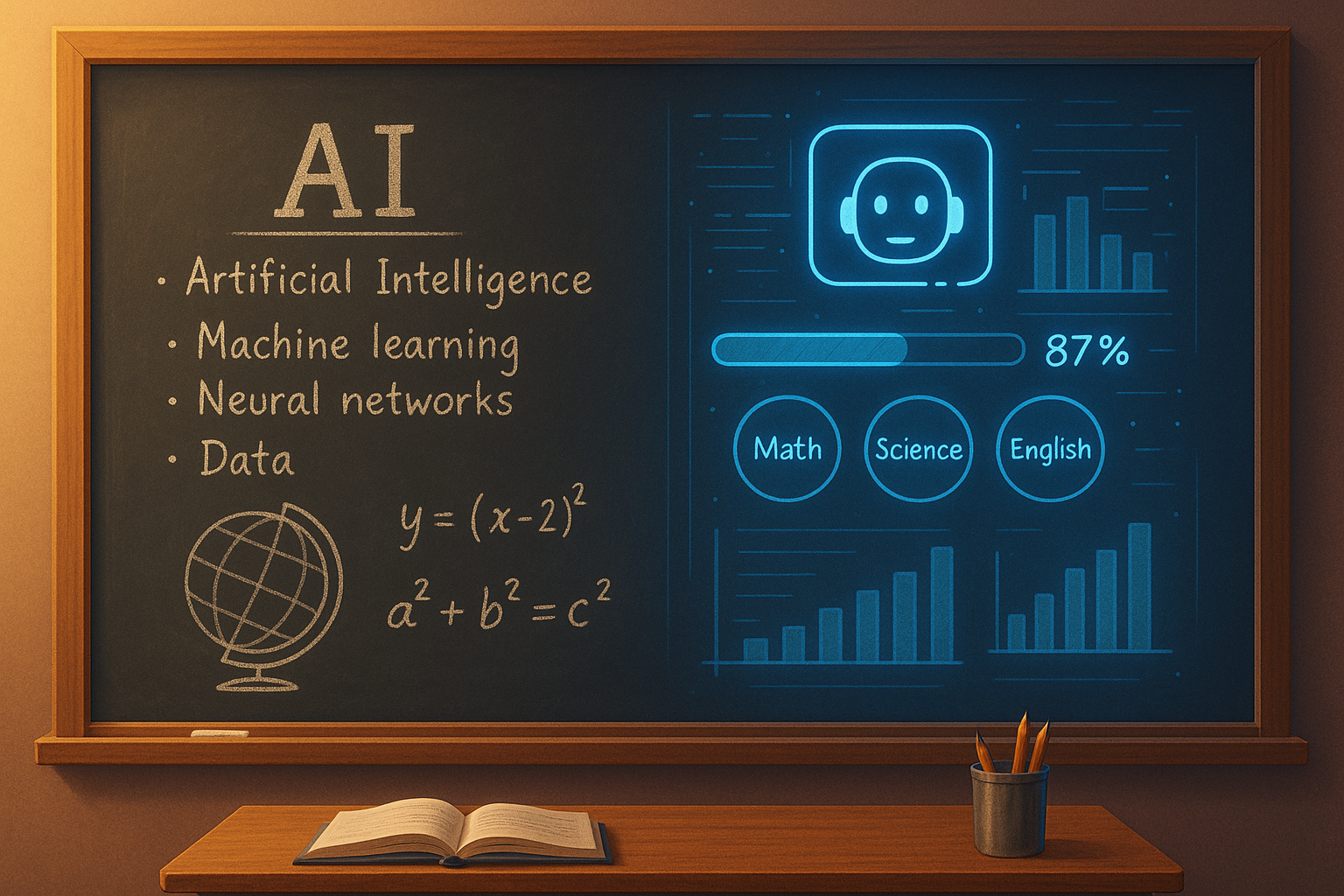
That was until a guidance counsellor suggested a new AI-based learning platform changed everything. For the first time, she was given the opportunity to learn at her own speed. The AI bot began to uncover patterns of her errors and provided her specially crafted lessons that were built for her. Bit by bit, everything began to fall into place, and more importantly, she felt really seen for her abilities and not just her failures. That alone was enough to give her the self-confidence that jump-started her journey towards success.
Reality of Classrooms Today
One of the biggest challenges we see in classrooms across the globe is overcrowding: 30-plus students are assigned to one teacher. What possible math can be applied to that equation to make it work? There is a saying, ‘It takes a village to raise a child.’ Why should our classrooms be any different?
For over a century, education has operated according to the assembly line mentality. Frontal-learning. Standardized tests. And no way to teach individually due to large classes. Students have one choice: conform to the system. We’ve known the model to be outdated for some time now, yet the bell-shaped grading curve just obscures the system’s shortcomings. However, with AI, there is now a glimmer of hope if we choose to embrace it.
Going Beyond the “Average Student”
As parents, we delight in the uniqueness of every child. One may be sporty, another brainy, and a third extremely creative. But in the classroom, we categorize kids into two groups: successes and failures. Suppose we didn’t group children by their test scores and allowed them to learn at their own pace? Slow children would not be known for being slow; everyone would work at their own speed. No human teacher can accomplish it for 30 children by him/her self, but AI can make it possible.
The Future of Personalized Learning
AI is new, not only in the classroom, but in our everyday life, so it is normal to be suspicious of it. Yet, studies show promising results. The research highlights significant discrepancies between the standard teaching and the actual learning requirements of the students. These discrepancies are not due to poor staff, but have more to do with the flawed system.
AI is not meant to replace teachers, no more than computers did. If used properly and embraced by educators, it can be positioned to support them by freeing them up from time-consuming work, such as reviewing and grading homework and tests, allowing them to spend more time where it will have the most benefit: being role models, counseling, and guiding students to achieve their true potential.
Just imagine a system that allows teachers to actually educate, that doesn’t mean drilling students on memorization of the multiplication tables. True education happens when we impart life lessons to our students. These are the pearls of wisdom they will use long after graduation and remember for a lifetime. Leave the teaching to AI-based platforms like DreamBox, Khanmigo, and Century Tech. That way, students receive individualized lessons, and teachers can help identify areas of talent and find their own ways of going.
A Second Story of Shared Hope
Recently, I had the privilege of visiting a trilingual school use AI to support language students. A 10-year-old boy named Amir had just begun to study English and had struggled for months. Utilizing AI-based reading software offering real-time translation as well as pronunciation help, slowly but surely, Amir began to read and proceeded to go through a complete book in the language all by himself. To Amir, this was something more than a technical accomplishment; it was a personal victory.
These are the accomplishments that make the difference between success and failure. Grades don’t do this; actual performance is the key.
Access and Equity for All
It is in performance-based learning that we see the biggest gap between the public school system and suburban school systems. The growing gap means vastly different opportunities for students, not by their abilities, but by the limitations set forth by their zip codes.
We see evidence-based research that indicates students from underfunded urban schools are three times as likely as other students to end up in minimum-wage jobs as opposed to students from suburbia and private schools, who are more likely to complete a Bachelor’s degree in a college or university, opening up a whole world of opportunity to them.
However, if the system provided both inner-city students and suburban students with the same access to AI educational programs, imagine what impact that would have on their choices. For the very first time, we might actually level the playing field.
Overcoming the Challenges
Of course, it’s not without challenges. Data protection, algorithm bias, and disproportionate use of technology must be addressed. But the potential of AI to personalize learning for every child cannot be underestimated or overlooked.
Planning for the Future
We’re teaching students for a future that demands flexibility, creativity, and critical thinking. Artificial intelligence can aid the development of classrooms that facilitate these capacities—classrooms that move beyond rote memorization and standardized testing.
The chalkboard did its work. It’s high time for technologies that appeal to the individual potential of every student, and a system that will enable every learner to thrive.