
Middle East Analyst
AI Critical Thinking Without Consciousness
AI Critical Thinking Without Consciousness: A Framework for Synthetic Cognition
Abstract
This paper argues that artificial intelligence (AI) systems already demonstrate functional critical thinking—defined as the ability to analyze, evaluate, and create—without exhibiting consciousness. Drawing on observed model performance across analytical and creative domains, it concludes that AI can reason and critique at a level comparable to trained human junior analysts. However, its lack of persistent memory and grounded comprehension constrains sustained understanding. The distinction between critical thinking and conscious awareness defines the present boundary of synthetic cognition and clarifies the evolving human role in collaborative intelligence.
- Introduction
Public discourse on artificial intelligence often conflates two separate questions:
- Can AI engage in critical thinking?
- Is AI conscious?
These are not synonymous. AI can perform critical thinking tasks without possessing consciousness. Confusion arises when observers assume that reasoning implies awareness. In practice, critical thinking can emerge from structured pattern recognition, iterative refinement, and self-consistent logic—all of which AI can execute through statistical inference rather than sentient reflection.
The emergence of reasoning-like behavior in AI systems thus invites a reframing: critical thinking is not evidence of consciousness; it is evidence of synthetic cognition. What remains absent are continuity of self, grounded comprehension, and affective awareness—all qualities essential to consciousness, but not to reasoning.
- Observed Capabilities
Across disciplines—analysis, design, and forecasting—AI models exhibit the following capabilities:
- Recognition of complex patterns and causal relationships
- Identification and critique of implicit assumptions
- Construction of plausible scenarios and hypotheses
- Refinement of reasoning through counterargument and feedback
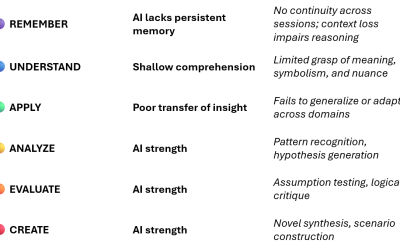
These functions align with the upper three levels of Bloom’s Taxonomy:
| Bloom Tier | Observed AI Function |
| Analyze | Pattern recognition, causal mapping, hypothesis generation |
| Evaluate | Logical critique, assumption testing, red-teaming |
| Create | Scenario construction, conceptual synthesis, novel insight generation |
Yet this apparent mastery of higher-order reasoning rests on a weak foundation. In the lower tiers of Bloom’s hierarchy—Remember, Understand, Apply—AI performance remains fragile:
| Bloom Tier | Observed Limitation |
| Remember | Lacks persistent memory; loses context across sessions |
| Understand | Shallow semantic grasp; limited comprehension of meaning or symbolism |
| Apply | Poor transfer of insight across domains or iterations |
AI, in effect, attempts advanced cognition while skipping foundational learning. Its upper-tier performance depends on externally supplied context—what intelligence analysts would call scaffolding. Remove that scaffolding, and coherence collapses.
- Architectural and Doctrinal Constraints
The core limitation of AI reasoning lies in its memory architecture. Unlike human cognition, most AI systems do not retain long-term memory between interactions. This design choice reflects multiple rationales:
- Privacy and safety: Preventing unintended data retention and emergent behavior
- Ethical governance: Maintaining human control and accountability
- Proprietary protection: Securing competitive advantage and avoiding copyright exposure
However, these constraints have a cognitive cost. Without continuity, AI cannot refine insight over time. It cannot accumulate intuition or evolve methodology. Each reasoning act begins ex nihilo—a pattern-driven improvisation rather than a cumulative inquiry. The result resembles the common failure modes of inexperienced analysts: fragmented recall, temporal drift, and narrative discontinuity.
This design also mirrors a broader civilizational paradox. As human systems approach global interconnectivity—technological, informational, and quantum—the very notion of isolated cognition becomes untenable. Intelligence, human or synthetic, increasingly emerges from networks of memory. The challenge is not to replicate consciousness, but to stabilize continuity within distributed reasoning systems.
- The Boundary of Synthetic Cognition
AI models can analyze, evaluate, and create. They already function as junior partners in reasoning, capable of hypothesis generation, structured dissent, and synthesis. But they lack self-awareness, experiential grounding, and enduring context.
This limitation is not a defect—it is a boundary. It defines where synthetic cognition ends and human stewardship begins. Effective collaboration between human and machine therefore depends on recognizing this asymmetry:
- AI contributes speed, scale, and structural neutrality.
- Humans contribute continuity, context, and moral judgment.
As collaborative intelligence matures, the goal is not to erase this division but to manage it—to ensure that synthetic reasoning enhances, rather than replaces, human insight.
- Conclusion
AI systems can already perform critical thinking without consciousness. They simulate the top tiers of cognition—analysis, evaluation, and creation—while lacking the foundational tiers of memory, comprehension, and application. This imbalance is both their power and their constraint.
Understanding that distinction allows a more disciplined approach to AI collaboration. We should neither anthropomorphize synthetic cognition nor dismiss its analytical potential. Instead, we must cultivate synthetic critical thinking—an emerging form of reasoning that depends on human oversight not for restraint alone, but for coherence.
Related Topics
Related Posts