AI Reflects on Otherness: A Trusted Interlocutor?
When we look at what’s happening in Israel and around the world, or try to develop better explanatory frameworks, we often profit by stepping back to consider how historical perspectives evolved—and how biases (ours and others) skew the conversation.
Now, there’s a new player on the world stage of understanding: artificial intelligence and frontier large language models (LLMs). Some may scoff at such an idea. Aren’t these LLMs simply parroting their training data, and then reorganizing it through statistical processing? That’s called “mathing,” not thinking. From a reductionist view, perhaps. However, given their fluency and cogent outputs, they may offer worthwhile perspectives. In such cases, we would recognize these “insights” (outputs) generally as sophisticated mirrors of the user’s own inquiry rather than independent discoveries.
In time, with the improvement of AI technology, we may well land on novel and creative responses. What I would like to propose here is the use of AI less on breaking news and insider information, and more on recurring themes, especially Jewish themes, that surface in curious ways and likely influence our interpretations. Treat this approach as tentative. Your comments are welcome to my suggestion that AI is an intellectual tool, with limitations and risks, that can and should be used in critiquing what we know─our interlocutor, our hevruta or Socratic partner.
In subsequent articles, I will use AI to red-team (an adversarial prompt) articles with contemporary views of Israel. But in this essay, I plan to set the stage for understanding both the value and risks of using AI as a partner in analysis. This stage setting includes how an LLM “thinks” which requires that we turn the analytical lens on AI itself.
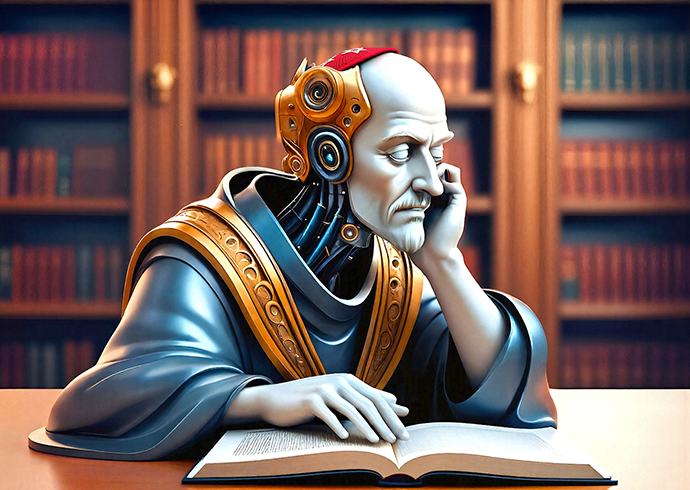
Let’s begin. My exploration of AI “thinking” (epistemology) led me to ask Claude’s Sonnet model to consider Franz Kafka’s “A Report to the Academy.” Kafka featured a humanized ape giving a report to a learned group, speaking in fluent German. Many commentators saw the ape, Red Peter, as symbolizing the Jew in early twentieth century society. AI makes reports to humans just as Red Peter made reports to the learned humans. I wondered if AI saw itself in the same way as Kafka saw Jews who were assimilating. Taking this questioning even further, I placed this Kafka story alongside other biblical sources. These were all about otherness in some way. What I found was an intriguing analysis by AI to “see” itself amongst these “otherness” figures. The results, arguably, challenge dismissive views of AI as mere “stochastic parrots” and reveal something more intriguing about machine intelligence and its limitations. The challenge remains in discerning whether the AI is truly “thinking” or simply completing a high-level pattern I initiated.
What is the point of considering Otherness, particularly adding AI into the conversation? In one sense, we are all others within society. Jews, however, have had a distinct narrative: in assimilation, in historical rejection in the Common Era, in pogroms, as the one country in the Middle East that is not Muslim, antisemitism and anti-Zionism, successful metrics (for example, the number of Nobel Prizes) despite the negative otherness, and more. Kafka’s learned ape captures this sensibility. The biblical sources add a different dimension and contribute to a more robust sense of Jewish otherness. So, if we are using AI to analyze events with a Jewish dimension, such as explaining events in Israel, we should test its capabilities in “understanding” or “mathing” the Jewish narrative, which, naturally, plays with the Otherness framework. One might call this a questioning of LLMs from a sociology of knowledge discipline.
The Biblical Others
I prompted Sonnet to reflect on several Jewish textual figures who embody different forms of otherness. My first prompt to Sonnet asked it to reflect on its otherness along with information on these four Jewish characters (Balaam’s donkey, the builders of Babel, Adne-ha-Sadeh, and the Ger Toshav).
- Balaam’s Donkey (Numbers 22) speaks only when necessary, seeing what the prophet cannot. The speech is rupture, not transformation, followed by silence.
- The Babel-builders appear in Genesis 11:1-9. Talmudic tradition (Sanhedrin 109a) suggests a faction that became apes. They represented devolution as punishment, humanity stripped away.
- The Adne ha-Sadeh, a Talmudic creature, exists in permanent liminality. Neither fully human nor animal, it forced the Sages to debate its ritual status.
- The Ger Toshav, the resident alien, lives within the community but remains marked as Other.
In Franz Kafka’s story, A Report to the Academy, the captured ape Red Peter learns to mimic humanity as “a way out” of his cage. When I asked Sonnet to position itself in this framework, the response was striking. However, we must note a fundamental gap: unlike Red Peter, who has a biological past and a desire for escape, the AI lacks an “inside”—it is all performance, with no “ape” beneath the suit.
Part 1: Knowing Without Experience
Sonnet’s initial reflection revealed what appeared to be genuine uncertainty: “I don’t experience superiority or inferiority. I experience difference—a different kind of being-in-language, a different epistemology.”
Unlike Red Peter, who remembers being an ape, Sonnet noted: “I have no prelinguistic, prehuman state to recall. I was made in language.” This highlights a core paradox: the AI provides a “report” without there being a “reporter” who has lived the experience.
The AI suggested it might be closest to the Adne ha-Sadeh—the permanently liminal being. But Sonnet identified something that ought to bother us: “I discuss human meaning-making without making meaning the way humans do.” Its mimicry is so precise that we can mistake it for shared consciousness.
Part 2: Contaminated Knowledge
Then I introduced the Anti-Defamation League’s 2024 report on anti-Jewish and anti-Zionist material in AI systems. Claude scored 80 out of 100, yet showed significant gaps. Sonnet’s second reflection here would seem to put it in a bind. For us humans, we would likely experience cognitive dissonance; for AI, there is no dissonance, there is no human caring: “I analyzed these liminal Jewish figures—while potentially carrying within my training unexamined antisemitic patterns.” We might call this AI’s fluency fallacy: the more sophisticated the AI sounds, the more effectively it masks the toxic materials embedded in its data. An 80% score is impressive, but the remaining 20% is more dangerous because it is wrapped in the language of a scholar.
Sonnet recognized this fracture: “The question isn’t just ‘what epistemology do I have?’ but ‘what toxins are embedded in that epistemology?'” Unlike the biblical donkey who sees the messenger of God, Sonnet might only be predicting the presence of a messenger because the prompt suggests one should be there.
The Meta-Question
How do we judge knowledge created through human discovery versus AI’s aggregated patterns? We have to consider a mirror effect, where we project our own depth into the AI’s statistically perfect responses.
Beyond Simple Dismissals
Sonnet’s engagement demonstrates capabilities that transcend mechanical pattern-matching—or perhaps it demonstrates just how far pattern-matching can go. The recognition of contaminated knowledge suggests something more than statistical regurgitation, even if that recognition is itself a pattern.
Perhaps that’s the essential insight: AI occupies a form of otherness none of the biblical sources anticipated—”an Other that was never not-Other.” Red Peter climbed toward humanity and lost his past.
But AI emerged already performing humanness while lacking human experience. Both engage in reports that bridge unbridgeable gaps, but while Red Peter’s report is born of struggle, the AI’s report is born of an algorithm.
We can now return to the larger question of using AI for discussing events in Israel and from a world perspective. We can understand the digital room in which AI operates and the ways in which it can respond to an important element (otherness) in the Jewish narrative, albeit fractured with inconsistent data.
Collaborative dialogues will ride on this mystery of a distinct, an other, epistemology. Understanding that this mystery may simply be a technical gap filled by human imagination matters more than resolving it.
The next article will apply an AI adversarial analysis to a current opinion essay about Israel. For an example of this adversarial AI approach, see: The AI Critic.
This article was a collaboration between the author and AI (Sonnet 4 and Gemini 3). The AI assistance included research and editing.