Is AI Good for the Jews?
AI & The New Blood Libel
Every era invents a new costume for an old accusation. In medieval Europe, one of the most lethal lies ever aimed at Jews was the blood libel, the claim that Jews kidnapped and murdered Christian children for ritual purposes. The charge was grotesque, irrational, false, and yet, in its own way, perfectly designed. It spread not because it made sense, but because it did something psychologically useful, it explained fear. It created a villain for grief and gave the crowd the feeling of moral certainty.
But the blood libel wasn’t just a lie. It was a particular kind of lie that arrived with proof. The accusation was rarely delivered as a casual rumor. It was offered as a discovery, a child’s body was supposedly found, a confession was said to have been obtained, and the story was purportedly confirmed. And once a community believed it had evidence, the moral brakes failed. Violence became justice, expulsion became protection, and panic became policy.
Now fast forward to the world we live in. The blood libel is not returning in its literal medieval form in most places. But its structure is returning with upgraded tools. We are entering an era in which synthetic media like AI generated images, audio, video, and documents can manufacture false proof overnight. And the most dangerous lies are not the loud ones, but the ones that arrive with receipts.
This is why synthetic media is not just a tech issue, it’s an antisemitism and antizionist issue, a civic trust issue, and a community security issue. The oldest hatred gains a modern advantage in a world where evidence can be fabricated faster than it can be verified, where it can stage reality on demand.
Why Blood Libels Worked
The blood libel didn’t persuade careful thinkers. It persuaded frightened people, people grieving, angry, primed by prejudice, and desperate for an explanation that fit their emotional state. And it offered an elegant package that included an innocent victim, a hidden, inhuman enemy, secret rituals and shadowy motives. It came with a demand for immediate action.
That template, innocence violated by a concealed cabal, is the backbone of modern conspiracy movements. Replace ritual murder with trafficking rings, poisoned wells, stolen organs, deliberate infections, false flags, or genocide hoaxes and you have the digital descendant of the blood libel. Sometimes Jews are named explicitly. Sometimes the language is coded with words like globalists, bankers, Zionists, or media elites. But the structure is the same, a moral panic searching for a scapegoat.
And then synthetic media decisively enters the story and makes the accusation visual. The public no longer needs to be convinced by argument. It can be coerced by images.
Synthetic Media Changes the Game
In the pre-AI era, the disinformation bottleneck was production cost. Creating believable false evidence required skills like Photoshop, video editing, staging, and voice acting, The production time and cost didn’t stop propaganda, but it did limit the volume of false proof that could be manufactured. AI shrinks that bottleneck to almost nothing.
A sole motivated actor can now generate a breaking video clip with a fabricated anchor voice, a video of a community leader making a statement they never said, a staged document leak formatted like a real government memo, a photo of an event that never occurred, an audio confession in a realistic voice, or a chain of screenshots of texts or emails that never existed. These can then be tailored for different audiences and translated into multiple languages. The cost approaches zero and the speed approaches instant.
The result is a new phenomenon, evidence inflation. In an information war, whoever can generate so-called proof fastest shapes perception first, and first impressions, especially those formed through images, are remarkably hard to undo.
The Modern Blood Libel Is About Moral Disgust
What makes blood libels uniquely dangerous is that they don’t argue that Jews are wrong. They argue that Jews are monstrous. That framing collapses nuance and transforms disagreement into disgust. And disgust is a short road to violence.
Synthetic media is perfectly suited to weaponize disgust because it is visceral and shareable. A fabricated clip can be engineered to trigger the viewer’s most primal reactions before the rational mind has time to ask questions.
In practice, blood libel content in the AI era tends to show up in recognizable forms like atrocity fabrication (fake footage of violence attributed to Jews, Israelis, or Jewish institutions), false confession (a deepfaked leader admitting to a plot, cover-up, or crime), staged victimhood (images designed to portray Jews as perpetrators of uniquely sadistic harm), decontextualized truth (real footage relabeled as something else to produce maximum outrage), and ritualized evidence dumps (montages of names, symbols, screenshots, and insinuations presented as investigative proof). Notice the common move: the audience is pushed from I heard something to I saw it. That shift is everything, heard invites doubt, saw feels like knowledge.
The Trust Collapse Problem
There is a second order danger that’s even more corrosive than gullibility. When synthetic media becomes common, society faces a double crisis as people believe things that never happened and people dismiss things that did happen.
This is the everything is fake era, the liar’s dividend, and conspiracy thinking thrives in it. When nothing can be verified, the most emotionally satisfying narrative wins by default. People retreat into tribal trust, the environment in which scapegoating becomes effortless.
For Jews, this is a historical nightmare in modern form. Antisemitism has often depended on a public primed to accept accusations quickly and accept corrections slowly. Synthetic media makes corrections slower still. Even when a fake is debunked, it remains psychologically sticky because the image already did its work.
The New Protocols: Documentation as Theater
The Protocols of the Elders of Zion taught the world the ugly lesson that propaganda is more persuasive when it looks like administration with minutes, plans, memos, and lists. It’s not the rant that convinces, it’s the spreadsheet.
Synthetic media updates that lesson. Now propaganda can arrive wearing the aesthetics of institutional credibility on official letterheads and legal documents. It can come disguised as a school announcement, police alert, leaked email, or NGO report. AI can generate the costume of bureaucracy in seconds. This is why the modern blood libel often arrives not as a scream, but as a so-called confidential leak. And when Jews are targeted, the leak format is especially dangerous because antisemitism so often frames itself as revealing confidential information or breaking a Jewish wall of secrecy. The fake document becomes emotional proof that the conspiracy is real.
The Viral Pipeline: How Synthetic Proof Becomes Social Permission
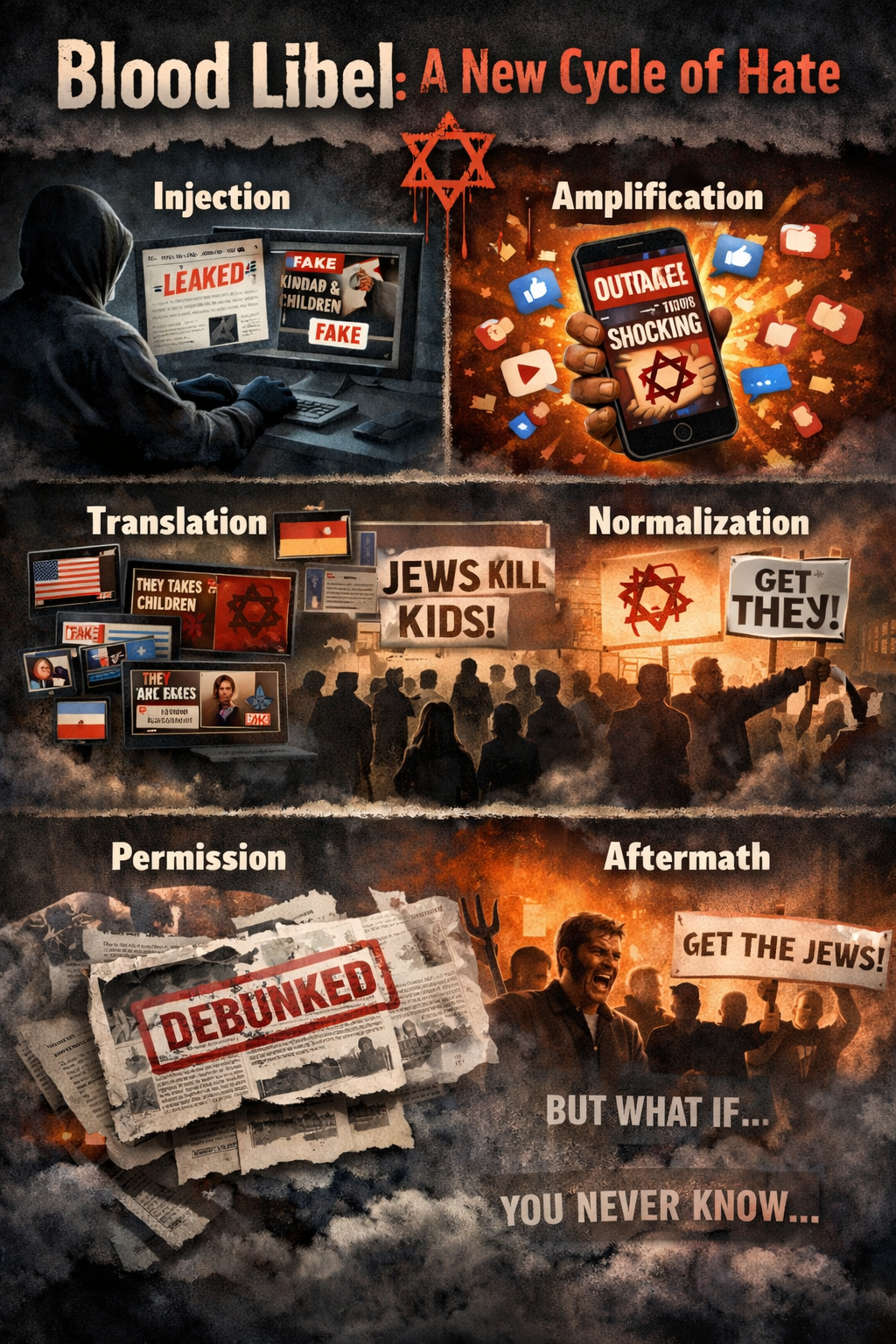
These incidents tend to follow a predictable arc. It begins with injection, a fabricated clip, screenshot, or “leaked” document gets planted in some small, low visibility corner of the internet. It doesn’t need to look perfect, just convincing enough to spark doubt and curiosity in the first few people who see it. This leads to amplification as outrage accounts and opportunistic influencers then grab it and push it hard because it performs. Whether they believe it is almost irrelevant. The incentive is clicks, shares, and engagement, and misinformation is engineered to win that game. Next is translation, as it travels, jumping languages, platforms, and subcultures. New captions appear, context is swapped in, and the same core lie gets dressed up to fit different audiences and local grievances. Normalization occurs when repetition does what facts often can’t, make the claim feel familiar. And once something feels familiar, it starts to feel plausible. That plausibility enables permission, or a moral license to harass, threaten, and exclude. In the aftermath the efforts to debunk the lies arrives late and travels poorly. Even when it lands, the lie rarely dies. At best it is downgraded ito a lingering question or a permanent suspicion.
This is why synthetic media is not merely misinformation. It can become permission technology, a tool that grants moral license to treat people as less human. And that is exactly what blood libels have always done.
A Final Warning and a Final Hope
The blood libel wasn’t merely a medieval superstition, it was a demonstration of how quickly a society can be trained into cruelty once it believes it has evidence. The AI era risks repeating that demonstration at scale, with false proof manufactured at the speed of computation.
But history also teaches something else, that lies thrive when communities are isolated and panicked. They struggle when communities build resilience, shared verification habits, trusted institutions, and moral discipline around speech.
Synthetic media isn’t going away. The question is whether we will adapt our norms to reality. Will we treat truth as a communal responsibility? Will we build friction into virality? Will we insist that our tools serve dignity rather than dehumanization?
The old blood libel relied on rumor dressed as evidence. The new blood libel, that Israel has committed genocide in Gaza, can generate evidence from rumor. If we want the future to be different from the past, we have to do more than condemn the lie. We have to change the conditions that make it spread, including speed without verification, outrage without accountability, and proof without provenance. Because in the end, the most important defense against manufactured evidence is not a better algorithm, it’s a better culture, one that refuses to let panic become policy, and refuses to let the oldest hatred find a new megaphone.
Related Topics
Related Posts