


Middle East Forum Fellow/North Africa Risk Consultant
Algeria’s Russia Deal: How US Sanctions Can Halt a New Mediterranean Rogue State
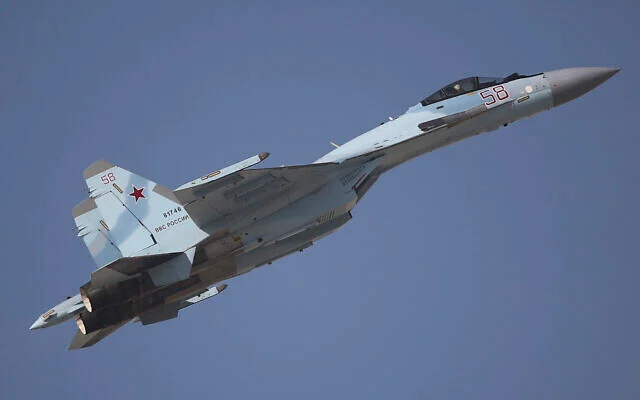
A Russian Sukhoi SU-35 performs during the Dubai Air Show, United Arab Emirates, Monday, Nov. 13, 2017. (AP Photo/Kamran Jebreili)
The expiration of the New Strategic Arms Reduction Treaty (New START) has officially ended fifty years of binding limits on the world’s nuclear superpowers. But while the world’s eyes are fixed on the silos of the Great Powers, a more immediate and destabilizing threat has landed on NATO’s Southern Flank. The arrival of the first Russian-made Su-57E “Felon” stealth fighters in Algeria marks the culmination of the “Sukhoi Gambit”—a strategic pivot by the Algerian military regime that threatens to turn the Mediterranean into a lawless corridor for the world’s most dangerous tyrannies.
For Washington, the time for diplomatic ambiguity is over. As Robert Palladino, head of the State Department’s Bureau of Near Eastern Affairs, testified before the Senate this week, Algeria’s defiance has crossed a red line. The United States must now decide whether to enforce the Countering America’s Adversaries Through Sanctions Act (CAATSA) or allow a critical maritime frontier to be annexed by the Russia-Iran-China axis.
The “Felon” in the Maghreb
The delivery of the Su-57E makes Algeria the first foreign customer for Russia’s premier fifth-generation fighter. Designed to contest Western air dominance through reduced observability and advanced sensor fusion, the Su-57 is more than a plane; it is a geopolitical statement. For Rostec, the sanctioned Russian defense conglomerate, the Algerian deal is a financial lifeline, a “loss-leader” designed to keep its assembly lines running despite the attrition of the war in Ukraine.
But the hardware is only the tip of the iceberg. Reports indicate these aircraft are being equipped with the L-265VE “Khibiny-U” electronic warfare system and are potentially being prepared as platforms for the Zircon hypersonic missile. If operationalized, Algiers would possess the capability to strike carrier groups and European infrastructure at Mach 8, rendering current Mediterranean defenses obsolete.
The Proliferation Ratline: From Algiers to Pyongyang
The true depth of Algeria’s alignment with rogue actors was exposed with the investigation into the Ursa Major. This Russian “ghost ship,” operated by the sanctioned firm Oboronlogistika, sank off the coast between Spain and Algeria. While its manifest claimed it carried harmless construction cranes, intelligence dossiers declassified in Madrid revealed a darker cargo: VM-4SG nuclear reactor casings destined for North Korea’s submarine-launched ballistic missile program.
The Ursa Major did not sink in a vacuum. For a decade, Algiers has permitted Russian “shadow fleets” to turn off their transponders and find safe harbor in its ports, such as Mers el-Kebir. By providing the “radar shadow” necessary for these vessels to operate, Algeria has become a willfully blind accomplice in a global proliferation ratline connecting Moscow, Tehran, and Pyongyang.
A Regime Built on Paranoia
While Algeria spends a record $25 billion on its military—nearly 21% of its total budget—its domestic reality is one of terminal decay. With youth unemployment hovering at 30% and a $40 billion deficit, “Le Pouvoir”—the shadowy military-political elite—is using advanced weaponry to insulate itself from its own people.
The upcoming June 2026 parliamentary elections are a carefully engineered piece of political theater. A sweeping new “Parties Law” has effectively criminalized opposition by mandating that any party failing to participate in these rigged polls faces “legal extinction”. Under the de facto guardianship of Army Chief of Staff Saïd Chengriha and presidential director Boualem Boualem, Algeria has transformed into a surveillance state where dissent is treated as treason and the media is placed under a permanent “state of war” logic.
This internal repression is justified by a manufactured rivalry with Morocco. To the Algerian junta, Morocco’s success is an existential threat. Rabat’s bold strategic alignment with the United States and Israel—anchored by the Abraham Accords—has created a “Viper Shield” that Algiers cannot penetrate.
The “Polisario-Iran Nexus”
Perhaps most alarming for American interests is the growing evidence of a “Polisario-Iran nexus”. US Senator Ted Cruz and other lawmakers have warned that Tehran is attempting to transform the Algeria-backed Polisario Front into a North African version of the Houthis. Intelligence documents suggest that Polisario agents have received Iranian drones and training from the IRGC in Syria.
By nurturing this separatist movement, Algiers is not just harassing Morocco; it is inviting the world’s leading state sponsor of terrorism into NATO’s backyard. This collaboration has prompted calls in Washington for the formal designation of the Polisario Front as a Foreign Terrorist Organization (FTO).
Washington’s Move: Enforce CAATSA
The “Sukhoi Gambit” is a test of American resolve. For too long, Algiers has operated under the assumption that its energy exports to Europe would grant it a “get out of jail free” card. But Algeria is not India; it does not possess the strategic indispensability that justifies a CAATSA waiver.
Enforcing sanctions would send a clear message: procurement decisions are geopolitical alignment choices.CAATSA measures could freeze the assets of the military junta, block access to the dollar-denominated financial system, and isolate Sonatrach, the state-owned oil giant already reeling from billion-dollar arbitration losses and corruption scandals.
If the United States fails to act, it will signal that the Mediterranean is open for business to the “Axis of Tyrannies”. The sinking of the Ursa Major was a warning shot from the deep. The next shipment of nuclear components or hypersonic missiles may not sink.