
‘All or Nothing’ Has Delivered Nothing
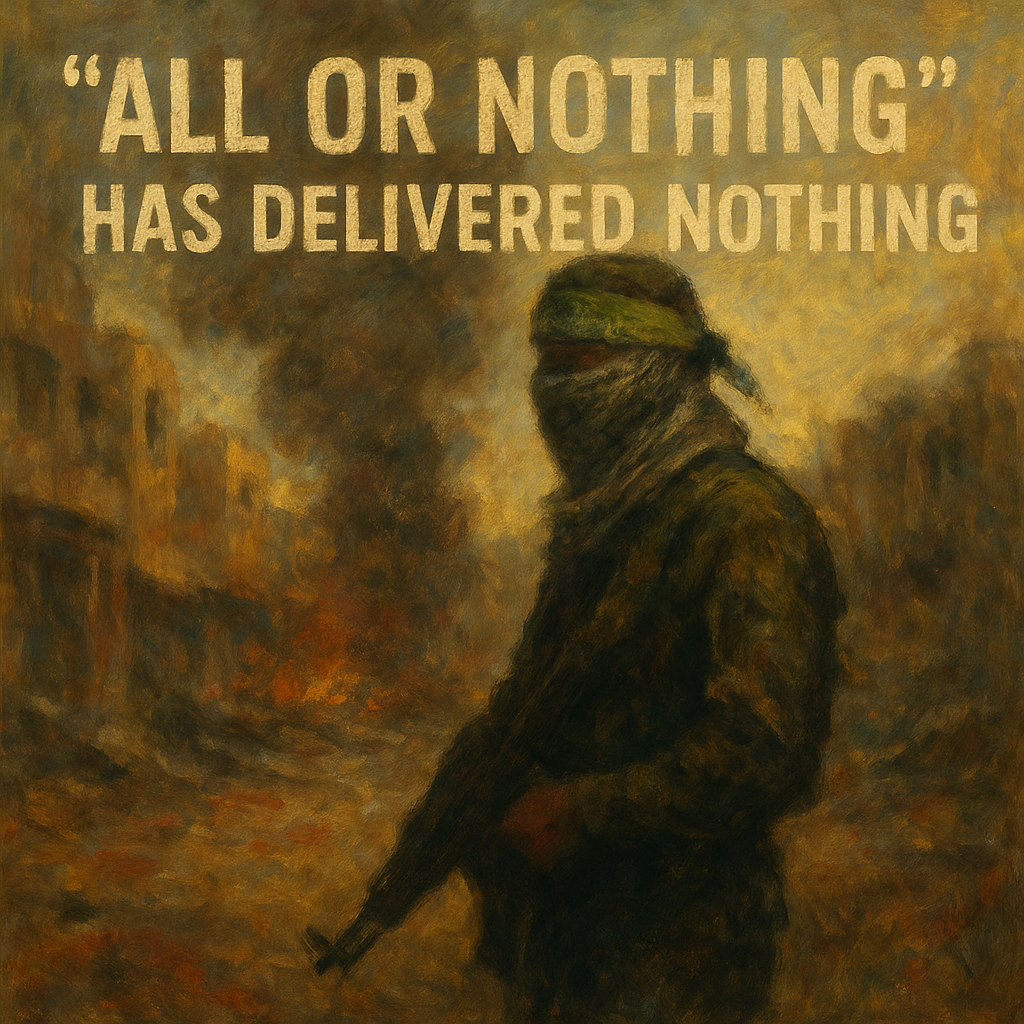
How exclusivist leadership, armed struggle, and outside patrons left Palestinians without a state
If you set an entire people on an “all or nothing” path, do not be surprised when they end up with nothing.
For a century, key Palestinian leaders and factions have insisted that all of “Palestine” must be theirs—no partition, no permanent recognition of a Jewish state, no compromise that feels less than total victory. Layer onto that a strategic preference for resistance over state-building, and you get a grim ledger: missed openings, internal splits, and weak institutions.
Regional patrons—from Tehran to Damascus—amplified the hardest lines and punished moderation. The result is visible to everyone: still no peaceful, thriving Palestinian state.
The pattern
- 1917–1948 | Mandate era. Arab leadership rejects partition (Peel 1937; UN 181 in 1947). War follows; Israel survives and expands; Palestinians end up stateless and dispersed.
- 1964–1988 | PLO rise. The charter claims all of Mandatory Palestine and rejects Israel. Armed struggle dominates. After costly setbacks, the PLO pivots in 1988 toward a two-state formula.
- 1993–2000 | Oslo & the PA. Mutual recognition; the PA is created to self-govern parts of the West Bank and Gaza. Final-status talks stall.
- 2000–2007 | Breakdown & split. The Second Intifada devastates both peoples. Hamas wins 2006 elections; the 2007 Gaza takeover splits Palestinian politics.
- 2007–present | Dual rule. Hamas governs Gaza; the PA governs parts of the West Bank. Reconciliation fails; Gaza wars recur; governance erodes. Iran and Syria back rejectionist lines and deepen factionalism.
Core thesis: A persistent exclusivist claim—“all the land is ours, permanently”—made compromise politically toxic, turning difficult-but-real statehood opportunities into all-or-nothing showdowns. The outcome has been no state, internal division, and fragile institutions.
The first fork in the road (Mandate to 1948)
Leadership centered on Haj Amin al-Husseini opposed partition as principle and strategy. Rejecting UN partition in 1947 aimed to prevent a Jewish state; instead, war followed and Palestinians lost both territory and the chance at immediate statehood. Early absolutism established a pattern: maximal aim, maximal risk—and a catastrophic downside when the war was lost.
The PLO’s long arc: from total liberation to painful pragmatism
The 1968 PLO charter denied Israel’s legitimacy and announced “total liberation” as the goal. Armed struggle kept the cause visible, but it also pulled Palestinians into disastrous fights—Black September in Jordan, the Lebanon war, the PLO’s expulsion. By the late 1980s, amid the First Intifada and geopolitical shifts, the PLO accepted the idea of partition and opened the door to Oslo.
Takeaway: Two decades of maximalism built identity and solidarity—but delayed the pivot to statecraft and diplomacy.
Hamas: Islamist rejectionism and the Gaza split
Founded in 1987, Hamas framed the conflict in religious terms and rejected permanent coexistence with Israel. Suicide bombings in the 1990s undercut Oslo and strengthened Israeli hard-liners. After winning the 2006 legislative election, Hamas seized Gaza in 2007, leaving Palestinians with dual governments (Hamas in Gaza, PA in the West Bank), recurrent wars, blockade, and deepening economic misery.
Some leaders have hinted at accepting a state on 1967 lines as an interim step, but formal recognition of Israel and a renunciation of the exclusivist end-state have never arrived.
Takeaway: Hamas has prioritized resistance over governance, feeding cycles of conflict that crush economic prospects and public trust.
The PA: state-building promise, stagnation in practice
Oslo created the Palestinian Authority to prepare for statehood. Early institution-building never matured into accountable, effective governance. Elections stalled; leadership centralized; corruption and public cynicism grew. Security coordination preserved calm in places but deepened perceptions of dependence. Negotiating positions (e.g., an expansive “right of return”) remained politically maximal even as administration at home lagged.
Takeaway: Without democratic renewal and service-first governance, the PA has struggled to look like the nucleus of a state.
Iran and Syria: external amplifiers of hard lines
Iran funds and arms rejectionist factions (Hamas, Palestinian Islamic Jihad), sustaining military capacity and incentivizing maximalist strategies that serve Iran’s regional contest with Israel and the West. Syria long “kept the Palestinian card,” hosting and backing factions opposed to Oslo to secure leverage—magnifying factionalism and punishing moderation.
Takeaway: Patronage rewarded intransigence over compromise, making unity and statecraft harder.
How exclusivity undercut a thriving state
- Missed openings. 1947 partition, autonomy frameworks, late-1990s/2000s final-status offers—none delivered full justice, but each could have produced a state. Rejection (or collapse amid violence) left Palestinians with less leverage and fewer options.
- Resistance over institutions. Investment flowed to armed wings, not courts, schools, and jobs. Where self-rule existed, governance disappointed.
- Fatal factionalism. The Hamas–Fatah split means no single negotiating partner and no unified chain of command for peace. Two mini-polities cannot promise stability.
- Public fatigue and legitimacy loss. Recurrent war, weak services, and cancelled elections hollowed out trust. Without legitimacy, leaders struggle to make—or keep—hard compromises.
Why rejection keeps winning the short-term contests
Three interlocking ecosystems tilt the field:
- Muslim Brotherhood/Qutbist Islamism (the wellspring of Hamas);
- Iran’s Khomeinist “Axis of Resistance” (IRGC/Quds Force, powering PIJ and much of Hamas’s military capacity);
- Transnational Salafi-jihadist micro-factions in Gaza that police the right flank.
Together they supply idea-ware (ideology), hardware (money, training, weapons), and stagecraft (sanctuary and prestige). That mix makes maximalism look heroic and compromise look like betrayal. It also starves bureaucrats, judges, engineers, and teachers—the people who actually build states—of legitimacy and resources.
Cast (briefly):
- Hamas (Brotherhood-rooted). Nationalist-Islamist; no formal recognition of Israel; political shelter from Qatar/Turkey; growing military overlap with Iran.
- Palestinian Islamic Jihad (PIJ). Sunni, Iran-aligned; armed-struggle-only; heavily enabled by IRGC-QF.
- IRGC/Quds Force (Iran). Regional organizer, financier, trainer for the “resistance” axis.
- Salafi-jihadi Gaza micro-groups. Small but ideologically potent; pressure Hamas from the right; sometimes clash with it when pushing emirate-style rule.
- Syrian state (historically). Hosted and leveraged Palestinian factions to retain regional veto power.
- PA/Fatah (contrast). Secular-nationalist pole; internationally recognized interlocutor; legitimacy weakened by stalled reform and elections but indispensable to any non-violent track.
What would actually change the trajectory
One platform, two polities. Reconcile Hamas and Fatah around a single program: non-violence, elections, rule of law, and a negotiated two-state end-state.
Governance first. Fight corruption; deliver daily wins—permits, electricity, water, jobs. Make the governing authority visibly useful so citizens see dividends from moderation.
Doctrine shift. Replace exclusivist slogans with pragmatic statehood language—workable borders, security arrangements, and refugee solutions that can be implemented.
Patron re-alignment. Trade external support that demands rejectionism for support that rewards institution-building and compromise. Choke IRGC/Quds Force lifelines; condition political havens (Qatar/Turkey) on verifiable behavioral shifts.
Narrative work. Teach a civic story that prizes citizenship, pluralism, and prosperity alongside historical memory. End the fetishization of “resistance theater.”
A realistic, phased political horizon. Pair pressure with staged gains—movement/economic corridors, measurable administrative powers, benchmarks toward sovereignty—so moderates can show results.
Anticipating objections
“Occupation policies drive rejection.”
Occupation undeniably fuels grievance. But even where Palestinian leaders did have agency—finances, curricula, policing, governance—hardline ecosystems repeatedly reinvested legitimacy in resistance over institution-building.
“Hamas isn’t ISIS.”
Correct, and Hamas has at times repressed ISIS-style cells. Yet its Brotherhood-rooted doctrine and armed praxis still sustain exclusivism and crowd out coexistence politics.
“The PA is weak and corrupt.”
Also true—which is why conditioning aid on reform and delivering daily service wins is central. A credible governance pole is the only sustainable alternative to armed prestige.
Bottom line
Peaceful coexistence becomes imaginable only when the expected returns from non-violent state-building exceed the returns from perpetual “resistance.”
Today, the balance is inverted by three ecosystems—Brotherhood-derived Hamas ideology, IRGC-powered militarization (especially PIJ), and a fringe Salafi-jihadi pressure bloc—amplified by external patrons and political havens. Diminish their leverage, rebuild legitimate governance, contain spoilers, and pair pressure with phased political gains—and Palestinian politics can once again afford to choose coexistence.