


Alliance Built on Illusion: Turkey, Saudi Arabia, Pakistan, and Regional Failure
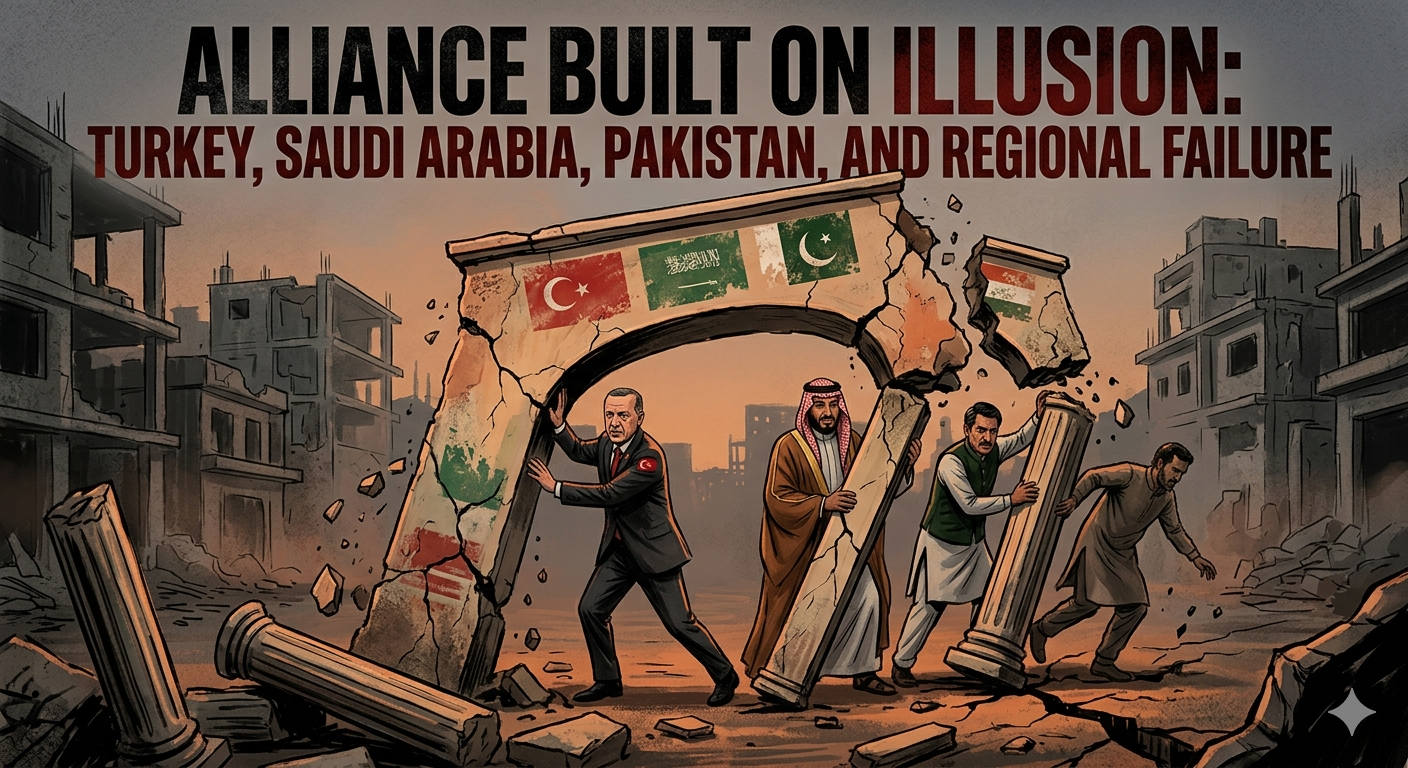
In modern geopolitics, alliances are often presented as symbols of unity, strength, and shared strategic vision. Yet, behind official statements and political rhetoric, many partnerships struggle with contradictions, competing interests, and unrealistic ambitions. The relationship between Turkey, Saudi Arabia, and Pakistan represents one of the most debated examples of this phenomenon in the contemporary Muslim world.
For years, these states attempted to project an image of collective influence across the Middle East, South Asia, and the wider Islamic world. Political leaders spoke about economic cooperation, military coordination, Islamic solidarity, and regional leadership. International observers frequently described these countries as emerging powers capable of reshaping regional politics. However, the reality on the ground has often been far more complicated.
Turkey sought to position itself as a dominant regional actor through assertive diplomacy, ideological influence, and military engagement in multiple conflicts. Under its ambitious foreign policy approach, Ankara attempted to expand its role from the Eastern Mediterranean to the Horn of Africa and Central Asia. While this strategy initially attracted attention and support, it also created tensions with neighboring countries and exposed Turkey to increasing diplomatic isolation.
Saudi Arabia, on the other hand, pursued its own vision of regional leadership based on economic influence, religious significance, and security partnerships with major global powers. Despite possessing enormous financial resources, Riyadh has faced criticism over its handling of regional crises, particularly in Yemen and other conflict zones. The gap between political ambitions and practical outcomes has weakened confidence in Saudi Arabia’s ability to lead a stable regional order.
Pakistan’s role within this informal alignment has been equally complex. Islamabad often attempted to balance its strategic relationships between Gulf countries, Turkey, China, and Western partners. While Pakistan publicly supported Muslim unity and strategic cooperation, domestic economic instability and political uncertainty limited its capacity to act as a decisive regional power. In many cases, Pakistan found itself navigating between competing alliances rather than shaping them.
One of the central weaknesses of this trilateral relationship has been the absence of a truly unified long-term strategy. Although the three countries occasionally shared common political narratives, their national interests frequently diverged. Turkey emphasized ideological and geopolitical expansion, Saudi Arabia prioritized regime security and economic modernization, while Pakistan remained focused on security concerns and economic survival.
The alliance also struggled to deliver meaningful regional solutions. In conflicts across the Middle East and parts of the Islamic world, political declarations often exceeded practical achievements. Public diplomacy created expectations of unity and transformation, yet many crises deepened rather than improved. This disconnect between rhetoric and reality gradually undermined the credibility of the partnership.
Furthermore, global geopolitical shifts exposed the vulnerabilities of such alliances. The rise of multipolar competition, changing energy politics, and evolving international partnerships forced each country to reconsider its strategic priorities. Instead of acting as a cohesive bloc, Turkey, Saudi Arabia, and Pakistan increasingly pursued separate and sometimes conflicting agendas.
Critics argue that the alliance became more symbolic than functional, driven by political image-making rather than institutional cooperation. Public narratives of solidarity could not fully conceal the structural weaknesses within the relationship. Economic challenges, diplomatic disputes, domestic pressures, and regional rivalries continuously limited the effectiveness of coordinated action.
Nevertheless, it would be inaccurate to dismiss these countries entirely as irrelevant actors. Turkey, Saudi Arabia, and Pakistan remain influential states with significant military, economic, religious, and demographic importance. However, influence alone does not automatically produce strategic success. Sustainable regional leadership requires consistency, trust-building, institutional cooperation, and realistic foreign policy objectives.
The experience of these countries demonstrates an important lesson in international relations: alliances built primarily on political narratives, emotional rhetoric, or temporary interests often struggle to survive the pressures of geopolitical reality. Lasting partnerships require not only shared ambitions but also shared responsibilities, practical coordination, and mutual strategic clarity.
In the end, the story of Turkey, Saudi Arabia, and Pakistan reflects a broader truth about modern geopolitics. Regional power cannot be sustained through symbolism alone. Without coherent strategy and genuine cooperation, even ambitious alliances risk becoming political illusions rather than engines of regional stability and progress.