
Carrie Bradshaw of the Middle East
Allyship won’t flirt with you from across the bar
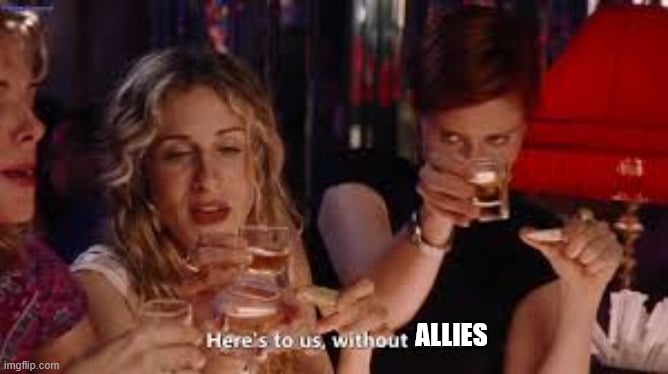
Adapted meme based on a scene from Sex and the City (HBO), included here for cultural commentary. (courtesy)
Spanish Guy and I walked out of a bar on Valencia Street, hands brushing, almost holding. I like a guy to make the first move. The sounds of percussion instruments growing louder surprised us as we made our way down the street toward a group of salsa musicians. He didn’t know how to dance. I did and wasn’t shy about it. A musician spun me as I laughed. If this was San Francisco, I wasn’t sure I was ready to leave.
I was 24. We met in Los Angeles two months earlier. He was in town just long enough to see the Hollywood sign and start up a Pacific Coast Highway situationship with me. Spanish Guy had been living in San Francisco for only a few months and wasn’t sure he wanted to stay. He was, however, sure he wanted a serious relationship. At first, I didn’t think there was a point to keeping in touch, then I figured I might as well have a reason to smile when my phone buzzed.
I used to think I liked being vulnerable. That it came easily to me. I’d play with it, like when you quickly pass your fingers through a flame. I don’t think it was real vulnerability, real intimacy. That doesn’t happen as often as we’d like it to, but there is something that feels familiar to vulnerability that we can keep at arms length.
Being vulnerable gets scarier as you get older, which is funny considering that’s when you have more control over your life. Maybe the control we have is what makes it scarier. Maybe it’s also being a part of a world that feels increasingly polarized, more punishing, less forgiving to saying the wrong thing.
It feels easier to be vulnerable— or pretend to be vulnerable— in your early 20s. Spanish Guy and I spoke daily. Our lives were far enough apart that the risk felt non-existent. That’s when a relationship is easy, you know, when it’s not really a relationship. We don’t have to show up as ourselves. We get to be someone else.
Showing up as someone else can feel like protection, and it comes in different versions. If you work in the Jewish world or have ever met a Jew, you know one of the biggest concerns for Jews is lack of allyship. After October 7th, many who looked to friends and neighbors were met with less than empathetic faces. We expected allyship to be easy. I’m not sure this experience is uniquely Jewish.
Spanish Guy was trying to come out to Los Angeles to see me again. I guess I could have waited for him to come, or waited for the connection to fade, but instead I packed my car, wrangled a couple of friends, and drove up the coast for a weekend. I had never been to San Francisco and decided to show up as my ultimate Carrie Bradshaw version.
It has not been difficult for me to temporarily connect with people when there are no stakes. That’s what makes dating fun when you’re young. You don’t have to worry about long-term goals, your partner’s student loans, parents and their retirement plans. You get to sit in the chemistry.
We want allyship to sit in the chemistry. We want to be at the bar, look at the other marginalized group across from us, and hope they’ll make the first move and buy us a drink. I can’t count how many guys at bars have bought me drinks, but I can count the ones that have met my parents on one hand.
This week, there was an attack on a mosque in San Diego, just a few hours south of Los Angeles. These attacks have become unsurprising to the Muslim community. We have that in common. Islamophobia and Antisemitism are not the same. Treating them as such combats neither. But separating the victims of violence dilutes the forward motion that we need to have meaningful impact.
I’ve seen some in our community tiptoe, unsure of how to make a statement or offer a hand because of some not-so-Israel-friendly things the Center has posted on their social media accounts— but if this isn’t the moment to look past our differences and try to mend relationships, what is? What are any of us waiting for? You don’t build bridges by begging for help or campaigning for others to be cancelled. You do so by showing up when it’s hard to.
We can be hurt and reach across the aisle. Partnership doesn’t spring up from ease. It has to be tended to for it to grow. That’s what makes vulnerability so scary. It takes work. It takes difficult conversations. Vulnerability, like allyship, requires constant decision-making and both require you to look at your partner and see their flaws, their problematic exes, and their old Tweets.
I don’t have the answer to the question of allyship. Mostly, I have dating stories that illustrate I haven’t always made the best decisions. As the salsa musician on Valencia Street spun me back toward Spanish Guy, he grabbed my hands. He opened his mouth to speak, but instead of being in awe of my dancing skills he told me he had been seeing someone in the city and didn’t want to lie to me.
What else could I do but laugh? I had driven seven hours to see a guy I thought mattered to me. The truth is, I wasn’t hurt by it.
Spanish Guy walked me back to the hotel where I knew my friends were eagerly waiting to hear about my night. I knew I’d be letting them down. We hugged and said goodbye. I walked into the janky Union Square elevator feeling kind of the same. I had wanted the experience to change me without allowing a real connection to happen. My screaming friends were more disappointed than I was.
I’ve been seeing someone new recently. The initial flirtation and chemistry have given way to a moment where difficult conversations are needed to build intimacy that can sustain long-term vulnerability. I haven’t been here— I haven’t allowed myself to be here— in a long time. It’s terrifying to allow myself to need someone, but isn’t that the ultimate form of vulnerability?
I’m writing this from the San Francisco airport with a mediocre cup of coffee cooling next to me. When I land in Los Angeles, New Guy will be there to pick me up from LAX, which any Angeleno reading this will recognize as the ultimate act of bridge building.
Related Topics
Related Posts