Hadassah National Assembly, Editor, Hadassah Writers' Circle
Alvin Ailey: A Foundation for Reflection on Rosh Hashanah
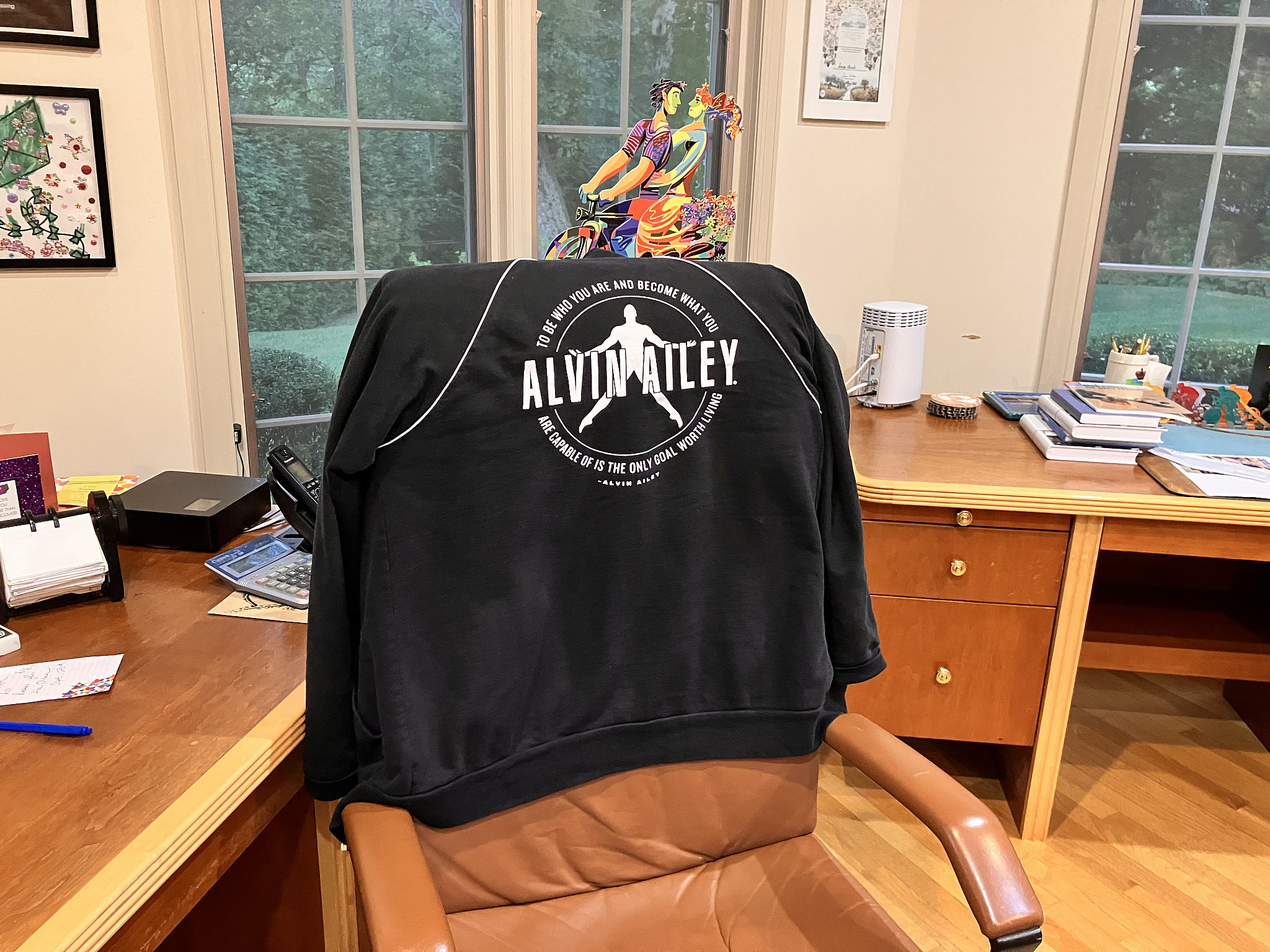
Photo of Alvin Ailey sweatshirt courtesy of the author.
I imagine many of you have heard of Alvin Ailey, founder and renowned choreographer of the Alvin Ailey American Dance Theater. Why do I mention him as Rosh Hashanah approaches?
Well, I have been a long-term Ailey fan, continually mesmerized by the company’s electrifying performances. In fact, I bought my first Alvin Ailey sweatshirt over a decade ago at a dance performance during intermission. I still wear that sweatshirt pretty often. Recently, the zipper broke and, in trying to decide whether it was worth replacing the zipper or not, I found myself re-reading Ailey’s quote, still resplendent on the back of the sweatshirt in bright white letters. Once again, it captivated me: “To be who you are and become what you are capable of is the only goal worth living.”
It seemed to be a great jumping off point for Rosh Hashanah reflection and introspection. I have no doubt that I’ve always been who I am because maintaining a persona separate from “the real me” neither called to me nor ever felt comfortable in concept. It was simply too complicated, and I had no need to be other than who I was.
But what about becoming the person I am capable of being? Have I done that? And what exactly did Ailey mean when he said that becoming what you are capable of is the only goal worth living? Is it his fancy way of saying that the most essential thing in life is reaching your potential? What if you are perfectly capable of following in your father’s footsteps to become an awesome surgeon but you have no desire to be a physician, let alone a surgeon? What if, in general, you are capable of playing a larger, more impactful role in the world, but you just aren’t motivated to do that? Does that mean that any other goal is morally deficient?
I would guess that Ailey’s motive with those words of wisdom was probably to motivate his dancers to give dancing their all and become the best dancers they could be. But, getting back to self-reflection, I have to ask myself, “Have I, after seven plus decades of life, become all I was capable of becoming? Have I achieved what I was meant to achieve?
In some ways, I believe I have. I evolved early into a Zionist and a writer and then eventually a wife, a mother and a leader and an engaged member of the Jewish community. These roles feel right; they seem to blend with my soul; and I do have the intuitive impression that they represent goals I was meant to reach for. But did I excel as much as I was capable of in each role? Who knows? Do any of us know whether we dug as deep as we could to become the best version of ourselves? Did we search for that inner strength that could propel us as far as we were meant to go? Are we doing that now?
I began thinking about where Judaism sits in terms of becoming who we are capable of as the primary goal of life. My immediate inner response was that Judaism, while taking a somewhat similar stance, places the emphasis quite differently. Judaism articulates a divine source for our capabilities and delineates our responsibility to employ those capabilities in partnership with God, for the sake of the wider world.
In an article on the Chabad website, Nissan Dovid Dubov expresses this sentiment beautifully in discussing the question, “What is Life’s Purpose?” He writes, “If a person does not fulfil his task and does not utilize his inestimable Divine powers, it is not merely a personal loss and failure but something that affects the destiny of the whole world.”
Judaism asks more of us than to live up to our potential. We are taught that we were created in God’s image and, therefore, human beings have a mandate to venerate and emulate God, living in accordance with the mitzvot as outlined in the Torah.
As the prophet Ecclesiastes wrote (chapter 12, verse 13), “The sum of the matter, when all is said and done: Revere God and observe His commandments! For this applies to all mankind.”
So, taking this reflection and introspection back to Rosh Hashanah, should I be chastising myself for not observing all of God’s commandments? Should I be promising myself to at least make a dent this coming year in keeping more of those commandments? Are we all capable of doing that? Of course, each of us must answer that question for ourselves. As for me? I admit that, rather than literally take on more of the 613 mitzvot, I prefer to ponder the purpose of God’s various commandments and strive to live a life that honors that purpose.
I know that many of you will say I am copping out here with a weak rationalization that isn’t convincing; that I’ve simply discarded important aspects of my heritage. Still, I am comforted that my life choices are well thought out. And, just like all of us, I know my impact is not limited to what I do myself. We are all enablers of one sort or another—either as parents, spouses, life partners, bosses, volunteers, members of extended families or friends — as we help others maximize their capabilities.
As a national leader and donor of Hadassah, for example, I love financially supporting the early opening of the Hadassah Medical Center’s Gandel Rehabilitation Center, enabling our resilient, devoted doctors, nurses and rehab specialists to give the wounded the care they need to achieve maximum recovery and resume their personal missions in life. I love supporting disadvantaged children in Israel to reach their potential in our Youth Aliyah villages and raising my voice for women’s health equity here in the US to ensure that unequal access to health care does not interfere with women living a quality life.
I am well aware that I am only one person and that, no matter what I am capable of, I will have a finite amount of impact. But, as one of my favorite meditation teachers, Matthew Hepburn, reminds his students, “Don’t underestimate the power of consistency. A steady drip of water will cut a channel through a mountain.”
Lonye is a member of the Hadassah Writers’ Circle, a dynamic and diverse writing group for leaders and members to express their thoughts and feelings about all the things Hadassah does to make the world a better place. It’s where they celebrate their personal Hadassah journeys and share their Jewish values, family traditions and interpretations of Jewish texts. Hadassah members are proud of their Zionist mission and their role as keepers of the flame of Jewish values, traditions and beliefs as well as advocating for women’s empowerment and health equity for all. Since 2019, the Hadassah Writers’ Circle has published nearly 650 columns in The Times of Israel Blogs and other Jewish media outlets. Interested? Please contact hwc@hadassah.org.
Related Topics
Related Posts