
Amazing Azerbaijan – Flame Towers, Mud Volcanoes, Mountain Jews And So Much More
My first trip out of the US — three months in Israel working on a kibbutz — turned me into an avid globetrotter. Over the ensuing years, I visited dozens of countries, spanning six continents. In November, my wanderlust brought me to Azerbaijan.
Full disclosure – Azerbaijan had not yet scored a spot on my list of must-see travel destinations. However, when the opportunity to go presented itself, the country won me over with its warm, engaging people, stunning sights – both manmade and natural – and an immersive culture that continued to evolve over the course of hundreds of years. And, although it is a Shi’a majority country, Azerbaijan is a secular, modern and tolerant society, with few women seen wearing hijabs, let alone burqas.
The first thing one notices about Baku – a once-vital stop along the legendry Silk Road, and now a vibrant capital – are the Flame Towers. In fact, it’s impossible not to notice them – the omnipresent structures each rise 623 feet above the city. When the sun sets, giant LED screens turn on and the three towers light up the night sky.
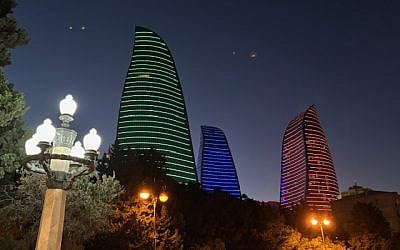
While Baku is a sleek, progressive and architecturally striking capital, it has a history dating back centuries. Its ancient walled Old City became Azerbaijan’s first UNESCO World Heritage Site in 2000, and UNESCO subsequently recognized four additional sites throughout the country.
Among them is the Gobustan Rock Art Cultural Landscape, which has the effect of transporting visitors back in time, to an epoch when early humans first began creating rock art. With some 6,000 petroglyphs carved into more than 1,000 rock surfaces, the site spans thousands of years of rock art history.
Additionally, although not a World Heritage Site, Azerbaijan’s mud volcanoes are a can’t-miss stop. The volcanoes are created by pressurized gas and liquids forcing mud and water to the surface, and hiking through a field of these bubbling, gurgling geological wonders is an unforgettable experience. With more than 350 located throughout the country, Azerbaijan is home to more mud volcanoes than any other place on Earth.
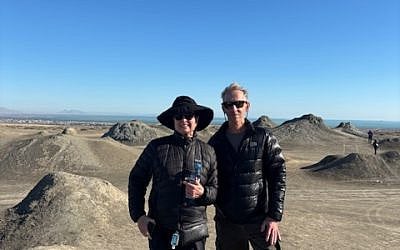
A Wild and Winding Journey to the Mountain Jews
Traveling out of Baku to the Caucasus Mountains, home of Azerbaijan’s Mountain Jews, is both exhilarating and hair-raising – a wild and winding journey combining jaw-dropping scenery with tight roads, hairpin turns, and a lack of guardrails that can send vehicles plunging into the abyss.
As I soon learned, hiking high in the Caucasus Mountains is not only about the vistas; it’s about the people as well. Memorable moments included a family hosting us for lunch in a village that has remained isolated for centuries; a shepherd taking time from tending his herd to chat with us; and even an Israeli soldier, Sasson, who chose to begin the traditional Hatiyul HaGadol, or ‘Big Trip’ – the post-army journey taken following completion of IDF service – in this remote area. Sasson told me he recently finished months of intense combat in Gaza, where, he shared solemnly, “I lost many friends and commanders.”

Conversations in a Tea House
Particularly intriguing were conversations I held with a pair of Mountain Jews, who I joined for a cup of tea in a traditional chaykhana, or tea house. As I looked around, I saw several other Mountain Jews who had gathered for tea, a smoke and game of backgammon.
Our guide, Akshin, translated as the two pensioners told me they were born and raised in the community, known as the Red Village or Red Settlement. Depending on the sources, the names derive either from the red bricks used to build the village, or, more recently, the red flag of Communism planted by Bolsheviks when they marched into the Caucasus region. Either way, the original Red Village was founded nearly 300 years ago, and both men traced their ancestry to the very beginnings of the community.
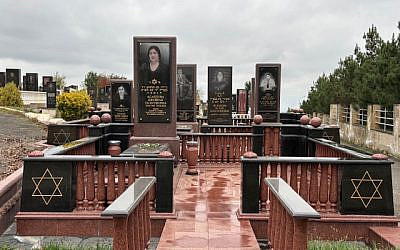
Today, the population of the Red Village is around 3,600. At one time, Akshin told me, it was closer to 9,000 but, with the collapse of the Soviet Union, many opted to leave, mostly to Israel, with smaller groups going to the U.S. or Russia. My new friends added that nowadays, more and more young people are choosing to leave the Red Village.
Descendants of the Ten Lost Tribes
At the beginning of the 20th century, the Red Village had 13 synagogues, ultimately reduced to two when Azerbaijan was part of the Soviet Union. Over the course of centuries, Mountain Jews – who consider themselves descendants of the Ten Lost Tribes – incorporated their own unique religious practices into traditional Judaism. Of Persian ancestry, Mountain Jews speak a distinctive language known as Judeo-Tat, which my tea house companions described as being similar to Farsi.
When asked how the Red Village sustains itself, they said the economy is largely agricultural, based mainly on growing and selling apples as well as pears, for which the area is particularly famous.
Tourism also helps, they said, as the Red Village is frequently visited by travelers, including Israelis. They noted that the Red Village has “good links with Israel.” While isolated, the Red Village does not exist in a vacuum. When asked if they were aware of the events of October 7, they responded, “Of course, of course.” In the wake of October 7, they emphasized that residents of the Red Village faced no protests, hostility or harassment of any kind.
“The True Meaning of Tolerance”
Following our tea house conversations, I further discussed harassment directed towards Azerbaijan’s Jewish community with Akshin as we walked through the Red Village. Upon asking if, for instance, there were anti-Israel protests in Baku, he emphatically responded, “No, no, no.” He continued: “Very few were on the Palestinian side. People said we have no reason to hate Israelis.”
As we stood in front of the Red Village’s famed Six Dome Synagogue, Akshin provided a vivid example of benevolent relations between Azerbaijan’s Shi’a and Jewish communities. Pointing to a nearby mosque, he highlighted the peaceful proximity of the mosque and the synagogue. “This,” Akshin asserted, “is the true meaning of tolerance.”
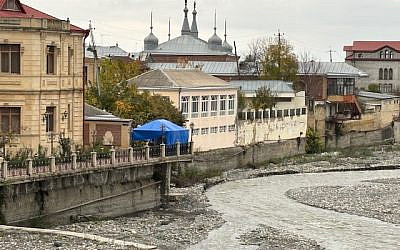
(Photos: James S. Galfund)