

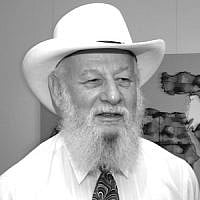
Author of "Through a Bible Lens"
Ambassador Huckabee and Birth of Ariel University
As a professor of experimental art and Jewish thought at Ariel University at its birth who is both American and Israeli, I was happy to see US Ambassador to Israel Mike Huckabee and his daughter, Arkansas Governor Sarah Huckabee Sanders, in Ariel, the heartland of the Jewish State. They joined US House Speaker Mike Johnson in replacing the term “West Bank” with “Judea and Samaria,” recognizing sovereignty of the entire Land of Israel as the homeland of the Jewish people for thousands of years.
According to Ambassador Huckabee, Western civilization had its origins in Israel with a people who heard God’s voice at Sinai. He stresses that Israel is not just the ancestral homeland of the Jewish people. It is the spiritual root system for the entire Western world that honors justice, individual dignity, and human rights.
I created the pioneering digital artwork below that expresses the biblical verse that Huckabee sees as capturing the major links to the land and people of Israel. It artistically presents Joseph’s words to his brothers in Genesis 50:20, “What you intended for harm, God used for good.” “That verse is everything,” Huckabee said. “It captures the Jewish story that even in the darkest moments, God’s hand can bring redemption.”
With his powerful words from the Bible, Mike Huckabee liberated my leading-edge work of art that shows Joseph encountering his brothers that had been dormant in my flat file for nearly four decades. Joseph’s revealing his identity to his brothers is the dramatic high point in the entire biblical narrative. This emotional encounter that I had documented in my edition of pioneering computer-generated screen prints remained dormant until the ambassador’s words awakened them for all to see.

These are the Bible’s words translated from the original Hebrew that Joseph said to his brothers: “I am Joseph! Is my father still alive?” His brothers were so startled, they could not respond. “Please, come close to me,” said Joseph to his brothers. When they came closer, he said, “I am Joseph your brother whom you sold into Egypt. Now don’t be distressed or feel guilty because you sold me. God has sent me ahead of you so that I can provide for you. Two years now there has been a famine in the in the midst of the land, and for another five years there will be neither plowing nor harvest. God has sent me ahead of you to insure your survival in the land and to keep you alive for you to be a great surviving group. It is not you who sent me here, but God. He made me Pharaoh’s vizier, manager of his entire government, and ruler over all the land of Egypt.” (Genesis 45:3-8)
It will be most appropriate for my innovative serigraph “Joseph Encountering his Brothers” to hang in the office of Ambassador Huckabee at the US Embassy in Jerusalem. It will also be meaningful for the serigraph to be on display in the office of Sarah Huckabee Sanders, the Governor of Arkansas, and in the print collection of the Arkansas Museum of Fine Arts.
These sleeping artworks expressing this powerful biblical event had given way to my enthusiasm for creating experimental artworks of cyberangels set free to fly around the globe into tomorrow and back into yesterday using leading-edge technologies sponsored by AT&T that overwhelmed my prints of Jacob’s conversation with his brothers. At the time, I was creating a wide range of pioneering artworks of biblical events at Pratt Institute in New York, where I was head of the art department, and at The Israel Museum’s experimental printmaking workshop in Jerusalem.
Ambassador Huckabee will appreciate that in my highly acclaimed books Through a Bible Lens: Biblical Insights for Smartphone Photography and Social Media (HarperCollins Christian Publishing) and The Future of Art in a Postdigital Age: From Hellenistic to Hebraic Consciousness (Intellect Books/University of Chicago Press), he will find praise of leading figures representing both Judaism and Christianity.
After my retirement as professor and founding dean at New World School of the Arts, University of Florida’s college of the arts in Miami, I returned to Israel, where I worked for seven years teaching hundreds of students while developing the College of Judea and Samaria into Ariel University. I had been a professor at Columbia University, at MIT Center for Advanced Visual Studies, and at Bar-Ilan University in Israel.
My Bible-inspired digital artworks are in the collections of more than thirty museums. For example, Smithsonian’s National Museum of American History in Washington, which sits across the lawn leading to the balcony where President Trump was inaugurated, to museums throughout the USA and abroad. The Chairman of the Department of Social & Cultural History at the Smithsonian wrote to me: “It gives me great pleasure to acknowledge the receipt of ‘Digitized Homage to Rembrandt’ presented to our Division of Graphic Arts. This lithograph from a computer-generated image is a most valuable addition to our collection.”
The development of these artworks describe the influence of Rembrandt’s printmaking. My wife Miriam, also an artist, and I sat in the print room of The Metropolitan Museum of Art in New York for many hours studying Rembrandt etchings of biblical themes that influenced my work. It was 1986. Our son, Rabbi Ron Alexenberg, who was archivist at the home in Jerusalem of Rabbi Kook, sent us a 1935 article in the London Jewish Chronicle. Rabbi Kook, who was the Chief Rabbi in pre-state Israel, lived in London during the First World War. He told that he visited the National Gallery frequently to see his favorite pictures, those of Rembrandt.
He said, “I really think that Rembrandt was a Tzadik (an especially righteous man). Do you know that when I first saw Rembrandt’s works, they reminded me of the legend about the creation of light? We are told that when G-d created light, it was so strong and pellucid, that one could see from one end of the world to the other. He reserved that light for the righteous when the Messiah should come. But now and then there are great men who are blessed and privileged to see it. I think that Rembrandt was one of them, and the light in his pictures is the very light that was originally created by G-d Al-mighty.”
My JerUSAlem-USA blog https://jerusalem-usa.blogspot.com/ is a participatory art project that invites residents and visitors to the 20 places in the USA named Jerusalem to document their experiences through photographs and texts that tell the stories of how the places got the name “Jerusalem.” There are JerUSAlems in Alabama, Arkansas, Georgia, Maryland, Michigan, New York, North Carolina, Ohio, Rhode Island, Tennessee, Utah, and Vermont. I hope to see stories from the Jerusalem area of Arkansas and the many other places in Arkansas that have biblical names.
I was born in New York and earned my doctorate at NYU. I am also an Israeli citizen who lives in Ra’anana with my wonderful wife Miriam of 66 years. Miriam and I are working on our 14th book, The Art of Love: The Love of Art. We are blessed with four children and their spouses and a rich range of grandchildren and great-grandchildren. I am happy to have lived half my life in the United States and half in Israel.