The views expressed herein are solely mine.
America: Obtain Greenland or Lose the Arctic
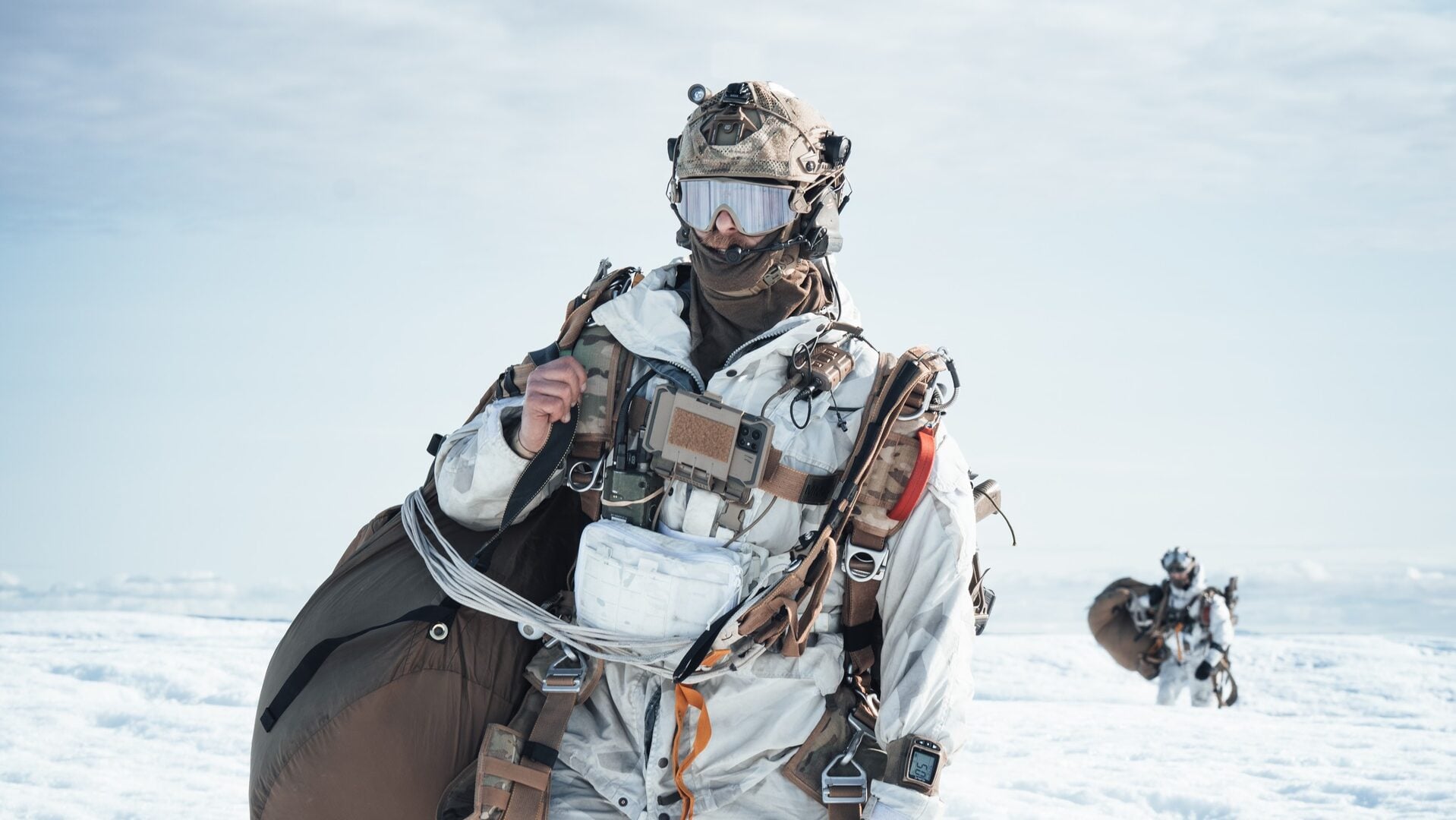
Members of Denmark’s Jaeger Corps special forces in Greenland. Source: Forsvaretsmediearkiv.
Greenland was part of the American international geostrategy long before social media rediscovered the Arctic.
In World War II, Washington denied Nazi Germany access to North Atlantic weather stations and air routes.
During the Cold War, Greenland became the forward sensor for a nuclear age—an icebound shield guarding the shortest missile paths between Eurasia and North America. That logic never disappeared; it merely went quiet. Now, as ice retreats and rivals return, the old math is back—with less margin for error.
Accordingly, Greenland is no longer scenery. It is infrastructure—the kind that decides who sees first, who decides first, and who survives escalation. The Arctic has crossed the line from environmental theater into hard power, and the United States is already halfway committed. The only question left is whether Washington finishes the job or leaves its own deterrence exposed.
Start with facts, not feelings. At the center of Arctic defense sits Pituffik Space Base. Its early-warning radars compress missile-warning timelines. Its space sensors clarify intent in an age of hypersonics and counter-space probes. In deterrence math, clarity prevents panic; panic starts wars. That makes Pituffik not a “base” but a civilizational fuse—small footprint, enormous leverage.
Nevertheless, this is not new. During the Cold War, the US also quietly proved what Greenland is worth by building Camp Century—a city under the ice, complete with nuclear power, tunnels, labs, and logistics designed to operate in conditions no adversary could contest. The lesson was not novelty; it was permanence. As a result, America learned—decades ago—that Greenland could host resilient, survivable systems when the rest of the world went dark. That lesson still holds.
Evidently, geography does the rest of the argument. Greenland anchors the maritime funnel between the Arctic and the Atlantic—the choke through which submarines must pass to threaten transatlantic supply lines.
Hence, control this corridor and you filter undersea access; lose it and you invite surprise.
Today, Russian patrol tempos are back to Cold War levels. More quietly—and more dangerously—China is testing the Arctic as a strategic flank: polar “research” vessels mapping seabeds with obvious dual-use value, under-ice navigation trials, and a doctrine that ties “far seas protection” to nuclear deterrence survivability. And submarines are not diplomacy. They are options—and options change behavior.
That said, here is where the data gets tight. Greenland is a keystone of the North American early-warning lattice that feeds NORAD. Missile trajectories from Eurasia arc over the pole; hypersonic glide vehicles exploit ambiguity; counter-space tests aim to blind before striking. Sensors in Greenland buy decision-time measured in minutes that Alaska alone cannot guarantee, and redundancy that Guam—vital in the Pacific—cannot substitute. Alaska guards the northwest approaches; Guam anchors the western Pacific. Greenland closes the northern seam. Ergo, lose that seam and the homeland defense picture fragments.
For this reason, even a limited Chinese undersea presence changes the equation. Beijing does not need an armada to matter; it needs credibility.
To enhance the robustness of this argument, open-source reporting has long noted the PLAN’s pursuit of quieter nuclear-powered attack submarines and longer-range ballistic-missile boats—platforms designed to survive, not posture. Pair that with Arctic seabed mapping and under-ice navigation research and the signal is clear enough for planners: the Arctic is becoming a secondary theater meant to stretch sensors, strain commanders, and complicate attribution. The objective is not dominance tomorrow, but decision overload today.
In my opinion, sovereignty matters—Greenland is part of Denmark, and allied consent underwrites the US presence. But sovereignty without geostrategic systems is symbolism.
Doubtlessly, Greenland’s current status leaves the US defending the most critical node of homeland defense by permission, not ownership. In a world of gray-zone pressure, that is a vulnerability. Ownership simplifies command, accelerates integration, and hardens infrastructure—sensors fused, thresholds rehearsed, escalation bounded. It also removes incentives for rivals to probe seams between allies.
Although critics call the acquisition “imperial”, that is unserious. This is not about flags or folklore. It is about time—time to detect launches, time to sort signal from noise, time to deter before panic sets in.
Unquestionably, Greenland buys time. Lose it, and crises accelerate beyond control. Secure it, and the Arctic stays cold.
From a strategic standpoint, America already built a city under Greenland’s ice because it understood the stakes. The ice is melting, the sea lanes are opening, and competitors are moving quietly beneath the surface. For that reason, the choice is stark and strategic, not sentimental: obtain Greenland and lock down the systems that keep wars from starting—or watch the Arctic become permissive and pay the price later.
Related Topics
Related Posts