
America’s ICE practices echo the Nazi Germany SA’s early tactics
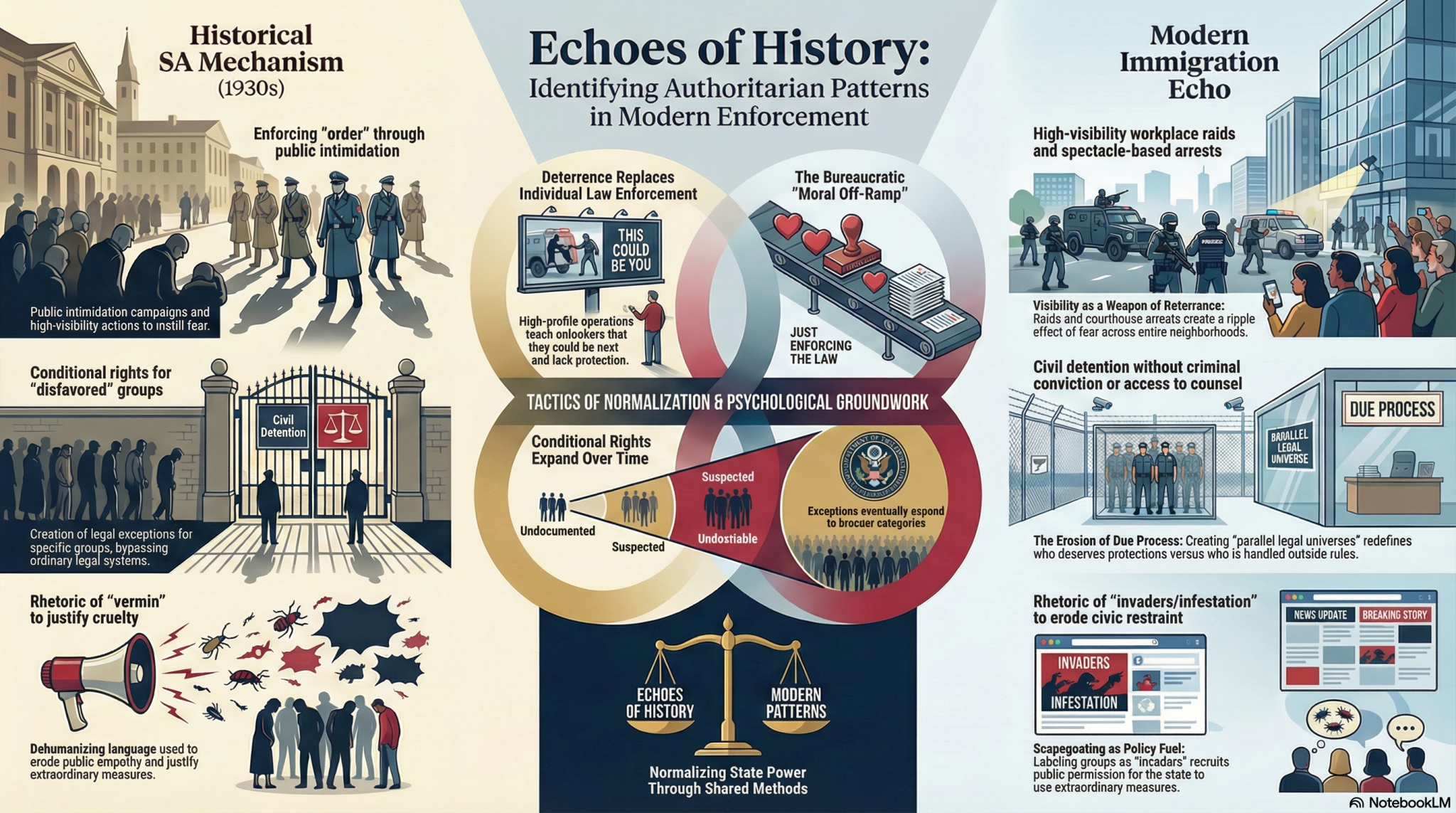
America’s ICE practices echo the SA’s early tactics — and Jews should recognize the warning signs
By now, “Nazi” comparisons have become so cheap in American life that many readers understandably recoil the moment one appears. Jews, in particular, have good reason to guard against rhetorical inflation that trivializes the Shoah.
But there is another danger: refusing to see patterns in the name of avoiding exaggeration. History does not repeat in carbon copies. It rhymes through methods, incentives, and the steady normalization of state power against disfavored groups. And that is where today’s immigration enforcement — especially some practices associated with U.S. Immigration and Customs Enforcement (ICE) — bears an unsettling resemblance to the early role played by the SA (Sturmabteilung) in 1930s Germany.
Let me be precise about the claim.
This is not an argument that ICE agents are Nazis, or that the United States is Nazi Germany, or that immigration enforcement is a prelude to genocide. Intent and outcome matter, and they differ profoundly. The point is narrower and, in some ways, more practical: some ICE practices resemble early-stage authoritarian policing tactics used by groups like the SA — not in ideology, but in how state power is normalized against marginalized populations.
For Jews who are heirs to a history of state-sponsored scapegoating, that distinction should not be a comfort. It should be a prompt to pay attention.
The SA lesson: intimidation first, “order” later
The SA was a mass paramilitary organization. It thrived on visibility and fear. It made a political project feel inevitable by enforcing “order” in public — through intimidation, sudden arrests, street-level violence, and the steady message that certain people did not truly belong.
The key mechanism was not a single atrocity. It was the gradual social agreement that some people could be treated as exceptions: exceptions to due process, to safety, to dignity. Once that moral exception became routine, the legal and political landscape could be reshaped around it.
That process has modern equivalents that do not require uniforms or truncheons — only bureaucratic authority paired with public spectacle.
Visibility as a weapon
One of the most disturbing aspects of aggressive immigration enforcement is not simply that it removes people from communities, but that it does so in a way designed to be seen and felt far beyond the person detained.
Raids at workplaces. Arrests near courthouses. Highly publicized operations. The ripple effect is predictable: parents avoid schools and clinics; witnesses avoid reporting crimes; families stop using public services they are legally entitled to access; entire neighborhoods learn to keep their heads down.
That is not just “law enforcement.” It is deterrence by fear — a strategy that reaches beyond individual cases to reshape the behavior of whole communities. The SA’s power likewise lay less in the number of people it directly harmed on a given day than in the lesson it taught everyone watching: you could be next, and no one will protect you.
The erosion of due process by legal exceptionalism
A second echo lies in the creation of a parallel legal universe.
In the United States, immigration enforcement is often treated as “civil,” not criminal — a categorization that can shrink procedural protections in practice. People can be detained who have not been convicted of crimes. Access to counsel can be limited by geography, cost, and detention conditions. The process can move fast for the government and slowly for the detainee. Families can be separated by administrative decisions that do not feel like courtroom verdicts but can be just as life-altering.
Authoritarian systems rarely begin by abolishing due process for everyone. They begin by redefining who deserves it.
Germany’s Jews and other targeted groups learned early that their rights were becoming conditional — not always through dramatic declarations but through the steady narrowing of protections. When a society accepts that a particular category of people can be handled “outside the usual rules,” the category tends to expand. Today it is “undocumented.” Tomorrow it becomes “suspected.” The day after that it becomes “undesirable.” These are not hypotheticals from a history book; they are the logic of political incentives.
Scapegoating as policy fuel
Every country has immigration laws. What distinguishes a liberal democracy from an illiberal one is not whether it enforces borders, but whether it needs an internal enemy to rally support.
When public officials talk about immigrants as invaders, infestations, criminals by default, or demographic threats, the rhetoric performs a function: it recruits the public into emotional permission. Once the public grants that permission — once the group is coded as inherently suspect — extraordinary measures begin to feel ordinary.
Jews know this story. The “criminal” and “vermin” tropes were not accidental in 1930s Europe. They were the psychological groundwork that made cruelty sound like prudence.
“Just enforcing the law” and the moral off-ramp
A bureaucracy’s most dangerous feature is its ability to distribute responsibility until no one feels accountable.
We have heard the phrase: just enforcing the law. The SA and other early enforcers of Nazi policy relied on a similar moral off-ramp: they were restoring order, protecting the nation, following directives. That language is seductive because it transforms moral choices into administrative routines.
But the law is not a substitute for conscience. Laws can be unjust. Laws can be weaponized. Laws can be enforced with discretion that amplifies harm. And in a democracy, the public is not absolved by legality. If anything, legality increases responsibility: we are the ones who authorize the state.
The crucial differences — and why they don’t let us relax
Yes, differences matter. The United States is not a one-party state. Courts exist. Journalists investigate. Elections change leadership. ICE is not a mass paramilitary organization. There is no equivalent to a totalitarian ideology commanding society-wide conformity.
Those differences are real — and they are exactly why the warning signs matter now rather than later. Democracies do not usually collapse overnight. They corrode through exceptions. Through the quiet acceptance of fear as governance. Through the normalization of hard measures against people few voters feel compelled to defend.
Jews should be among the first to resist that corrosion, not because we are uniquely virtuous, but because we are uniquely experienced in what happens when “targeted” becomes “expanded,” when “temporary” becomes “permanent,” when “they” becomes “you.”
Never Again
“Never Again” was never meant to be a slogan reserved for the final chapter of catastrophe. It is a discipline of attention in the early chapters — when the measures are still being justified, when the targets are still politically convenient, when the cruelty still hides behind paperwork.
That is why the comparison to the SA, carefully framed, is not a cheap insult. It is a warning about mechanisms: fear as policy, visibility as intimidation, rights as conditional, and the slow training of a public to accept the unacceptable — so long as it happens to someone else.
And if Jews, of all people, cannot see where that road begins, then memory has become mere memorial.