


America’s Last Hawk
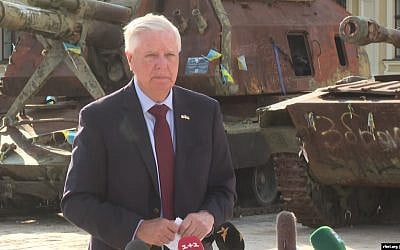
The news of Senator Lindsey Graham’s sudden death came just as he had returned from his tenth wartime visit to Kyiv — only on Friday he was meeting with President Zelensky, talking about Ukraine’s air defense and sanctions against Russia.
Graham was never a classic legislator-diplomat. On the contrary — he was a man who stressed the necessity of forceful pressure on dictatorships and on their leaders. Who insisted that only such a position by the United States can help democratic countries build the foundations of their own security in our difficult world.
Senator Graham’s support for Ukraine, from the moment Russian aggression against our country began, was always consistent and principled. Indeed, in every other case of Russian aggression, the senator held to precisely the same position. Take the decision to attack little Georgia — the prelude to the great wars of the post-Soviet space. Even then, Senator Graham had an absolutely clear position and a clear message for the administration of President George W. Bush — up to and including proposals to be more resolute in defending Georgian sovereignty and to take more forceful political steps.
Just as clear and unambiguous was the senator’s position on the Middle East, where he always called for a hard line toward Iran and the other dictatorial regimes that threaten the security of both the United States and the democratic countries of the region.
From this point of view, Senator Graham’s position was unique — in a situation where both Israel and Ukraine had practically lost their traditional bipartisan support, which had come to be concentrated either in Republican or in Democratic ranks. Senator Graham supported both countries — and today he is remembered with words of gratitude in Kyiv and in Jerusalem alike. And this, too, is a reminder of what American policy ought to be toward democratic countries fighting for their existence against repugnant dictatorial regimes — regimes that believe force, coercion, and ideological fabrications can justify the killing of civilians and the seizure of other people’s territories.
One could say, of course, that the lessons of the era Lindsey Graham embodied in American political life will surely be taken to heart. But I would not be so optimistic. All of us can see that new political times have arrived. People have come to power who think not so much about principles as about electoral victories. People who have no wish to explain the substance of values to their compatriots, but who seek above all to please those compatriots for the sake of a quick win at the polls. And who do not even consider that for those very compatriots the next elections may simply never take place — because of the danger of war and of their deaths. What used to be, incidentally, merely a figure of speech when we talked about that danger and that death is now becoming reality in many countries of the world. And the number of those countries will only grow in our difficult twenty-first century — unless we heed the political legacy of people like Senator Lindsey Graham. And of Senator John McCain — whom Graham, in his time, defended from Donald Trump himself.
Lindsey Graham will remain the embodiment of the American politics that gave the world hope for peace and survival in the worst decades of the twentieth century and the beginning of the twenty-first. And today that position may be our hope that the world will manage to climb out of the political and military abyss into which we have all fallen — with fewer ruins, fewer victims, and less of that sense of catastrophe which does not leave us.