The views expressed herein are solely mine.
America’s New Anti-Israel Left-Right Consensus
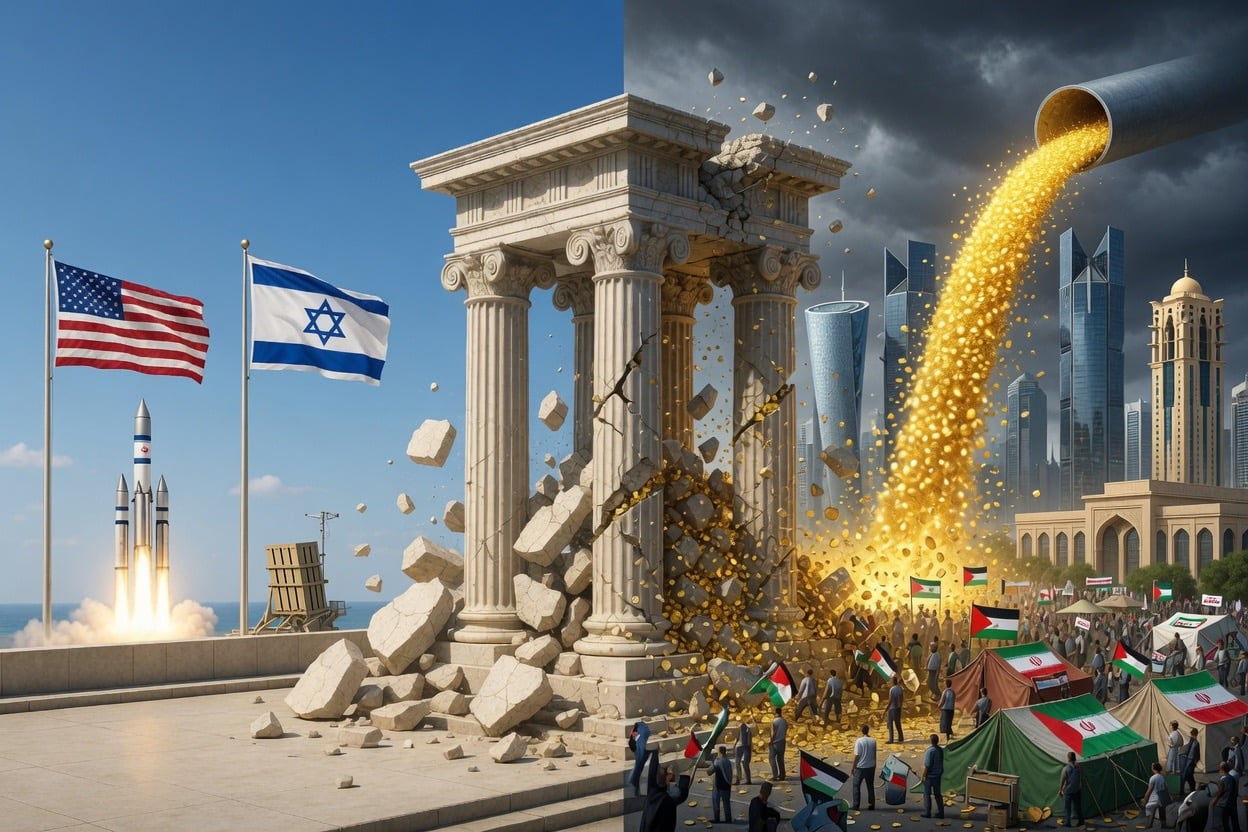
Credits: AI-Generated Image.
Fifteen years ago, both major American political parties treated Israel as a strategic asset in the Middle East. Gallup’s 2011 surveys showed clear majorities sympathizing more with Israelis than with Palestinians across Democratic and Republican ranks. By February 2026, that foundation had cracked. Gallup found that only 36 percent of Americans sympathized more with Israelis, while 41 percent sympathized more with Palestinians. Among Americans aged 35 to 54, the split was starker: 28 percent for Israelis versus 46 percent for Palestinians. Among Democrats, sympathy for Israelis had fallen to just 17 percent, while 65 percent sympathized more with Palestinians. Republicans remained at 70 percent sympathy for Israelis, yet the broader erosion has already affected aid debates, diplomatic posture, and policy consistency.
The left’s shift accelerated after the 2018 election of Representatives Ilhan Omar and Rashida Tlaib. Their embrace of rejectionist slogans and dual-loyalty tropes moved anti-Zionist positions from activist margins into congressional debate, campus organizing, and elite media language.
Doha catalyzed this turn by becoming the largest foreign source of funding to American higher education, pouring more than $6 billion in disclosed gifts and contracts into top-tier universities over the past 15 years. In 2025 alone, the U.S. Department of Education identified Qatar as the largest foreign source of reportable gifts and contracts to American universities, exceeding $1.1 billion.
Between 2016 and 2025, the emirate also spent nearly $250 million through Foreign Agents Registration Act-registered lobbying and public relations firms. These expenditures coincided with the spread of frameworks that recast Israel as a colonial actor and reduced the Democratic willingness to approve security assistance without conditions.
Qatari influence operations reveal their contradictions most clearly when state-aligned outlets attack credible competitors. The New Arab, owned by the Qatari holding company Fadaat Media and chaired by Azmi Bishara—a close advisor to Emir Sheikh Tamim bin Hamad Al-Thani who fled Israel amid accusations of aiding Hezbollah—markets itself as an independent English-language platform with correspondents in more than twenty countries. In reality, it functions as an instrument of Qatari state influence, advancing Doha’s preferred narratives under the cover of professional journalism.
This past weekend, as the Iranian regime launched ballistic missiles at Israeli civilians, The New Arab chose to target the Middle East Forum for its open support of the Iranian people against the regime. Unlike the Middle East Forum, a transparent American think tank that states its commitments openly, The New Arab cloaks state-directed messaging in the language of objective reporting—then attacks others for the very advocacy it exists to obscure. This is how Qatari networks shape narratives inside elite institutions already sympathetic to the left’s turn.
In tandem, a growing segment of the American right has followed a parallel track, though its manifestations remain more elite and media-driven than electoral. Influential voices in conservative media and policy circles increasingly frame sustained partnership with Israel as an optional entanglement rather than a strategic necessity. Arguments for “restraint” and claims that “the Zionists are not our allies” often downplay Israel’s unmatched intelligence on Iranian nuclear and missile programs while emphasizing short-term fiscal or diplomatic costs.
Qatar’s influence operations have crossed party lines. During the 2017 Gulf crisis, the emirate directed millions through lobbyists to shape U.S. executive branch views and reached out aggressively to conservative-leaning outlets, policy circles, and donor-adjacent institutions. The combined result is bipartisan softening toward actors that host Hamas leaders, finance ideological infrastructure, and promote Muslim Brotherhood-linked networks.
Israel’s strategic value rests on concrete deliverables. It supplies real-time intelligence on Iranian nuclear and missile programs that no other regional partner matches in volume or speed. Joint development of missile defense systems has produced technology that the United States has integrated into its own forces. Annual American security assistance of $3.8 billion sustains Israel’s qualitative military edge against Iranian proxies operating in Lebanon, Syria, Iraq, Yemen, and attempted networks in Latin America. The 1973 American airlift proved decisive when Israel faced simultaneous attack from multiple fronts. Any reduction in commitment today removes a demonstrated deterrent against escalation.
Substituting Qatar, Turkey, or Pakistan for Israel would shift the regional balance against America’s own interests. Qatar has transferred an estimated $1.8 billion into Hamas-controlled Gaza while maintaining the Hamas political bureau in Doha and broadcasting anti-Western content through state-backed and Qatar-linked media platforms. Turkey undermined its NATO alliance with the United States by acquiring Russian S-400 systems in open defiance of Washington, facilitating ISIS transit routes during the Syrian war, and backing the 2010 Mavi Marmara flotilla against Israel. Pakistan maintained Taliban sanctuaries before and after 2001, pursued nuclear proliferation through the Abdul Qadeer Khan network, and now advances Chinese infrastructure projects that extend Beijing’s influence toward the Arabian Sea. None of these states matches Israel’s record of intelligence cooperation or technological contribution to Western defense systems.
Qatari spending illustrates the mechanism. Its Foreign Agents Registration Act outlays exceed Israel’s direct government lobbying and have produced access in both parties and elite institutions. Turkish and Pakistani networks operate on smaller but documented scales. The cumulative effect dilutes consistent American pressure on Iranian expansion and on groups that reject Israel’s existence.
Disturbingly, Europe supplies the clearest precedent for the trajectory now visible on the American left. After the October 7, 2023 attacks, antisemitic incidents rose 185 percent in France, 82 percent in the United Kingdom, and 75 percent in Germany, according to tracking by major Jewish organizations. European governments facing large Muslim voting blocs issued one-sided statements and tolerated sustained street campaigns against Israel.
The same pattern of demographic concentration and electoral mobilization now appears on the American East Coast. The Council on American-Islamic Relations estimates more than 2 million registered Muslim voters nationwide, with concentrated turnout in New York, New Jersey, and Virginia. The 2025 elections showed record participation in these states and the election of New York City’s first Muslim mayor. These outcomes have already translated into stronger local pressure for reduced support of Israel.
The erosion of bipartisan commitment carries direct geopolitical costs. It weakens deterrence against an Iranian-led coalition that coordinates proxy forces across multiple theaters. It reduces American leverage over energy routes and maritime chokepoints. It hands narrative advantage to states that fund rejectionist groups and align with China or Russia on regional questions.
Washington cannot afford to treat Israel as a negotiable line item. At the precise moment an Iranian-led axis is expanding its reach from Beirut to Sanaa and testing American resolve across multiple theaters, Israel remains the only regional partner that delivers unmatched real-time intelligence, technological cooperation, and proven deterrence against that coalition.
Related Topics
- 2025 Hostage Deal
- Anti-Zionism
- antisemitic violence
- Antisemitism
- Benjamin Netanyahu
- China
- Christian Zionism
- Donald Trump
- Europe
- France
- Gaza
- Gaza Reconstruction
- Gaza Rocket Attacks
- Gaza Strip
- genocide
- Germany
- Great Britain
- Hamas
- Hezbollah
- Hostages in Gaza
- IDF
- Iran
- Iran Nuclear Deal
- Iraq
- Islam
- Israel At War
- Israel-Iran Conflict
- Israel-US Relations
- Israel: Jewish and Democratic
- Israeli Foreign Policy
- Israeli Politics
- Israeli society
- Lebanon
- Middle East
- Pakistan
- Palestinian Statehood
- Palestinians
- Qatar
- Russia
- Syria
- Terrorism
- The Arab World
- Trump Peace Plan
- Tucker Carlson
- Turkey
- United Kingdom
- US Midterm Elections
- US Politics
- Weapons
- Yemen
- Yom Kippur
- Yom Kippur War
- Zionism
- Zohran Mamdani
Related Posts