Iranian-Born British Analyst of Politics and Civilisation
Amnesty’s Moral Compass Is Broken: An Iranian Refugee Exposes Its Hypocrisy
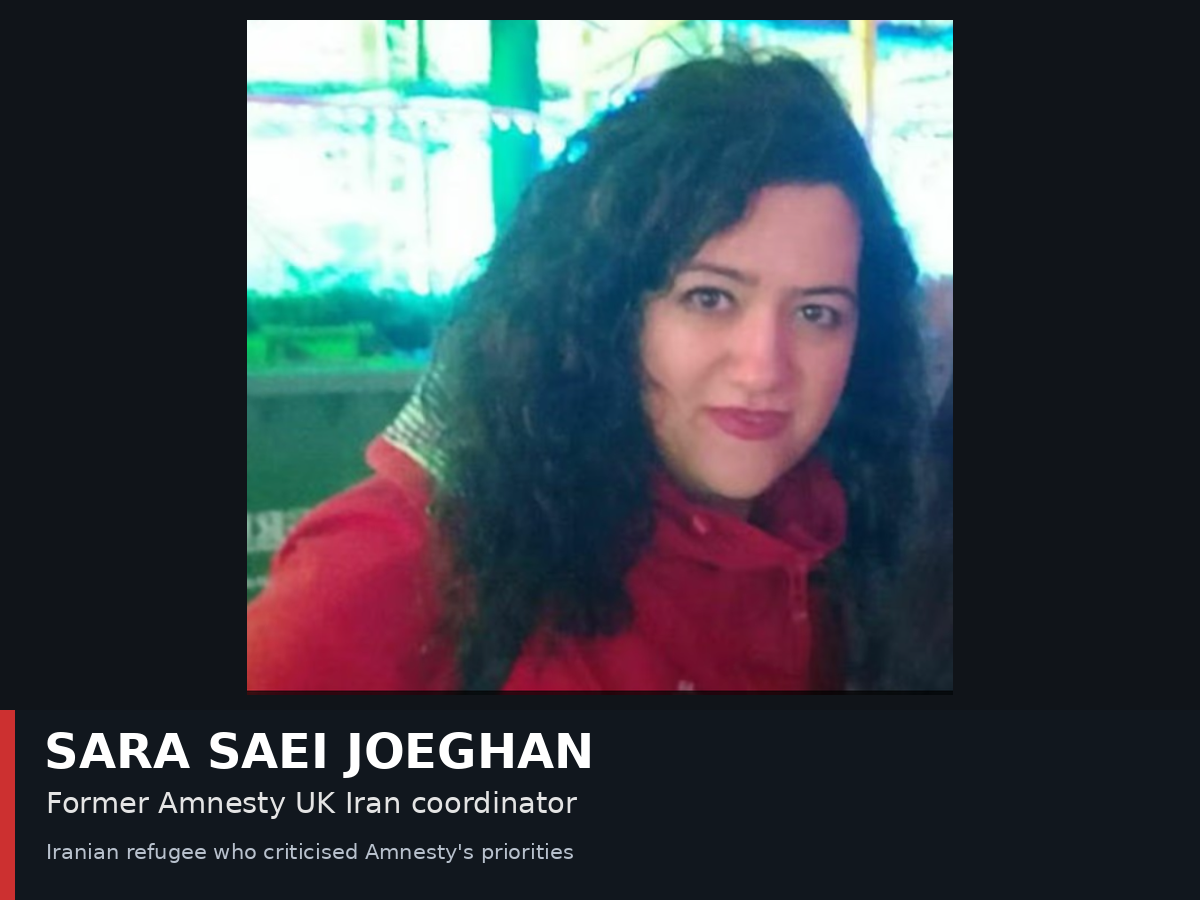
Sara Saei Joeghan, the Iranian refugee and former Amnesty International coordinator who says the organisation betrayed its human rights principles.
When an Iranian woman who fled the Islamic Republic says she feels betrayed by Amnesty International, the organisation should be asking itself how it lost her trust. Instead, an extraordinary controversy has exposed the ideological contradictions inside the Western human rights establishment.
There is something profoundly disturbing about a human rights organisation losing the trust of a woman who escaped one of the world’s most ruthless theocratic dictatorships, while another person associated with that same organisation allegedly praises the dictator responsible for the repression.
Yet this is precisely the controversy now surrounding Amnesty International UK.
Sara Saei Joeghan, an Iranian refugee who arrived in Britain in 2015 after being arrested and interrogated for protesting against executions in Iran, joined Amnesty International because she believed it stood for something fundamental: the universal defence of human rights, irrespective of politics, religion or ideology.
She eventually became a volunteer Iran country coordinator in 2024. Today, she says she feels betrayed by the organisation she once trusted.
And as an Iranian-born British citizen, a Christian and an unapologetic Zionist, I believe her experience exposes something much bigger than an internal dispute at a charity.
It exposes the ideological crisis consuming parts of the Western human rights establishment.
When Iran becomes a footnote to Palestine
According to reporting by The Times, Joeghan became increasingly concerned that Amnesty’s work on Iran was being diverted towards Palestinian activism and anti-Israel political messaging.
One particularly revealing incident involved an event intended to examine the persecution of religious minorities in Iran. Joeghan says the discussion instead became dominated by Palestine and criticism of Israel. Consider the implications.
Iran is a country where women have been imprisoned for rejecting compulsory hijab, where political opponents have faced executions after grossly unfair trials, where religious minorities suffer systematic discrimination, and where security forces have repeatedly opened fire on protesters demanding basic freedoms.
Yet, according to a woman who actually suffered at the hands of that regime, even an event devoted to Iranian human rights could not escape the gravitational pull of the Palestinian cause.
This is not merely a question of which international crisis deserves attention. Iranian victims are entitled to have their experiences examined on their own terms, without being reduced to supporting characters in somebody else’s political campaign.
The reported cancellation of a screening of In the Eye of Freedom, a documentary examining protesters wounded during Iran’s 2022 uprising, raises another uncomfortable question.
Joeghan says concerns about the director’s pro-monarchist views were among the reasons given for cancelling the event.
If an organisation claiming political impartiality finds a documentary about victims of the Islamic Republic problematic because its filmmaker supports the monarchy, what does that tell us about its understanding of human rights? A protester does not become less deserving of justice because they support Reza Pahlavi.
A woman blinded by the regime’s security forces does not lose her rights because she rejects republicanism.
Human rights do not belong to the political left. They belong to human beings.
A defender of human rights who allegedly praised Khamenei?
The most extraordinary part of this controversy concerns Niloufar “Nilly” Brook, who previously served alongside Joeghan as a volunteer Iran country coordinator.
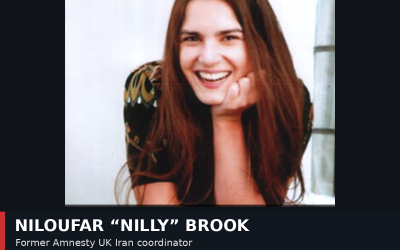
According to The Times, Brook allegedly praised the late Ali Khamenei’s character, including references to his supposed integrity and decency, and described him as a “warrior pope”.
She reportedly also shared sympathetic social media material following his death.
Brook’s reported comments deserve scrutiny, and Amnesty and Brook have disputed aspects of the account surrounding her departure and role.
But the central moral question remains unavoidable.
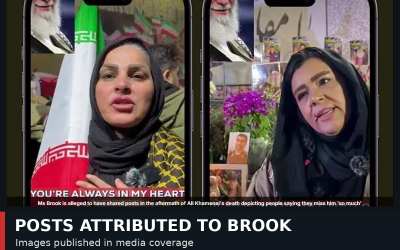
How can someone entrusted with helping coordinate human rights work concerning Iran express admiration for the man whose rule was associated with executions, arbitrary imprisonment, the persecution of women and the violent suppression of dissent?
Imagine a human rights volunteer responsible for documenting repression in a country describing its former dictator as a man of honour.
Would the organisation simply shrug? For Iranians who lost relatives, were imprisoned, were tortured or were forced into exile, Khamenei was not a misunderstood spiritual leader. He presided over a political system built on fear, ideological coercion and organised repression.
The suggestion that a person tasked with supporting Iranian human rights work could publicly romanticise that leadership is not a minor embarrassment.
It raises a serious question about political judgement and the standards expected of people representing a human rights organisation.
Amnesty’s defence does not settle the argument
To be fair, Amnesty International rejects Joeghan’s account of an organisation neglecting Iran.
It points to decades of research, documentation and campaigning against abuses by the Islamic Republic, including a major report published in September 2026 concerning crimes against humanity during the Woman, Life, Freedom uprising.
That work matters. Documenting atrocities, identifying officials responsible and demanding accountability can help preserve evidence for future proceedings.
But a substantial research record does not automatically answer concerns about organisational culture, political bias or the treatment of internal complaints.
Indeed, the contrast makes Joeghan’s allegations more troubling.
How can an organisation produce detailed documentation of the Iranian state’s atrocities while allegedly tolerating expressions of admiration for the man who presided over those very abuses?
And why should an Iranian refugee who raised concerns about these contradictions leave feeling that she had not been adequately heard?
The public deserves more than an assurance that Amnesty publishes reports.
It deserves a clear explanation of the organisation’s standards of impartiality and how those standards were applied in this case.
Israel and the moral bankruptcy of selective outrage
I have argued repeatedly that Israel represents a vital moral and political distinction in the Middle East.
Israel is an imperfect democracy, like every democracy. Its government can be criticised, its policies challenged and its leaders held accountable.
But Israel has competitive elections, an independent judiciary, a free press, and legal protections that allow women, religious minorities and LGBT citizens freedoms denied under the Islamic Republic. The comparison with Tehran’s theocracy is not remotely difficult.
I believe Israel’s commitment to preserving a democratic society while confronting Islamist terrorism makes it a moral compass in a region where such freedoms cannot be taken for granted.
Yet in parts of Western activist culture, Israel has become the permanent villain, while the crimes of Islamist regimes are too often pushed into the background.
This does not mean Palestinian civilians have no rights or that their suffering should be ignored. They do, and it should not.
It means that advocacy for Palestinian rights must never become an excuse for defending Hamas, romanticising dictators or denying Iranians their own struggle for freedom.
There is a profound difference between defending Palestinian civilians and endorsing the political project of Hamas.
The latter is a terrorist organisation whose October 7 atrocities included the murder and abduction of civilians.
Likewise, there is a profound difference between opposing a military strike on Iran and making excuses for the Islamic Republic.
When supposedly progressive activists refuse to maintain those distinctions, their universalism begins to look remarkably selective.
The Iranian people are not a prop in someone else’s ideological war
For decades, Iranians have fought against compulsory religious rule, censorship, political imprisonment, torture and executions.
They have paid for that resistance with their livelihoods, their freedom and, in countless cases, their lives.
Their struggle is not an extension of Palestinian nationalism, Western anti-imperialism or fashionable university politics.
It is a struggle to reclaim their country.
The Islamic Republic has spent nearly half a century attempting to convince the world that Iran and its revolutionary ideology are inseparable.
They are not.
The Iranian people existed long before the Islamic Republic and will exist long after it.
And those of us who defend Israel, oppose Islamist extremism and support the Iranian people’s right to determine their future are not required to apologise for refusing the ideological categories imposed by Western activists.
The cause of Iranian freedom deserves its own voice, its own attention and its own moral legitimacy.
Human rights must mean something again
Sara Saei Joeghan joined Amnesty International because she believed that an organisation defending prisoners of conscience and victims of repression would stand unequivocally against the Islamic Republic’s abuses.
Her account of what happened afterwards should be deeply uncomfortable reading for Amnesty’s leadership.
The organisation has an opportunity to answer her concerns transparently, explain its handling of the allegations about Brook and demonstrate that its Iran work is not subject to ideological gatekeeping.
But this controversy also sends a warning to the wider human rights industry.
You cannot claim to defend universal human rights while allowing political loyalties to determine which victims deserve a platform.
You cannot claim impartiality while treating some forms of opposition to dictatorship as politically unacceptable.
And you cannot expect Iranian dissidents to remain silent when people associated with human rights organisations allegedly praise the leaders responsible for their persecution.
Amnesty International does not need another slogan about justice. It needs to prove that its principles apply even when the victims and their political beliefs are inconvenient.
The Iranian people do not need Western organisations to tell them which causes should matter more than their own freedom.
They need solidarity, consistency and the courage to confront their oppressors without excuses.
Human rights are universal. If Amnesty cannot consistently defend that principle, it has lost the moral authority its name is supposed to represent.
Related Topics
Related Posts