Russian-American-Israeli Palestinian. Palestine is Israel.
Amos Oz, AI, and the Burden of Decisions
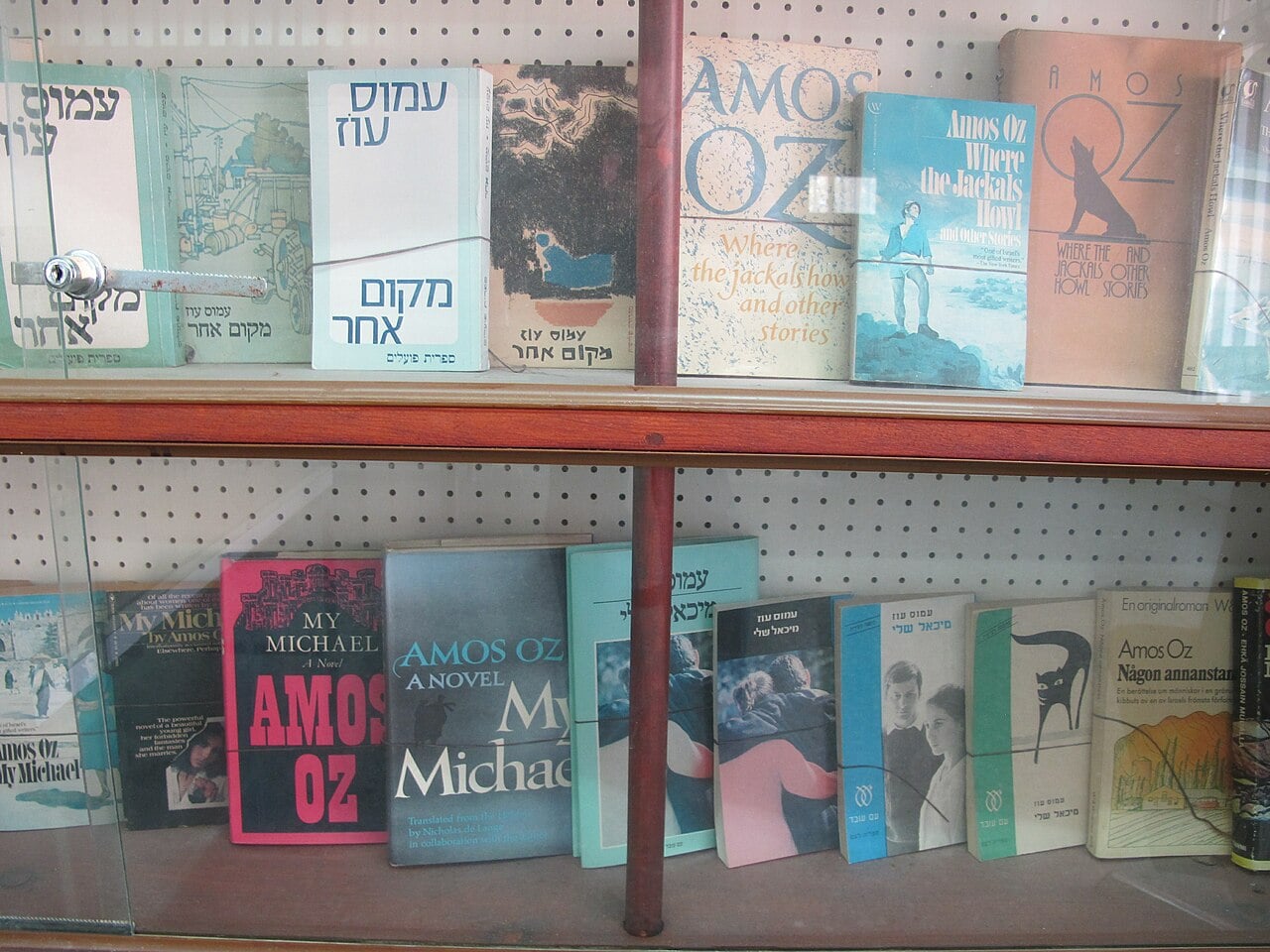
Amos Oz’s books on display at the entrance to the Kibbutz Hulda archive, a quiet reminder of a writer’s labor, patience, and the countless decisions behind every word. Photo by Michael Jacobson (CC BY).
Exploring Creativity, Judgment, and the Role of Technology in Craft
Amos Oz (1939–2018), one of Israel’s most celebrated contemporary writers, once described writing a novel as an act of almost unreasonable patience. To write eighty thousand words, he said, is to make a quarter of a million decisions. Not only the obvious ones, such as plot, character, love, betrayal, life and death, but the finer ones too. Whether the light is blue or bluish. Whether the word should appear at the beginning of a sentence, or only shine faintly at the end. Whether it should be named at all, or merely suggested.
Here are his exact words:
Writing a novel, I said once, is like trying to make the Mountains of Edom out of Lego blocks. Or to build the whole of Paris, buildings, squares, and boulevards, down to the last street bench, out of matchsticks.
If you write an eighty-thousand-word novel, you have to make about a quarter of a million decisions, not just decisions about the outline of the plot, who will live or die, who will fall in love or be unfaithful, who will make a fortune or make a fool of himself, the names and faces of the characters, their habits and occupations, the chapter divisions, the title of the book (these are the simplest, broadest decisions);
not just what to narrate and what to gloss over, what comes first and what comes last, what to spell out and what to allude to indirectly (these are also fairly broad decisions);
but you also have to make thousands of finer decisions, such as whether to write, in the third sentence from the end of that paragraph, ‘blue’ or ‘bluish.’ Or should it be ‘pale blue’? Or ‘sky blue’? Or ‘royal blue’? Or should it really be ‘blue-gray’?
And should this ‘grayish blue’ be at the beginning of the sentence, or should it only shine out at the end? Or in the middle? Or should it simply be caught up in the flow of a complex sentence, full of subordinate clauses?
Or would it be best just to write the three words ‘the evening light,’ without trying to color it in at all?
— Amos Oz, A Tale of Love and Darkness (2002)
This is not a romantic description of writing. It is almost anti-romantic. There is no thunderbolt of inspiration here, no divine whisper. There is work. There is attention. There is responsibility for every small choice.
And it is precisely here, at the level of choice rather than inspiration, that artificial intelligence enters the writer’s workshop.
AI does not bring talent. It does not bring voice. It does not bring moral vision, emotional truth, or lived experience. What it brings is assistance in navigating the overwhelming density of decisions that Oz describes so soberly. It is not an author. It is a tool.
In that sense, AI is best understood not as a rival to writing, but as an extension of the long history of cognitive tools that writers already rely on. Spell checkers did not make writers illiterate. Word processors did not kill style. Dictionaries did not flatten language. Each of these tools removed friction from mechanical or repetitive tasks, allowing attention to shift elsewhere. Artificial intelligence does the same, only at a higher resolution.
One might dismiss it as a spell checker or autocomplete on steroids, but that would underestimate what is happening. Large language models help writers formulate thoughts, explore phrasing, test tone, and examine alternatives at speed. They surface possibilities. They do not decide.
The fear that AI will flood the world with bad writing is not entirely unfounded, but it is also misdirected. The real danger is not AI-assisted writing, but unchecked automation. When texts are generated en masse without human review, judgment, or accountability, quality erodes. But this is not a property of AI. It is a property of negligence.
On average, when used responsibly, AI increases quality. It raises the floor. It does not lower the ceiling.
A writer of genius, someone like Amos Oz, does not become less precise because a tool accelerates the drafting process. If anything, such a writer gains time. Time to reconsider. Time to refine. Time to return once more to the question of whether the light should be blue or bluish. The quarter of a million decisions remain. They are simply reached by a shorter path.
For less gifted writers, the effect can be even more pronounced. When language models are trained on good writing, coherent argument, and careful structure, they expose patterns that many people never formally learned. Rhythm. Transitions. Balance. Restraint. Used attentively, AI becomes a teacher as much as an assistant. It does not replace learning. It accelerates it.
There is nothing unprecedented about this. Throughout history, many prolific or influential figures relied on extensive assistance. Politicians dictated speeches written by others. Public intellectuals depended on editors who shaped arguments line by line. Some famous authors worked with collaborators or ghostwriters who handled drafts while the named author performed the final pass, applying judgment, voice, and coherence. Many “single-author” books are, in fact, heavily shaped by editors and research assistants.
Alexandre Dumas famously ran what was, in effect, a literary workshop, producing novels at a scale that would have been impossible alone, while retaining final authority over tone, structure, and narrative direction. In our own time, James Patterson has openly built a model of large-scale collaboration, working with co-authors while remaining the organizing intelligence behind the work.
This arrangement was not considered immoral. It was considered efficient.
In that light, artificial intelligence is a peculiar kind of ghostwriter. It does not demand credit. It does not displace another human being. It does not have interests of its own. And it is available not only to the powerful, but to anyone with access to a keyboard. From an ethical standpoint, this is not corruption. It is democratization.
Yet despite this, a strange shame has grown around using AI. Some people hide it. They deliberately remove stylistic markers. They inject awkward phrasing. They add typos. They normalize quotation marks and strip punctuation so that no one suspects assistance. This is not integrity. It is theater.
Hiding AI use is like deliberately misspelling words so that no one thinks you used a dictionary. Ironically, I predict that some people will do the opposite — deliberately adding stylistic markers so that no one thinks they were trying to hide AI use.
Even more curious are those who publicly complain that they are tired of reading AI-generated text, while quietly using AI themselves to write those very complaints. Sometimes they forget to scrub all the traces. A quotation mark gives them away. A rhythm does. The irony would be comic if it were not so revealing.
The truth is simpler and less dramatic. In the near future, everyone will use AI in some form, just as everyone uses calculators, computers, and spell checkers today. No disclosures are required for those tools, and none should be required here either. Their use should be assumed by default.
What matters is not whether AI was used, but whether the final product satisfies the creator’s own standards. Whether it expresses exactly what they intend. Whether they stand behind every sentence, every note, every brushstroke, every design, every translation, every line of code, every frame of film.
Some claim that AI will soon plan and coordinate all work, replacing nearly all humans, leaving only a handful to supervise machines. It is true that AI already automates tasks such as translation, editing, and coding. But this does not eliminate human contribution. It redistributes it.
AI excels at execution within defined parameters. It does not possess intuition, lived judgment, or moral responsibility. It cannot replicate the distributed creativity of millions of independent minds making uncoordinated, value-laden choices. When certain tasks are automated, humans are not rendered useless. They are freed to do different work. To learn. To synthesize. To imagine. To choose.
AI can generate novel situations, stories, or images, but it does not truly imagine in the human sense. It recombines patterns it has learned rather than simulating outcomes with understanding or intention. It cannot predict consequences as humans do, nor weigh actions morally, socially, or emotionally.
This brings us back to Amos Oz.
Writing, as he understood it, is not typing. It is choosing. Artificial intelligence does not make those choices for us. It simply places more options on the table, faster than before. It externalizes the inner editor. It makes the silent questions louder and more explicit. Blue or bluish. Here or there. Say it plainly or let it glow indirectly.
The responsibility remains human. Always.
If AI has value, it lies precisely here. Not in replacing voice, but in helping us express it more clearly. Not in thinking for us, but in sharpening the act of thinking itself.
The evening light still belongs to the writer. Whether it is blue, bluish, or left unnamed remains a human decision.
* * *
Related Topics
Related Posts