An escape escalator to heaven or the divine call to earth?
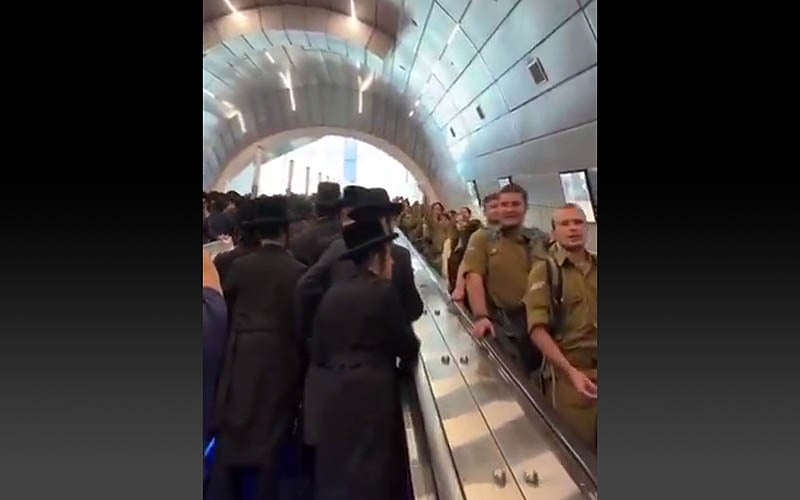
I’ve looked at this picture of the soldiers and the Haredim on the escalator countless times. Not only because it captures, in one searing frame, the fractures running through Israeli society at this moment, but because it gestures toward a rift woven into our people’s story from its very beginnings — a theological fault line that surfaces again in this week’s parsha.
It is the rift between Yaakov and Yisrael.
Between the quiet, sheltered “ish tam yoshev ohalim” — the man who dwells serenely in the tent, immersed in the safe world of sanctity and interiority, protected from the vicissitudes of the field — and the man he becomes: Yisrael, the name that will define the Jewish destiny.
The man thrust into exile, compelled to leave home and certainty behind, to wrestle with forces he barely understands — human, divine, or internal — his life unfolding in ruptures that carry him through fear, longing, resilience, and transformation.
And nowhere is this journey expressed more vividly than in Yaakov’s dream in this week’s parsha. At first glance, it appears, in the words of Led Zeppelin, to be a “stairway to heaven”: a glimpse of the Divine, a fleeting passage into transcendence and clarity. But, in truth, the dream calls him to the opposite. Rather than inviting Yaakov to ascend, the vision grounds him. It teaches that the connection between heaven and earth is not a route of escape, but a charge of engagement.
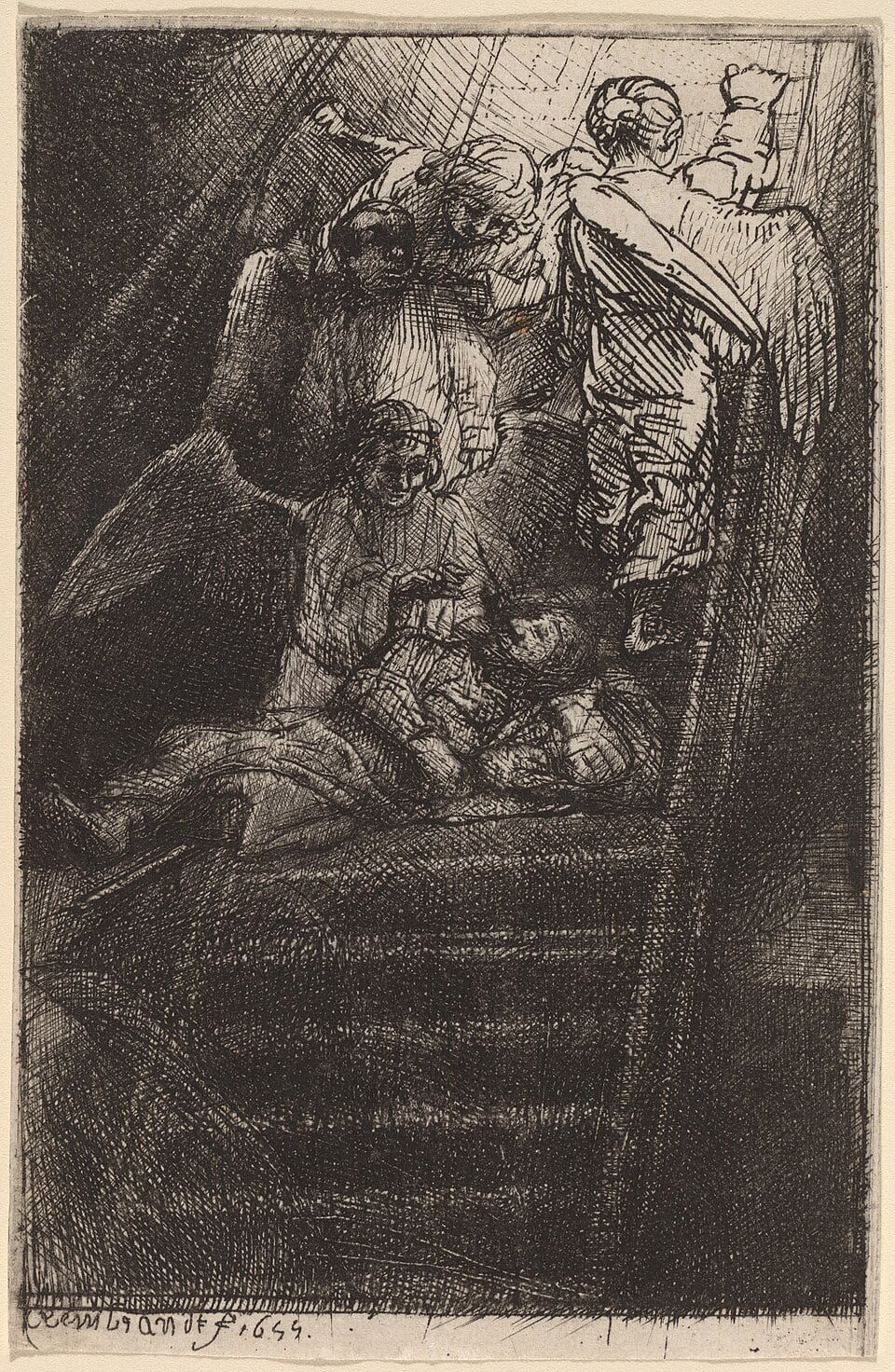
It is no wonder that this meeting point between heaven and earth has fascinated artists from Chagall and Rembrandt and beyond. The image captures not only the human imagination but also the curiosity of modern philosophers who grapple with how God fits within a worldview shaped increasingly by scientific rationalism.
Classical responses to this tension often collapse the ladder entirely: some naturalize or collapse God into the fabric of nature — as Spinoza does — or blur God into the universe through pantheism. Others, in the spirit of Nietzsche’s proclamation of the “death of God,” deny transcendence altogether, insisting that the modern world has no room for Divine Presence. In all these visions, the ladder disappears — there is no heaven to reach for, and no God who reaches toward us.
The opposite extreme insists that God is found only beyond the world — the mysterium tremendum accessible solely through radical mysticism and withdrawal. Yet such asceticism is equally foreign to the Jewish imagination.
The image of Yaakov’s ladder suggests that the fragile yet essential connection between heaven and earth might be discovered beyond these binaries.
וְהִנֵּה֙ מַלְאֲכֵ֣י אֱלֹקים עֹלִ֥ים וְיֹרְדִ֖ים בּֽוֹ׃
“And behold, angels of God were ascending and descending upon it.”
(Genesis 28:12)
The angels ascend before they descend. The movement heavenward originates from a ladder planted firmly in the earth below. Jacob is not asked to climb the ladder heavenwards. He is asked to wake up.
“Vayikatz Yaakov mishnato — And Jacob awoke from his sleep” (28:16)
In awakening from his dream, he exclaims:
“אָכֵן יֵשׁ ה’ בַּמָּקוֹם הַזֶּה וְאָנֹכִי לֹא יָדָעְתִּי – Behold God is in this place and I did not know!”
The shock is precisely this: Could God be here — in the chaos, outside the boundaries of the tent and the known, beyond the holiness of the land itself? And perhaps most startling of all: is God with him even after the betrayal? Is God in this place; in that alien part of himself that looks so different from the Yaakov he thought he was?
The answer is yes.
God is found precisely in this place — in the parts of life marked by nuance and rupture, darkness and enigma; in the boundary between the conscious and the unknown; in the liminal space where certainty dissolves. It is there that God reveals Himself to Jacob for the first time.
Judaism is not a tradition that seeks escape from the world. It invites us to find the Divine within the raw, unvarnished texture of lived experience — to intuit patterns of holiness in the midst of confusion, struggle, and becoming. Covenantal life, as the Torah teaches, is not about ascending to pristine holiness above but about meeting the Divine within the dust and complexity below.
In the words of Martin Buber: “If you can hallow this life, you meet the living God.”
It is not accidental that the Hebrew term for soldiers entering the battlefield is “שדה קרב” — s’deh k’rav, literally, the field of battle. Just last week, we watched as Yaakov moved from the sheltered dweller of tents to the man of the sadeh, the field. Soldiers enter the field not because they seek it, but because circumstances thrust them there. So too with Yaakov. He did not choose to become, in part, Esav; the role was placed upon him by his mother, Rivka, and, more profoundly, by destiny itself. He resisted it at first. His deception is fraught with moral complexity, and the questions around it remain unsettling. But the deeper truth remains: had Yaakov stayed in the tent, we would never have become the people we are.
Ordinary people become extraordinary not by lying on a beach in Barbados, but by walking into the field — the place where challenge, adversity, and the hard work of cultivating character shape who we become. Personal transformation is rarely born of comfort; it emerges from the terrain we never chose.
This idea — that the ordinary can become extraordinary — brings to mind a song that has become part of the emotional soundtrack of this period: “Giborei Al” (Superheroes) by the Israeli band Hatikva 6. It reminds us that superheroes are not born with innate superpowers. They are ordinary people, living ordinary lives, who choose to rise above the everyday and act in extraordinary ways.
Yaakov’s ladder invites us to see these everyday heroes in a new light. The angels ascending and descending are not otherworldly beings — they are us, whenever we rise to the occasion. They remind us that holiness is not about escaping life but transforming it.
The Torah introduces not only a revolution in theology — monotheism — but a revolution in anthropology. In the Bible, God is not a capricious force but a relational entity who enters into a covenant with humanity. We do not merely believe in God; we are shown that God believes in us, calling us away from spiritual escapism toward engagement in and with the world. The image of Yaakov’s ladder reminds us that the greatest mistake is to confuse spiritual height with spiritual flight. The danger is never in devotion itself, but in the direction it takes.
But even the right direction requires constant recalibration, and the parsha itself warns us of this through its two dream-bookends.
Dream Bookends:
At the start, when Yaakov is still locked into his idealistic tent-dweller persona, he dreams of angels, ladders and transcendence — but the call is to step into the world he has yet to enter. Later, in Lavan’s house, his dreams shift. No angels, only sheep and the grind of work. There, God reminds him to step outward to the bigger picture of covenant, purpose, and mission.
Young Yaakov, the tent-dweller, must learn that holiness exists beyond the safety of his righteous interior world. Older Yaakov, the man of the sadeh — the field — must be reminded that ambition and success are not ends in themselves. Together, the dreams teach him — and us — to preserve the ladder that connects heaven and earth so that the repetitive, earthbound work of daily life — can also carry divine meaning when lived with intention and awe.
Two Ladders, Two Theologies
This is precisely what that modern photograph captures — two opposing ladders, two opposing theological orientations.
On one escalator, the soldiers descend.
On the other, the yeshiva students ascend.
It is not their clothing, religiosity, profession, or politics that define the divide. It is something far more fundamental: a difference in how one understands the direction of Jewish life.
The ascending figures embody the instinct toward escape — an orientation that imagines the pinnacle of spirituality in the “tent,” shaped by separation, purity, innocence, and protection against the dangers of the world.
The descending figures embody the opposite — the journey toward responsibility in the sadeh, the field, where moral purity is risked in the hard work of repair, protection, survival, and transformation.
This is our moment of becoming Yisrael
In our long history, there were moments when Yaakov’s tent — withdrawal, inwardness, self-protection — was the only paradigm that ensured Jewish survival. But this is not one of those moments.
If we are to survive and flourish — if we are to fulfill our calling as a light unto the nations; if we yearn for healing in our people, our society, our spiritual life — then we must step out of the tent.
What is needed now is nothing less than a theological recalibration: a return to the Abrahamic and Jacobic vision in which God calls us not away from the world but into it. We must choose — consciously, courageously — the direction of Yaakov’s ladder.
“Behold, God is in this place, and I did not know it.”
Yaakov’s words are a wake-up call — not only for him but for us. They remind us to see the divine in the mundane, and to recognize that angels are often ordinary human beings who rise to the moment not by elevating earth to heaven but by bringing heaven just a little closer to earth.