Strategic Intelligence Consultant & Insights Advisor
An Open Letter to the Archbishop of Canterbury
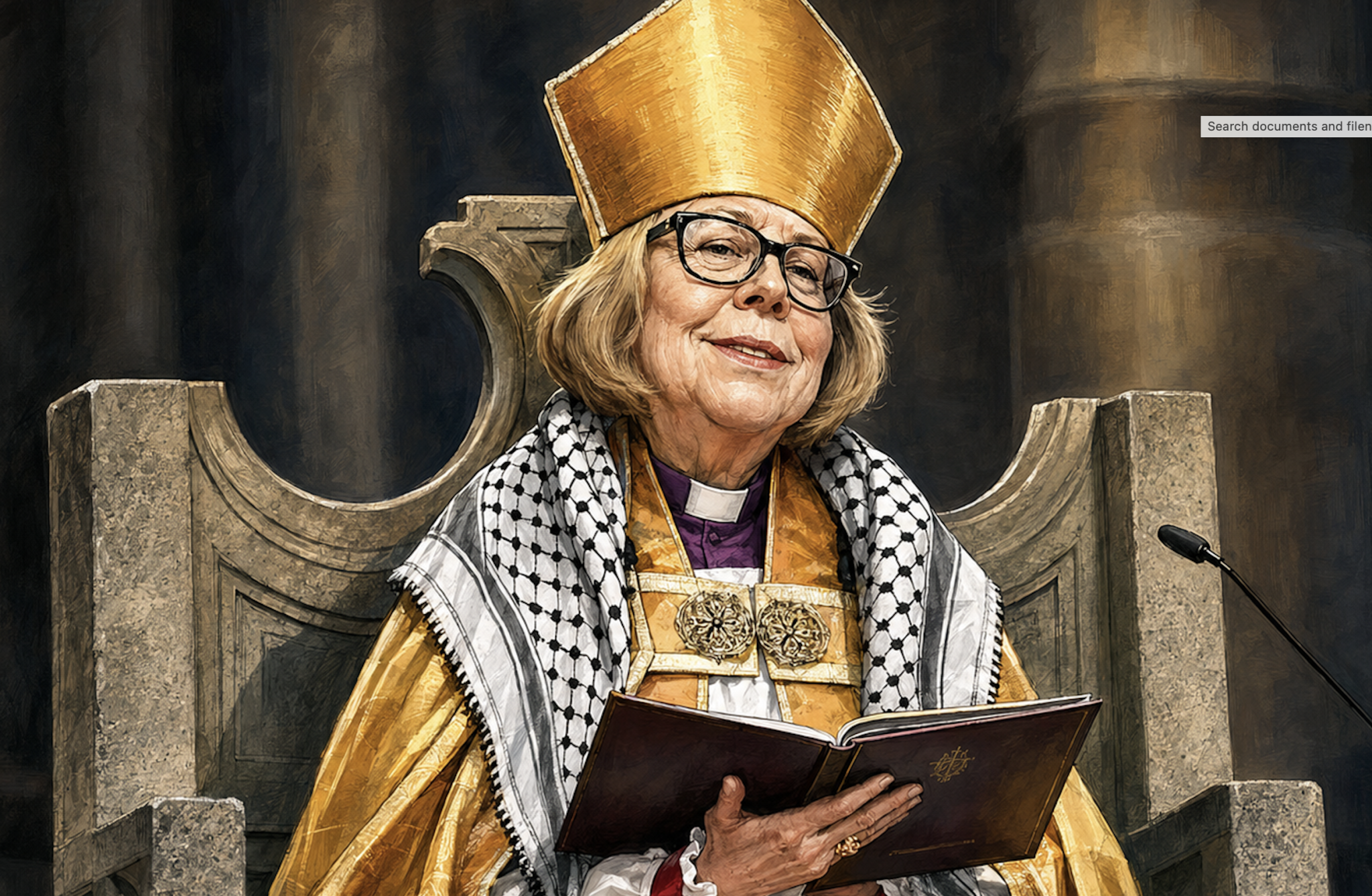
Archbishop of Canterbury (caricature made by AI)
You grieved for Palestinian Christians in the Holy Land. I ask you to grieve, with equal honesty, for the Jewish lives that 7 October stole — and to name what truly stands between this land and peace.
A response to the joint pastoral letter of Archbishop Sarah Mullally and Archbishop Hosam Naoum, issued at the close of their pilgrimage to the Holy Land.
Your Grace,
I write not to dismiss your pilgrimage but to take it seriously. You went to the Holy Land to pray with Palestinian Christians, to sit with families who feel unmoored by years of conflict, and to plant an olive tree on land its owners fear losing. A Christian leader who cares about the ancient Christian presence in that land, who weeps for the suffering in Gaza, and who longs for peace is doing something honourable. I do not doubt the sincerity behind your words, and I share your grief for innocent civilians.
But moral seriousness asks more of us than compassion. It asks for context, proportion and honesty. Your letter, written with Archbishop Naoum, presents Israel as the principal author of Palestinian suffering, while saying almost nothing about the ideology and the choices of the Palestinian leadership that brought mass murder, hostage-taking and war into Israeli homes on the morning of 7 October. A Christian appeal for peace cannot be credible if it treats Jewish self-defence as the central moral problem and leaves the eliminationist forces of Hamas and Palestinian Islamic Jihad as little more than background noise.
So I offer this reply in the same spirit in which I hope your letter was written: directly, and to each of the claims you made.
“A credible path towards ending the occupation”
You urge Anglicans to press politicians towards ending the occupation, as though Israel need only withdraw and peace will follow. The recent past says otherwise. In 2005 Israel removed every settlement and soldier from Gaza. Within two years Hamas seized the Strip by force, and the blockade you and others lament followed because of that takeover and the rockets that came with it — it did not precede it.
That sequence is not a debating point; it is the lived memory that shapes how Israelis hear the word “withdrawal.” Israel’s security posture was not handed down as theology. It was built, painfully, out of suicide bombings, rockets, tunnels, abductions and cross-border raids, and above all out of 7 October. To ask Israel to relinquish control without enforceable guarantees is not a peace plan. It is a request that Israel gamble with Jewish lives, and Israelis are entitled to refuse a second Gaza overlooking their towns.
The West Bank is also more complicated than the phrase “the occupation” allows. Jordan annexed it in 1950, a move almost no state recognised; Israel took control in a defensive war in 1967. UN Security Council Resolution 242, so often invoked, did not demand unilateral surrender to undefined lines. It tied withdrawal to the end of belligerency and to the right of every state in the region to live within secure and recognised borders. You cite the 2024 ICJ advisory opinion; you might equally have cited the framework the parties themselves signed at Oslo, which left borders, settlements, refugees and Jerusalem to be negotiated — not settled by declaration.
A two-state solution — but with whom, and on what terms?
You call for a viable two-state solution in which Israelis and Palestinians live in peace, dignity and security. As an aspiration, that is at least morally sound, and I share it. But if we do consider it, it becomes an empty phrase unless the Palestinian side is asked to do the one thing your letter never names: recognise Israel as the nation-state of the Jewish people and abandon armed rejectionism. At least their leadership does not want a two state solution.
The obstacle is not that Israelis refuse peace as such. It is that Hamas and Palestinian Islamic Jihad have treated the whole of Israel as illegitimate. Hamas’s 1988 covenant did not merely object to Israeli policy; it called for religious war, named jihad as its path, and declared all of Palestine an inviolable Islamic trust. Its softer 2017 document still denied Israel’s legitimacy, still spoke of the land “from the river to the sea,” and accepted 1967 lines only as a staging post, never relinquishing the claim to the whole. That is not a two-state programme. It is a rejectionist one in instalments — and a letter that asks Israel to concede territory while saying nothing of this asks only one party to take the risk.
Jerusalem cannot be shared by erasing one of its peoples
You write that Jerusalem’s status should be settled by negotiation as a shared capital, respecting the rights of all faiths, the historic Status Quo and the Hashemite custodianship of the holy sites. Negotiation, yes. But any honest discussion of Jerusalem must begin with a truth your letter passes over: Jerusalem is not shared in history by Christians and Muslims. It is mainly and most importantly the centre of Jewish prayer, Jewish memory and Jewish peoplehood, and has been for three thousand years.
A “shared” Jerusalem cannot mean one that validates Christian, Muslim and Palestinian claims while treating the Jewish claim as negotiable or absent. Hamas’s own charter is candid about this: it assigns the holy places to the Palestinians and the wider Islamic world and refuses the Jewish state any legitimacy at all. A Christian leader should be the first to resist that framing, not to echo its silences. To speak warmly of Christian roots in this land while speaking faintly of Jewish rootedness risks reviving an old and bitter Christian error — the habit of seeing Jews as guests in their own ancestral home.
Palestinian Christians matter — and Israel is not their simple cause
The decline of Palestinian Christianity should trouble Jews and Christians alike. It is an ancient community, and its survival matters. But it is misleading to lay its vulnerability chiefly at Israel’s door. Christian emigration is driven by war, economic stagnation, political dysfunction, corruption and the steady Islamist pressure that has hollowed out Christian communities across the whole region — from Iraq to Syria to Lebanon. Even in Bethlehem, the picture is one of hardship, insecurity and fear from many directions, not a single Israeli cause.
There is a contrast your pilgrimage did not dwell on. Inside Israel, Arab Christians are full citizens, and their community has grown rather than collapsed. The honest question a Christian leader must also ask is this: what future would Christians have under Hamas, under Islamic Jihad, or under any political culture that treats Jewish sovereignty as a blasphemy to be erased rather than a neighbour to be accepted?
Checkpoints are a hardship, not an original sin
You spoke of the web of checkpoints Palestinians must navigate. That hardship indeed is real, and it touches work, health, study and dignity. It should never be waved away. But to describe the checkpoint without the bombings and massacres that produced it is to show the consequence and hide the cause. Israel’s restrictions arose in a country whose buses, cafés and crossings were targeted by suicide bombers, gunmen and terror cells, and whose southern communities were overrun on 7 October.
A state has not only the right but the duty to protect its citizens; Article 51 of the UN Charter affirms it. The real debate is not whether Israel may defend itself — it may — but how to make those defences effective, lawful and as light as possible on ordinary lives. That is a serious conversation, and I would welcome the Church’s voice in it. It is not the same as casting Israeli security itself as the sin.
Condemn settler violence — and do not let it define a nation
Your letter names “settler” violence and forced displacement; the accompanying Lambeth Palace statement, not the pastoral letter, spoke of expanding settlements. On the violence, we could agree. Some attacks by some Israeli extremists on Palestinians are criminal, shameful and strategically self-destructive. They should be investigated and prosecuted, and Israel should do more, not less, to enforce its own law against them. A defence of Israel does not require defending every settler or every outpost.
But settler crime, however grave, cannot be made to cancel the Jewish people’s right to self-determination, nor to excuse terrorism against Israelis. The moral logic is simple and it cuts cleanly: prosecute the violent, dismantle the unlawful — and still affirm that Israel is a legitimate state with legitimate security needs. One does not dissolve the other. Judea and Samaria is the heart of our Jewish Patriarchs and Matriarchs.
“Illegal settlements” is a contested claim, not a closed case
The Lambeth Palace statement accompanying your visit, like much Church language, treats the illegality of the settlements as settled. It reflects the majority and mainstream view of many international bodies, and I do not pretend that view does not exist. But Israel rightly so contests it, arguing the West Bank or Judea and Samaria is disputed territory with genuine competing claims to be resolved by negotiation rather than by decree. One need not accept every Israeli legal argument to see that the question is harder than a single adjective allows. Oslo deliberately left settlements to permanent-status talks — alongside terrorism, incitement, demilitarisation, recognition, refugees and borders. A peace process that addresses only the settlements is not addressing peace; it is avoiding the harder question of what comes the day after Israel withdraws.
Detention deserves scrutiny — but it is not hostage-taking
You met Layan Nasir and the family of a young woman held without charge, and you carried their stories home. Administrative detention is a grave instrument; it should be exceptional, evidence-based, reviewable and never punitive, and democracies must hold it to rigorous account. I will not defend its overuse.
But your letter offers no case-specific detail — no allegation, no review, no security context — by which a reader might weigh these detentions. And it draws no line where one is morally essential: the line between a contested security detention subject to courts, and the abduction of civilians as bargaining chips. On 7 October, Hamas and Islamic Jihad seized women, children and the elderly from their homes and dragged them into Gaza. The UN’s own commission documented their part in the killings and the kidnappings. A Christian voice can criticise excessive detention and still say plainly: taking hostages is not resistance. It is a war crime.
Gaza’s agony is real — and Hamas began this war
The suffering in Gaza is profound. The collapse of its hospitals, the shortages, the dead and wounded children — none of this should be minimised, and I will not insult you by pretending otherwise. You rightly honour the Al Ahli hospital and those who serve there.
But moral clarity requires asking how Gaza came to this war. It did not begin with an Israeli whim. It began on 7 October, when Hamas-led attackers murdered roughly 1,200 people and abducted 251 into Gaza. And Hamas chose to fight from within one of the most crowded civilian spaces on earth, embedding itself among the very people whose deaths it then displays to the world. The law of armed conflict forbids using civilians as shields; Hamas has built its entire strategy upon it. This does not relieve Israel of its own duties of distinction, proportion and humanitarian access. But it does mean Hamas cannot manufacture a catastrophe and then wield that catastrophe as immunity.
International law cannot be a sword aimed at only one nation
You describe the region’s crisis as an abandonment of international law and a turn to military force, and you hold that war is never the answer. But the law you invoke is not a weapon reserved for Jewish self-defence. The same law forbids the murder of civilians, the taking of hostages, indiscriminate attack and the use of human shields — and it affirms the right of a state to defend itself once attacked. A letter that centres Israeli force while mentioning the “atrocities of 7 October” only once, and never naming Hamas, the hostages, the tunnels or the rockets at all is not balanced, and it is not, in the prophetic sense you would value, true. It is selective.
The obstacle your letter would not name
Let me be precise, because precision is a form of fairness. It is neither true nor decent to accuse all the Palestinias of genocidal intent towards us the Jewish people. I hope that at least some Palestinians want what anyone wants: safety, dignity, family, a future free of corrupt and violent rulers. Palestinian civilians are not Hamas, and I will not let anyone blur that line.
But it is entirely fair to say that Hamas and the factions around it have declared eliminationist aims toward Israel and toward Jews, in their founding charter and in their conduct. The most powerful armed Palestinian movement of our era has not sought a state beside Israel. It has sought Israel’s disappearance, and on 7 October it showed the world what that ambition looks like when it is acted upon. This is the reality your letter underplays. The Palestinian tragedy is not only that they lack a state; it is that they have been led, again and again, by men who preferred Israel’s destruction to their own people’s deliverance.
What a real peace would actually require
If a two-state solution is to be considered seriously, it must be worthy of the name: not a slogan, not a euphemism, but a framework grounded in security, recognition, and political reality. It would require, at the least: explicit Palestinian recognition of Israel as the Jewish people’s nation-state; an end to hostage-taking as policy; the disarmament or removal from power of Hamas and Islamic Jihad; a demilitarised Palestinian state with guarantees that keep it from becoming another Iranian missile base; an end to the incitement that teaches children that all of Israel is stolen and that killing Jews is heroic; and accountable Palestinian governance free of corruption and the cult of martyrdom.
A pilgrimage that visited only one grief
Archbishop, compassion that travels only one road is not Christian witness; it is political theatre dressed in pastoral language.
You went to the Holy Land and rightly heard the pain of Palestinian Christians. Their suffering matters. Their fear matters. Their future matters. But if your pilgrimage was meant to speak seriously about peace, justice and human dignity, why did your published itinerary appear to bypass the Israeli communities where Jews were butchered, raped, mutilated, kidnapped and burned alive on 7 October?
Why did you not go to the Nova festival site, where hundreds of young people — most of them Jews — were massacred and dozens abducted? Why did you not stand in Sderot, where civilians and police officers were murdered as Hamas gunmen stormed the city? Why did you not sit with Israeli parents whose children were slaughtered or seized as hostages? Why did you not meet the families of the women and men subjected to sexual violence — including rape and gang rape — on that day and when they were in captivity? And why did you not travel north, to the Israeli Jews and non-Jews driven from their homes because Hezbollah, an Iranian proxy, has shelled civilian communities across the border?
A Christian leader can care about Palestinians without erasing Israelis. You can oppose the hardship of the West Bank without minimising Hamas’s genocidal ideology. You can pray for Gaza without forgetting the hostages. But when a pilgrimage offers the world one people’s tears and not the other’s, it does not heal. It teaches the watching world that Jewish suffering is secondary — politically inconvenient, morally less urgent.
That is the wound this visit has deepened. A true pilgrimage of peace would have gone also to Nova, to Sderot, to the kibbutzim of the south, to the hostage families, and to the displaced communities of the north. Anything less risks turning solidarity into selective witness — and selective witness, however gently it is phrased, is exactly how the world learns to look away.
In closing
Your Grace, you have a particular responsibility, and I press it on you as a friend. A Christian leader speaking of the Holy Land is heir to a long and painful history in which Jews were too often cast as strangers in their own homeland. You have it within your office to refuse that inheritance — to speak of Jewish vulnerability, Jewish history and Jewish rights as plainly as you spoke of Palestinian ones.
The Jewish people are not foreigners in Jerusalem. Israel is not a colonial accident. And Israel’s security measures did not appear out of nowhere. Peace will not come from one-sided lament. It will come when Palestinian leadership accepts that Israel is permanent, that Jewish self-determination is legitimate, that terror is not resistance, that hostages are not currency, and that Jewish life is not expendable. Call for justice for Palestinians — please do — but hold to the same moral standard those who murder Jews, glorify violence and seek Israel’s end.
A credible path forward must defend Palestinian dignity and Jewish safety together. Anything less is not peace. It is moral evasion dressed as compassion — and the Holy Land has had enough of both.
With respect, and in hope,
Yaakov Chaliotis
A British Jew
Related Topics