
An Aging Jewish Feminist
An Unfinished Dialogue with My Sister: Parshat Vayeshev
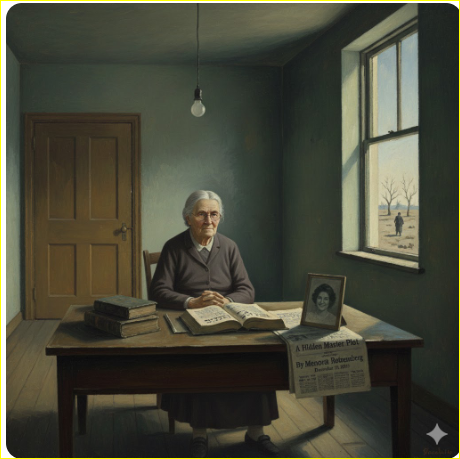
It is exactly a year ago that my beloved sister, Menorah Rotenberg died. By chance, when I taught my Genesis Bible class last week, we talked about the Joseph Cycle. I dedicated the class to my sister’s memory. She was obsessed with the Joseph story. I brought to their attention the analogies of the Joseph story with the Akedah. While teaching, I realized how my sister’s thoughts and writings had permeated my own thinking. She focused on the genotype—the passing on of trauma from one generation to the next. You can read the d’var torah she wrote in 2003, which appeared in the Forward. Here is a summary of her article entitled, “A Hidden Master Plot,” by Menorah Rotenberg.
 In my sister’s article she points to the fact that the Joseph narrative, echoes many recurring themes from Genesis. One of the most prominent motifs—expulsion—reappears immediately, this time with Joseph as the outcast. Yet the Joseph story also mirrors the Akedah, the Binding of Isaac. Joseph, like Isaac, is a cherished child: Jacob favors him above all his sons and gives him a special tunic, provoking his brothers’ hatred. This raises the question of where such excessive parental love will lead, given that the last time it appeared, it culminated in the near-sacrifice of Isaac. She points out that rereading this portion reveals numerous echoes of the Akedah’s language and imagery. Jacob sends Joseph to check on his brothers’ welfare. Menorah writes:
Even if Joseph’s narcissism had blinded him to his brothers’ hatred for him, and even if he hadn’t grasped the exasperated irony of Jacob’s precipitous send-off, he would have recalled that Shechem reeks with the butchery and violence associated with the rape of Dinah (Genesis 34). Joseph agrees to seek out his brothers and, in a striking parallel, he uses the terminology of the Akedah, echoing his great-grandfather Abraham’s words: “I am ready” (hineini, 37:13). He then goes out to seek his brothers, foolhardily wearing his tunic, which enables them to “see him from afar” (37:18), just as earlier Abraham saw “the place from afar” (22:4).
Joseph approaches his brothers visibly, from afar, marked by the tunic that fuels their anger, just as Abraham once saw the fateful mountain “from afar.” She writes:
Reuben’s entreaty — “do not lay a hand on him” (37:22) — reminds us immediately of the angel’s urgent charge to Abraham, “do not lay a hand upon the boy” (22:12). Then, fortuitously, “Abraham lifted up his eyes and saw and behold [hiney]… a ram was caught in the thicket… and he offered him up for a burnt offering [v’yaleyhu l’olah] instead of his son” (22:13). In our story, Joseph is languishing in a pit (37:24). His brothers “lifted up their eyes and saw, and behold [hiney], a caravan of Ishmaelites [37:24]… and there passed by Midianite merchantmen and they drew him up [v’yaluhu] from the pit and sold Joseph” (37:28).
Like Isaac before him, he is nearly sacrificed yet ultimately preserved. She concludes:
And so, once again, the beloved son was nearly sacrificed but saved by God to play a redemptive role. While the Akedah may not have been consciously revisited, it may nevertheless be the hidden master plot directing the narrative of the Joseph cycle.
JACOB WAS THE PROBLEM
Were my sister here today, I would ask her the question: Why did Jacob “duplicate” the story of the akedah by sending off his own son to slaughter? Was it unconscious? Deliberate? After all, he too was sent off by his parents to a foreign land, not to see them again for more than twenty years. It was surely foolhardy on Jacob’s part to send Joseph off to look for his brothers and to see if all was well (shalom) with them:
Israel said to Joseph, “Your brothers are pasturing at Shechem. Come, I will send you to them.” He answered, “I am ready — hineni.” And he said to him, “Go and see how your brothers are and how the flocks are faring — רְאֵ֜ה אֶת־שְׁל֤וֹם אַחֶ֙יךָ֙ וְאֶת־שְׁל֣וֹם הַצֹּ֔אן — and bring me back word.” So he sent him from the valley of Hebron (Genesis 37:14).
And who were these brothers? Jacob didn’t have a clue about his sons. These are the brothers who hated Joseph so much that they could not bring themselves to speak civilly (shalom) with him:
“And when his brothers saw that their father loved him more than any of his brothers, they hated him so that they could not speak a friendly word to him — וַֽיִּשְׂנְא֖וּ אֹת֑וֹ וְלֹ֥א יָכְל֖וּ דַּבְּר֥וֹ לְשָׁלֹֽם׃” (Genesis 37:4).
But was Jacob truly so unaware? Was this going to be some sort of test for Joseph? Or was he testing himself — following Abraham’s lead in “almost” sacrificing his son? My sister focused on Joseph “testing” himself, seeing himself as an Isaac figure, whereas I see Jacob identifying with Abraham. To my great sorrow, I am no longer able to share my thoughts with her, and tell her how her reading of biblical tales informed my own way of interpreting text.
BROTHERS AGAINST BROTHERS TODAY IN ISRAEL
The cruelty of Joseph’s brothers is inexplicable, even if Joseph was an insufferable narcissist who, for some unfathomable reason, was his father’s favored son. Equally inexplicable is the in-fighting and violence we see today among our “brothers” in Israel. A few days ago, I read with some shock the following:
Shalom Yerushalmi, the political correspondent of Zman Yisrael, reports on a violent incident that took place three weeks ago, in which the vehicle of outgoing Labor Minister Yoav Ben-Tzur was attacked. The attack itself was reported at the time, but Yerushalmi reveals this morning that during the incident, the minister’s personal security guard cocked his weapon, threatened the demonstrators, and was about to fire into the air. Ben-Tzur grabbed his hand and prevented him from shooting.
“The drawn weapon,” Yerushalmi writes, “is what drove off the dozens of rioters after they smashed the minister’s car window and threatened to harm him, his driver, and the security guard who were sitting inside the vehicle.” Israeli society is boiling more than ever, and the worst is still ahead of us as we enter the toxic months of campaigning before elections. Israeli citizens are now harming one another over ideological disputes, with violence that continues to escalate. This too is part of the legacy of the current government.” [ChatGPT translation from Hebrew]
The rupture in relationships is permeating our society. Our leaders are like Jacob — not only doing nothing about it, but exacerbating the chaos and hatred between his sons, Joseph’s brothers. The question that haunts me is whether this is the legacy handed down to us — a legacy of brothers unable to speak shalom to one another, of parents blind to the fractures within their own households, of leaders who do not care about the consequences of their words and actions. Are we destined to replay the tragedy of Joseph and his brothers on the stage of contemporary Israel? These stories are not meant to be read as distant history, but as a mirror. If we do not learn to see one another as kin, if we allow hatred and suspicion to rule our hearts, then the ancient cycle will continue unbroken. If we allow ourselves to recognize the warning embedded in Jacob’s failure and Joseph’s suffering, then we do not have to allow history to repeat itself. We can choose a future, in which shalom is not a word we fail to speak, but a value we fight to preserve.
May we have a real Shabbat of shalom!
Related Topics
Related Posts