London based entrepreneur, cybersecurity analyst doing a PhD in AI
Analysing Moses – Take off your Sandals.
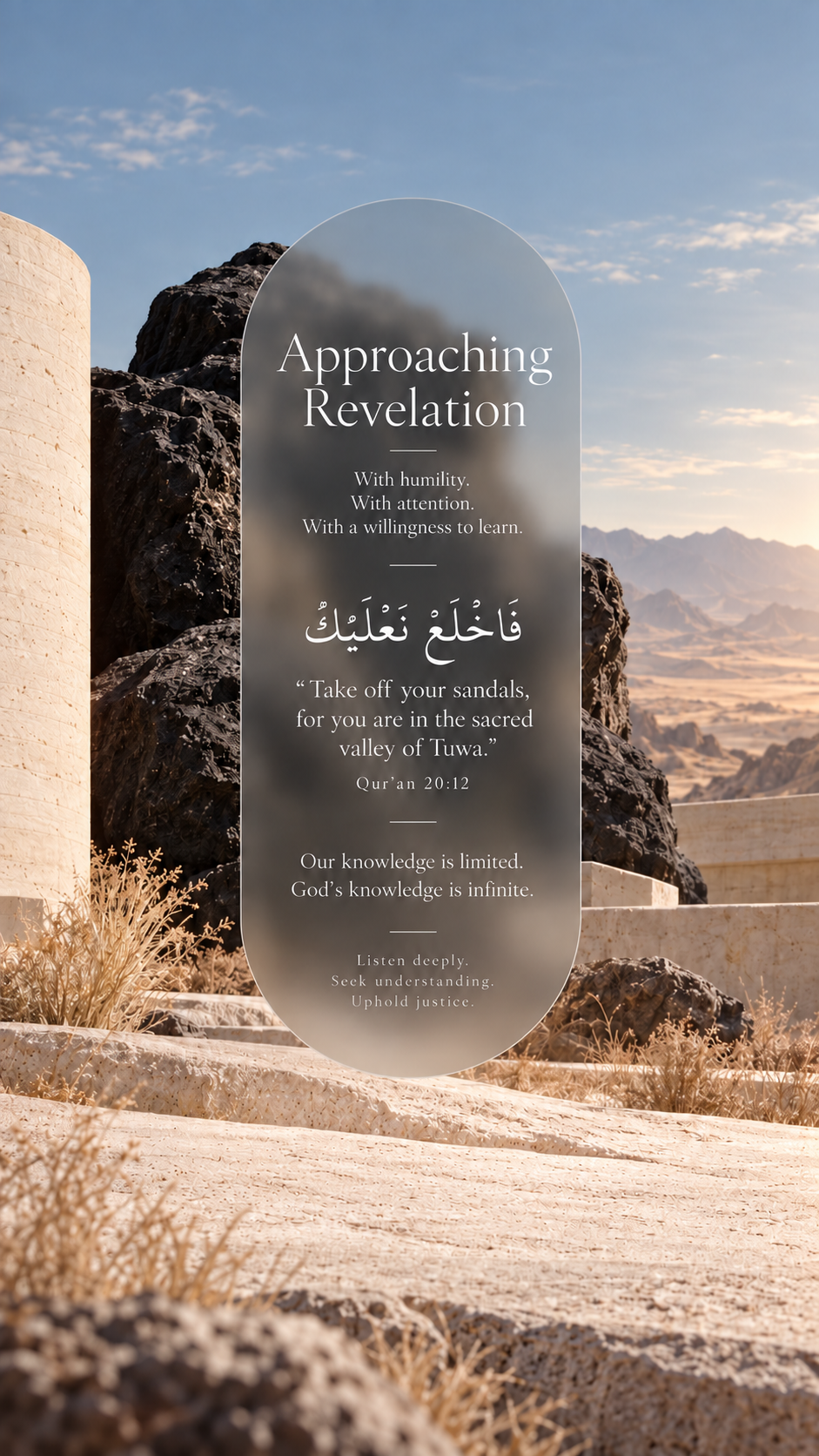
Approaching revelation requires humility.
Taking Off Your Sandals: Humility Before God, Responsibility Before Others
Approach revelation with humility. Trust God with the unseen. Use your intellect—and protect other people’s rights.
1. Approaching Revelation With Humility
Moses عَلَيْهِ ٱلسَّلَامُ approaches a fire. Then he hears a command that changes the significance of where he stands:
“I am indeed your Lord. Remove your sandals, for you are in the sacred valley of Tuwa.”
— Qur’an 20:12, full verse, translation of the meaning.
Taking off his sandals sets the stage. Something momentous is happening. Moses عَلَيْهِ ٱلسَّلَامُ is being addressed by God, and the sacredness of the encounter requires reverence.
The next verse makes the purpose clear:
“I have chosen you, so listen to what is revealed.”
— Qur’an 20:13, full verse, translation of the meaning.
First, recognise where you stand. Then listen.
Ibn Kathir includes respect for the blessed place among the explanations for removing the sandals. Ma‘arif al-Qur’analso discusses humility. The command concerns actual sandals; the connection with our attitude towards revelation is a reflection drawn from the encounter. Ibn Kathir; Ma‘arif al-Qur’an.
There is a useful parallel with Wudu, the ablution through which Muslims prepare for prayer:
“You who believe, when you rise for prayer, wash your faces and your arms to the elbows, wipe your heads, and wash your feet to the ankles. If you are in a state of major ritual impurity, purify yourselves. If you are ill or travelling, or one of you has relieved himself, or you have been intimate with women, and cannot find water, then seek clean earth and wipe your faces and hands with it. God does not intend to impose hardship upon you; He intends to purify you and complete His favour upon you, so that you may be grateful.”
— Qur’an 5:6, full verse, translation of the meaning.
Removing sandals at Tuwa and performing wudu are distinct commands. Yet both remind us that approaching the sacred involves preparation.
Wudu establishes ritual purity. It can also become a moment of attention: we pause, prepare ourselves and recognise that we are about to stand in worship before God.
Similarly, the command to Moses عَلَيْهِ ٱلسَّلَامُ interrupts the ordinary course of his journey. He must become attentive to something greater than his immediate concerns.
That is how we should approach revelation: with questions, intelligence and a willingness to learn, recognising that our knowledge is limited and God’s is absolute.
Humility does not require abandoning thought. It requires accepting that we may need correction.
2. When Something Painful Happens: Trust God With What You Cannot See
We usually judge an event by its immediate effect. Receiving what we wanted feels good; losing it feels bad.
But we cannot see every consequence.
The Qur’an says:
“……Yet you may dislike something that is good for you, and love something that is bad for you. God knows, while you do not know.”
— Qur’an 2:216, full verse, translation of the meaning.
The immediate context concerns fighting prescribed despite the believers’ reluctance. Its teaching about knowledge and preference also invites wider reflection: what we desire may harm us, while something unwelcome may eventually benefit us.
Sometimes we discover this later. Sometimes the explanation remains beyond our reach.
Moses’ encounter with Khidr gives this limitation a memorable form. The Qur’an introduces the servant he meets:
“Then they found one of Our servants, to whom We had given mercy from Us and whom We had taught knowledge from Our presence.”
— Qur’an 18:65, full verse, translation of the meaning.
Moses witnesses a boat being damaged, a boy being killed and a wall being repaired without payment. He objects to what he sees. Later, explanations disclose what had been hidden:
“As for the boat, it belonged to poor people working at sea. I intended to damage it because beyond them was a king taking every boat by force.”
— Qur’an 18:79, full verse, translation of the meaning.
“As for the boy, his parents were believers, and we feared that he would overwhelm them with rebellion and disbelief.”
— Qur’an 18:80, full verse, translation of the meaning.
“So we intended that their Lord should give them in his place one better in purity and nearer in affection.”
— Qur’an 18:81, full verse, translation of the meaning.
Finally:
“As for the wall, it belonged to two orphan boys in the town. Beneath it was treasure belonging to them, and their father had been righteous. Your Lord intended them to reach maturity and bring out their treasure, as a mercy from your Lord. I did not do this on my own initiative. That is the explanation of what you could not bear patiently.”
— Qur’an 18:82, full verse, translation of the meaning.
The account helps us contemplate the unseen dimensions of God’s wisdom. Witnessing an event does not mean knowing its full explanation.
Khidr’s knowledge was granted by God. His final words deny that he acted on his own initiative. This exceptional encounter teaches us about human limitation; it does not provide ordinary people with permission to imitate his actions.
Its personal lesson is that we can trust God when circumstances exceed our understanding.
That trust does not promise an obvious worldly reward after every disappointment. The benefit may concern our spiritual growth or the Hereafter.
The Prophet Muhammad ﷺ teaches that gratitude makes favourable circumstances beneficial for the believer, while patience makes adversity beneficial. Sahih Muslim 2999.
We can grieve and seek relief while retaining that hope. We need not invent a reason for every tragedy, especially someone else’s.
Sometimes the most honest prayer is: I do not understand this. Help me through it, and guide me towards what is good.
3. When Someone Does Wrong: Stop the Harm
The boundary must be explicit:
No rabbi, imam, pastor, political leader or military commander may say: “This child will become a terrorist, so we must kill the child now.”
A child is not guilty of a crime imagined by an adult.
Such a claim treats speculation as certain knowledge and uses an imagined future to justify present violence. Religious language makes that reasoning no more legitimate.
The Qur’an says:
“Say: No one in the heavens or the earth knows the unseen except God; nor do they perceive when they will be raised.”
— Qur’an 27:65, full verse, translation of the meaning.
God may disclose particular knowledge, as the account of Khidr describes. No ordinary leader can manufacture that authority by claiming it. Every human being is responsible for what they see, hear as well as their rational thought process acting on the information they know as the below verse shows.
Do not follow what you have no ˹sure˺ knowledge of. Indeed, all will be called to account for ˹their˺ hearing, sight, and intellect. ” – Quran 17:36
Someone asserting independent knowledge of the unseen is assuming a prerogative belonging to God. Demanding unquestioning obedience on that basis approaches the demand: Treat my judgement as divine. I know the future; submit to me.
That is a grave distortion of religious authority. Killing an innocent child on this basis is a plain evil that society must prevent. The claim is profoundly misguided and a betrayal of the scripture invoked to defend it.
We can condemn that reasoning without presuming to pronounce on a particular person’s ultimate fate before God.
The Prophet’s ﷺ teaching about obedience makes the practical boundary clear.
He appointed a commander over a military detachment and instructed the companions to obey him. The commander became angry, ordered a fire to be lit and told them to enter it.
Some considered complying. Others refused, reasoning that they had followed the Prophet to escape the Fire. Nobody entered. Sahih al-Bukhari 7145.
The Prophet ﷺ approved those who refused and stated:
“There is no obedience in disobedience to Allah. Obedience is only in what is right.”
— Sahih Muslim 1840a, translation of the relevant excerpt.
The commander’s appointment did not make his wrongful instruction legitimate.
The companions retained moral responsibility. Their refusal upheld their faith.
Likewise, the Prophet ﷺ explains that helping an oppressor means preventing the oppression. He instructs believers to respond to wrongdoing according to their ability, through action, speech or rejection in the heart. Sahih al-Bukhari 2444; Sahih Muslim 49a.
Responsible action may mean protecting someone, reporting misconduct, supporting victims or pursuing lawful reform.
God’s ability to bring good from suffering never makes the person inflicting it righteous.
4. How to Live: Use Your Intellect, Trust God, Respect Rights
The Prophet Muhammad ﷺ gives a practical instruction:
“Strive for what benefits you, seek Allah’s help, and do not give up.”
— Sahih Muslim 2664, translation of the relevant excerpt.
Use your abilities. Seek advice. Examine evidence. Learn from mistakes. Improve what you can.
The same hadith then teaches acceptance when an unwanted outcome occurs, rather than becoming consumed by endless “if only” thoughts.
Effort and trust belong together. We remain responsible for our decisions while recognising that we cannot control every result.
Our intellect is bounded. We know some things, misunderstand others and remain ignorant of much. That makes fair procedures essential.
You cannot appoint yourself judge and take another person’s life, liberty or property because you believe your intentions are good. Punishment and disputed claims require lawful authority and fair process.
The Qur’an commands:
“You who believe, uphold justice steadfastly, bearing witness for God, even against yourselves, your parents or your relatives. Whether someone is wealthy or poor, God has the greater claim over both. Do not follow desire and depart from justice. If you distort your testimony or turn away, God is fully aware of your actions.”
— Qur’an 4:135, full verse, translation of the meaning.
Justice includes protecting people we dislike and accepting evidence that challenges our interests.
Legal procedures must also be used honestly. The Prophet ﷺ warned that a persuasive litigant might obtain a judgement awarding something that belonged to another person. That judgement would not make taking it morally permissible. Sahih al-Bukhari 2680.
We should therefore pursue our rights through accountable means, never through deception or private vengeance.
The humility required here applies especially to those exercising power. The Prophet ﷺ identifies arrogance with rejecting truth and looking down on people. Sahih Muslim 91a.
God warns:
“Your Lord says: ‘Call upon Me; I will answer you. Those who are too proud to worship Me will enter Hell in humiliation.’”
— Qur’an 40:60, full verse, translation of the meaning.
The same experience may require both trust and action. If someone harms us, we can entrust its ultimate meaning to God while seeking protection and a remedy. If a plan fails, we can accept the outcome, learn and try again.
Taking off our sandals sets the stage for this understanding. Before revelation, we become attentive. Before God, we acknowledge our limits. Before other people, we remain accountable.
Approach revelation with humility.
Trust God with the unseen.
Use your intellect—and protect the rights of others.
Perhaps, real strength is how much you are able to protect, not destroy. As individuals, societies and institutions set up to serve the people who pay for it through their taxes.
Related Topics
Related Posts