Congregational Rabbi | M.A.H.G.S., Holocaust and Genocide Studies | M.A.J.S., Jewish Studies | M.A.H.L., Hebrew Letters | Hebrew Union College–Jewish Institute of Religion ’21 | Gratz College ’16 | American University ’11
Anti-Zionist Jews need to do Repentance this year
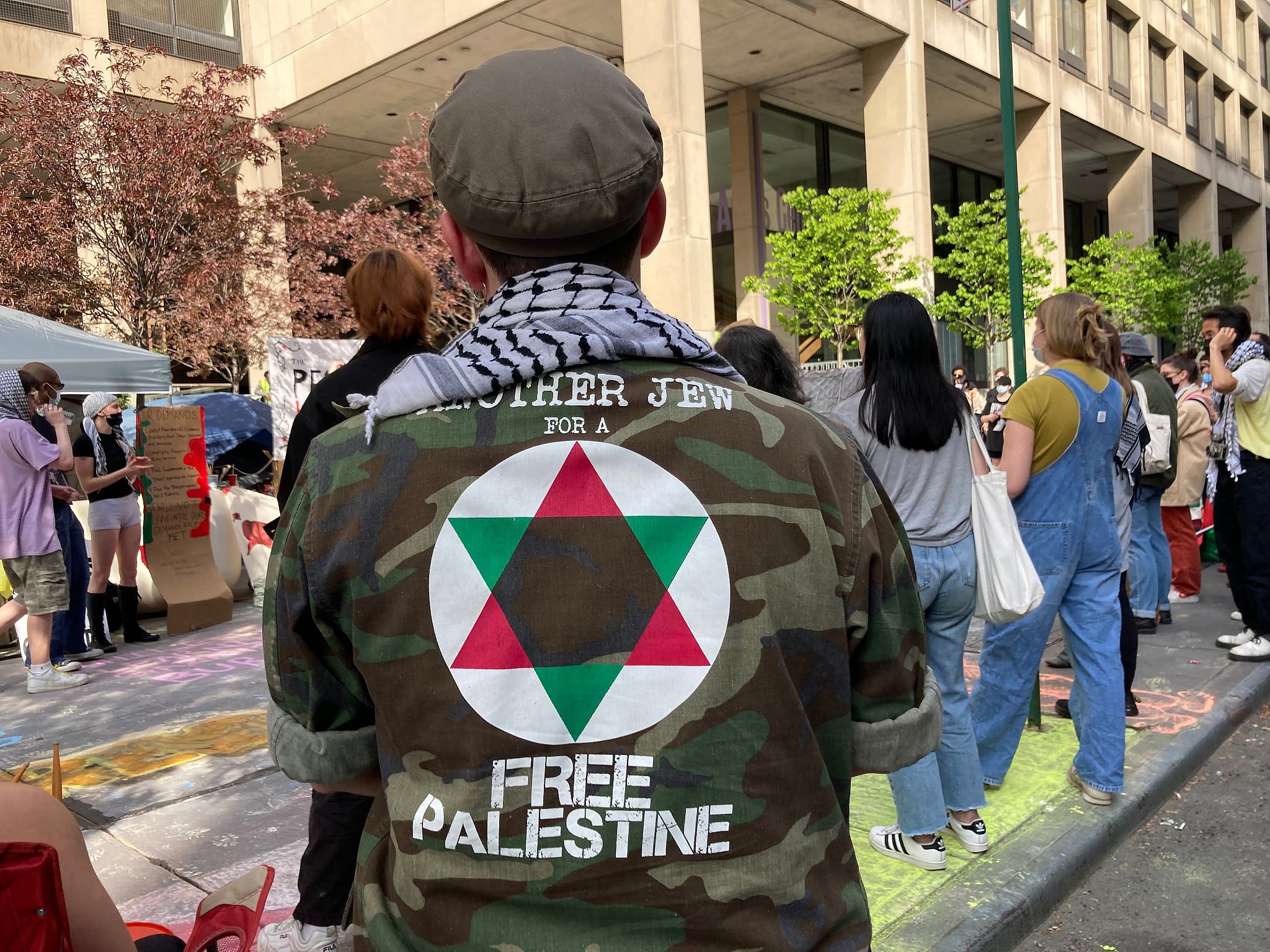
(Image editorial credit: rblfmr / Shutterstock.com). New York NY USA-April 28, 2024 Students from the Fashion Institute of Technology (FIT) and their supporters rally for Palestine at the school in New York. 2455660945
Avinu Malkeinu. Again and again during this sacred season, we return to these words. We confess that we have fallen short before You, our Father and our Sovereign, and we ask: have compassion upon us and upon our children; bring an end to sickness, war, famine, and oppression. Bring an end to the reign of those who cause pain and terror.
Looking back over the past year, I ask: have we lived up to the words of Avinu Malkeinu? Have we worked for a world with less sickness, less war, less famine, and less oppression? Or have we excused, even defended further pain and terror? Have we lived up to the calling of what it means to be both human and Jewish, as reflected in the story of creation and in the binding of Isaac?
In the course of a year, our world has changed tremendously. Israel stands at the center of a profound global rupture, as much of the world community has turned against it.
This shift points to something larger than politics alone; it reflects a deeper fracture in our moral imagination and in our willingness to defend the dignity and security of the Jewish people.
Erev Rosh Hashanah, I reflected on September 11—a date that was the beginning of a new era in America. I also reflected on Parashat Nitzavim and where we all stood on September 11. For myself, and for everyone alive that day, 9/11 was our Nitzavim moment. Young and old alike, we were called to hear the words we read at this time of year: Atem nitzavim hayom kulchem lifnei Adonai Eloheichem—“You stand this day, all of you, before Adonai your God.”
So too, September 11, 2001, and the days that followed became a kind of moment of consolation and unity—a nechemta. Just as the Israelites were called to transform standing into action, America was called to transform unity into responsibility.
Now, twenty-five years after September 11, we must ask where we stand—together as a nation, and especially as Jews. The unity that once seemed so powerful has fractured in the nation. Voices that excuse terror and rationalize violence have risen to prominence. Platformed today in public life are statements like “America deserved 9/11,” or continued defenses of and associations with the Blind Sheikh, Omar Abdul Rahman, who was convicted on terrorism charges related to the 1993 World Trade Center bombing. With the emergence of this revision of unity, antisemitism has spiraled out of control.
Today, in 5787, we face a new set of experiences through which to understand Nitzavim. In the aftermath of October 7, Jewish life in America faces new challenges. This year, I must speak directly about my concern for the safety and security of the American Jewish community as it relates to anti-Semitism.
What if I told you that the greatest existential threat to our people in 5787 does not come from the dagger-wielding, rocket-propelled-grenade-toting, explosive operatives most of us associate with 10/7?
The truth is that the greatest threat to Jewish wellness and safety today is not purely physical, but something much worse: an immoral degeneration from within the Jewish community. When the language of a vocal minority of Jews shifts toward indifference—toward vocal anti-Zionism or Hamas apologism—our community is in true mortal and moral danger. Such indifference is not morally neutral. It erodes conscience, distorts justice, and gives cover to those who excuse terror.
Dara Horn, in her lectures, essays, and book People Love Dead Jews, explores how the history of the Soviet Union offers a troubling blueprint for modern antisemitism and anti-Zionism.
Earlier this year, I had the opportunity to attend one of her lectures on this subject. Horn traces the origins of certain contemporary anti-Zionist slogans back to Soviet state propaganda and to the tragic phenomenon of the so-called “Good Jew”—Jews who were pressured to weaponize their own identity in order to prove loyalty to a hostile regime.
In her writing and interviews, Horn explains how the Soviet Union weaponized identity politics. Long before the State of Israel was established in 1948, Soviet Bolsheviks launched campaigns targeting Zionism.
In 1918, during the Russian Civil War, the Communist Party sought to win over the millions of Jews living in the former Russian Empire by separating them into ideological factions. Horn notes that widely used contemporary labels—such as describing Zionism as “racism,” “colonialism,” “apartheid,” or “genocide”—did not emerge in a vacuum. She argues that they were shaped and amplified as propaganda tools during the twentieth century to isolate Israel and push Jews out of public life.
In her essay “The Cool Kids,” published in Tablet Magazine, Horn analyzes the Yevsektsiya, the Jewish sections of the Soviet Communist Party. The history of Russian Jewry illustrates the ultimate failure of trying to become the “Good Jew” in order to please a totalitarian system. Led by secular, Marxist Jews, the Yevsektsiya operated under the banner, “We are not antisemitic; we are just anti-Zionist.” To prove they were “good internationalists” who rejected the supposed chauvinism of Jewish national identity, members of the Yevsektsiya helped shut down synagogues, banned the Hebrew language, and denounced traditional Jews to the regime.
Horn argues that societies often project their concept of evil onto Jews. To gain acceptance in hostile environments, Jews are pressured to erase their own culture, religion, or autonomy—to perform the role of the “Good Jew.”
But as the Soviet experiment showed, trading identity for political validation offers no lasting protection. Eventually, all members of the Yevsektsiya were jailed or executed. Without the protection of Jewish organizations, formal Jewish life was forced underground and Jews were restricted from both leaving the Soviet Union and rising to success within it.
Only in the 1990s, after the collapse of the Soviet Union, were almost 2 million Jews finally free to leave for Israel and the United States.
Today’s dilemmas for the Jewish community are not new; they are the latest iterations of older forms of antisemitism.
Once again, a small, vocal segment of the Jewish community is tempted to distance itself from Jewish peoplehood to gain approval from movements that do not ultimately protect Jewish life. This small, destructive, vocal segment of our community includes many progressive rabbis, institutional and collegial professors and academics, and students alike.
When voices within our own community advance a language of global unity while severing Jewish identity from Israel, they risk repeating a dangerous pattern: seeking acceptance by diminishing the very covenantal identity that sustains us and a Jewish state.
Yes, Israelis may be critical of our government. I will be voting in upcoming Israeli elections in October to exercise my right to vote. As American Jews, be there with me, spiritually or in person, but do not call for my or my country’s annihilation.
If these destructive voices are amplified internally or externally, our fate as Jews could echo the painful experience of Soviet Jewry. And so, today, I charge these voices in our own Jewish community to teshuvah.
Today is an opportunity to stand again as one people: to embrace the covenant of Judaism, our peoplehood, and our identity; to return to the core words of Hineni—“Here I am”; and to stand with our people as they did in Parashat Nitzavim, prepared not merely to hear a call, but to answer it with action.
To apologize for the wrong and hurt created in the Jewish community, both here in America and in Israel, by passively and actively hurting the Jewish people.
Today asks us to return. Rosh Hashanah is about teshuvah—not only repentance, but return: return to God, return to conscience, return to our people, and return to what is good, without defending what is evil. Ultimately, I believe that the message of Rosh Hashanah 5787, rooted in the stories of creation and the Akedah, is a message of moral choice.
In a world turned upside down by hatred, and in a year scarred by antisemitism and moral confusion, we must choose to stand united as a people.
We must choose life, not self-destruction.
This year, the call is to renew our vows, to choose life, and to embrace the sacred responsibility of free will. As Jews, we must make conscious choices rooted in our deepest commitments to ethical monotheism, covenant, and human dignity. We keep our covenant with God by living and acting as Jews, so that the covenant continues to live through us.
To be a Jew is to protect what is holy and what is right. Holiness triumphs over evil when we accept the responsibilities of Jewish life: refusing complacency in the face of suffering, standing up for what we believe, and protecting our children—in Israel, in America, and wherever our people call home.
Related Topics
Related Posts