


Stand for Jewish life. Fight antisemitism.
Antisemitism at European universities
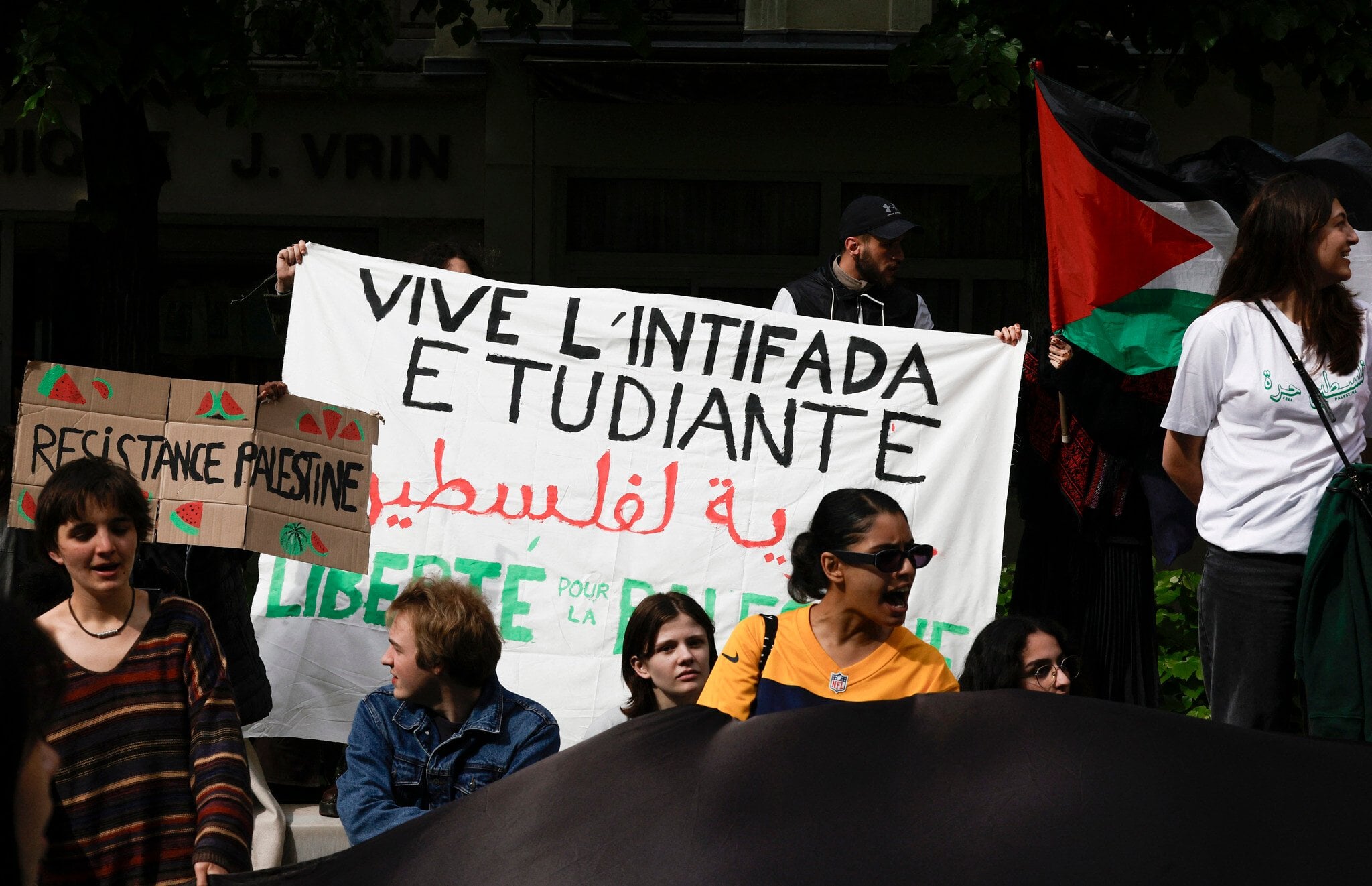
Students shout slogans and display a banner reading "Long live the student intifada" as they take part in an anti-Israel rally at the Sorbonne University in Paris on April 29, 2024. (Geoffroy Van Der Hasselt/AFP)
Since October 7, 2023, Jewish students across Europe have awoke to campuses that feel less like safe places of learning and more like battlefields of hatred. A new report by B’nai B’rith International, “A Climate of Fear and Exclusion: Antisemitism at European Universities,” documents this continent-wide crisis. From Vienna to Paris, London to Stockholm, Jewish students describe a landscape marked by intimidation, exclusion and outright violence. The report notes:
Some campuses have become arenas where antisemitic rhetoric, discrimination, and even acts of violence have become increasingly prevalent.
In Europe’s universities, anti-Israel activism has spiraled into open antisemitism. These are not isolated incidents or academic squabbles. They are a systemic failure of higher education. The campus climate has grown corrosive. Jewish students report hiding their identity. Many refuse to wear a kippah or Magen David on campus – for fear of harassment or worse. The report catalogs mounting evidence from Austria, Belgium, France, Germany, Italy, the Netherlands, Spain, Sweden and the UK. As B’nai B’rith warns:
Outright antisemitic incidents, extreme anti-Israelism and mainstreamed anti-Zionist sentiment have intertwined and fueled an overall environment of ambient, atmospheric antisemitism in which Jewish students find themselves marginalized, silenced, or even targeted for their religious and cultural identity.
“I don’t feel comfortable anymore”
A Jewish student at the University of Vienna describes how “toilets in the New Institute building have been smeared with blatant statements” and how protest camps on campus – some openly chanting for an “intifada” – have made even routine seminar work feel terrifying. Another recalls that “even if nothing has happened to me directly, as a Jewish student I still go to campus with an uneasy and queasy feeling”, reluctant to wear anything publicly Jewish out of fear.
Jewish students report being shouted at and ostracized simply for putting up posters saying “No to antisemitism” or for wearing traditional symbols. In Strasbourg, three Jewish students at the university’s health faculty were “verbally threatened, then hit and knocked to the ground” by fellow students chanting “Zionist fascists” while the victims were distributing pro-hostage posters. In Belgium, the co-president of the Union of Jewish Students of Belgium was assaulted near a pro-Palestinian encampment – his attacker openly admitting it was because “he was Jewish”. A FU Berlin Jewish student was hospitalized after a classmate punched him so hard his face fractured. Swastikas and hate graffiti are scrawled on dorms, lecture halls and library doors. As one student said:
We are constantly told: ‘Take off your necklace. Don’t tell anyone you’re Jewish.’
Jewish and Israeli students have largely withdrawn from campus life. A French Senate committee report cites a survey in which 91% of Jewish students in France said they had endured at least one antisemitic incident, including verbal threats and assaults linked to Israel. Israeli academics and students in the Netherlands speak of an “alarming increase of hostility and hate” in higher education. Across Europe, the message is unmistakable: raising an Israeli or Jewish identity flag can get you shouted down at best and physically attacked at worst.
Anti-Zionism, extremism and Islamist agendas
How did campuses reach this breaking point? The report points to a toxic mix of ideological drivers which now have fully coalesced. Campus Israel-bashing has become mainstreamed, with entire courses and departments framing Israel solely as an oppressive colonial power.
In Germany and Austria, communist and Marxist-Leninist collectives – some explicitly tied to known terrorist organizations – helped form new antisemitic coalitions on campus. The feminist group Zora even praised Hamas’s massacre of October 7 as an “act of self-defense”. Organizers like Samidoun (tied to the PFLP) and Masar Badil (linked to Hamas) ran encampments and rallies, sometimes streaming live to Iranian state media. In Spain, aggressive student camps adopted slogans like “From the river to the sea, Palestine will be free”. One Madrid camp even required participants to sign a pledge to support the PLO’s thawabit (the doctrine of “armed resistance” against Israel). In the UK, pro-Palestinian societies literally glorified terrorist leaders: students cheered Hamas’s Yahya Sinwar and Hezbollah’s Hassan Nasrallah as heroes.
Meanwhile, Islamist influences are pouring in. In Italy, Islamic youth activists led campus rallies calling Israel’s wars “genocide” and baptizing protest tents with chants for “intifada”. At the University of Granada in Spain, student protesters with ties to Palestinian extremist movements held prayer rallies declaring “long live the Palestinian resistance” and taped their mouths with Israeli and US flags to symbolize “blood on their hands” – eerily evoking last year’s Ramallah lynchings. In UK, the Federation of Ahlul Bayt and the Palestine Society at King’s College openly praised Hamas and Hezbollah. Under such ideological bombardment, ancient antisemitic themes resurface: Jews as “Nazis” in disguise and Israel as a new apartheid regime. One infamous chant heard on Dutch and Swedish campuses – “Zionists are all the same, Nazis by a different name” – shows how quickly memory gets twisted.
The result is a campus culture that equates any defense of Israel with intolerance. Even moderate Jewish faculty who quietly express pro-Israel views find themselves branded as racist. Meanwhile, those who shout down Israel’s existence in the name of anti-imperialism claim moral high ground. This false moral equivalence — denouncing Israeli self-defense as racist but ignoring the chanting “Kill the Jews” on the quad — has flipped reason on its head.
When peers and professors look away
Far too often, those who witness campus antisemitism stay silent or, worse, encourage it.
In France, dozens of university presidents publicly insisted that suggesting “universities do not combat antisemitism” is “propaganda and a lie”. Yet their words ring hollow when at the same time pro-Palestinian coalitions win faculty endorsements and organize daily “teach-ins” preaching “Zionism = racism”. In Germany and the UK, the report documents professors who posted antisemitic messages online or led seminars legitimizing terrorism. A faculty member at a UK university tweeted that “the ease with which the Jew … describes the mutilations of war is indicative of a placid cruelty”, echoing classic blood libel. In Italy, dozens of lecturers and even entire academic senates threw their weight behind academic boycotts of Israel; some even invited speakers who accused Israel of Apartheid. A Union president at Lund University (Sweden) compared Israel to the Nazis, and his “Student Union” called for an academic boycott of Israel.
Where are the student leaders? At many universities, pro-Palestinian groups control the narrative. In Brussels and Leuven (Belgium), mobs renamed buildings after terrorists, while Jewish students were shouted down if they tried to speak. In London and Leeds, open letters by Jewish student organizations begged administrations to intervene; often the only response was police clearing a camp long after the damage was done. Even Jewish faculty and chaplains have faced death threats. In Leeds (UK), the student rabbi had to relocate with his family after receiving online messages like “Bring him to me [knife emoji]”. Yet only few faculty members publicly protested these outrages.
This bystander silence is deadly. As the report observes, “the refusal to acknowledge Jewish students’ lived experience of antisemitism and failures to address antisemitism by university administrators” has contributed to the crisis. When antisemitic slurs are chalked on lecture halls or “Kill Israhell” is scrawled on a university library – incidents the report documents in detail – it sends a clear signal: the institution will look the other way. And so the hate festers.
Boycotts and “cancel culture”
A core value of any university is free inquiry. Yet on some campuses, even basic academic cooperation is under threat. “Academic freedom” is being weaponized in the most twisted way: student radicals and sometimes even administrators are demanding that Israel itself be deplatformed from academia. The report recounts dozens of academic boycott campaigns; petitions calling on universities to sever all ties with Israel, calls to freeze joint research projects, or to bar Israeli professors. In France, student and faculty activists pressured Sciences Po Strasbourg to cancel its partnership with Israel’s Reichman University, and in Italy the rector of the University of Padua was accused of “demonizing” those who refused a research ban on Israel. In the Netherlands, Erasmus University “froze” new collaborations with Israeli institutions under pressure.
These campaigns fall under the banner of “free speech”, but in practice they censor dialogue. The report calls it a double standard. Israel is singled out as the only democracy that must be “isolated” academically. This betrays a corruption of academic freedom: what was once an ideal of diverse viewpoints has devolved into a mandate that certain viewpoints are forbidden. In the Netherlands, student associations that lobbied against academic ties with Israel were met with only lukewarm resistance from university boards; administrators rarely disciplined encampment leaders for intellectual intimidation. In Belgium, Ghent University’s rector ultimately cut ties with three Israeli research centers after activists demanded it.
Inside the classroom, Jewish or Israel-friendly professors find their lectures scrutinized or silenced. The report notes cases where courses on the Holocaust were quietly canceled, supposedly to avoid tension. Academic integrity is under assault when scholarship on the conflict is permitted only one way. A senior Vienna professor’s remark that “anyone who recognizes Israel’s right to exist recognizes imperialism” – which the report flags as outright hatred – underscores how even faculty are now risking faith-based dogma over academic rigor.
Holocaust denial and calls for violence
The report uncovers a normalization of violence and Holocaust distortion as part of campus protest. It documents slogans and symbols that would have been unthinkable on campuses a year ago: swastikas daubed on walls, chants for an “intifada” echoing through university squares, and open calls to “Kill the Jews”. At the University of Vienna’s Jewish Studies Library, someone spray-painted “Kill Israhell” on a sign one week after October 7. A Paris campus library found graffiti reading “Death to Israel, death to the Jews”, alongside crude Nazi slurs. And on one Madrid encampment banner, students scrawled “Zionists out of the University” beneath a picture of Hamas’s logo.
Holocaust distortion has become a common tool in these battles. Protesters openly compare Israel to Nazi Germany – as when Jean-Luc Mélenchon (France) likened banning a pro-Palestine speech to the acts of Eichmann, or when a Gothenburg Student Union leader (Sweden) said Israel was committing another Holocaust. Encampments have featured academics known for Holocaust denial; one Madrid rally included a lecturer who wrote a book called “From the Nazi to the Zionist Holocaust”. Chants of “From the river to the sea, Palestine will be free” (a genocidal slogan) mingle with taunts that “Zionists [are] all the same – Nazis by a different name”. The report cites Israeli flag burnings and Hitler moustaches added to photos of Jewish scholars as examples of campus “protest art.” In the UK, students held a vigil at the National Union of Students conference openly cheering for Hamas. In the Netherlands, an Amsterdam encampment burned an Israeli flag and waved banners reading “Destroy what destroys” next to Israeli-Jewish graves.
This poisoning of memory reflects an institutional abdication of responsibility. Universities boast about Holocaust education, yet one Dutch university quietly canceled an entire lecture series on the Holocaust and antisemitism “to avoid conflict”. In Vienna, a planned course on Palestine had to be canceled because its speaker insisted “now is not the time” to reflect on the Shoah. Without clear condemnation from above, antisemitic students wear dark slogans and wreath symbols (the red triangle used by Hamas) as if they were badges of honor. The B’nai B’rith report observes that this kind of extremism “has raised serious concerns about the ability of universities to ensure the safety and well-being of their students.”
An epidemic across Europe…
In France, a surge of campus antisemitism prompted the government to ban pro-Palestinian rallies and form a special Senate taskforce. Jews in France suffered a fourfold spike in violent antisemitic acts since October 2023, and polls showed 91% of Jewish students endured insults or worse.
In Germany, incidents exploded after October 7. The anti-hate monitor RIAS recorded 113 campus antisemitic incidents in 2023, with a sharp jump post-October. Protest occupations at Humboldt University and others were led by banned extremist groups. Jewish students were assaulted; at FU Berlin, one was left concussed by a fellow student. By May 2024, German universities were finally re-criminalizing banned slogans like “From the river to the sea” and considering expelling violent students, but only after fears had already taken root.
The UK has seen an unprecedented spike too. The Community Security Trust (CST) documented 272 university-related antisemitic incidents in 2023/24 – a 413% jump from the previous year. From London to Oxford, campus Jewish spaces were vandalized, and death threats tormented Jewish student societies. One university lecturer in UK was even caught repeatedly heckling a Jewish event on the Farhud pogrom, interrupting a Holocaust remembrance talk with outright denial.
Other countries reflect similar patterns. Spain’s universities saw dozens of pro-Hamas encampments in spring 2024: 21 Spanish campuses briefly “occupied” by student protesters calling for “intifada” and severing academic ties. In some cases local authorities did intervene, but only after weeks of classes interrupted.
Italy’s Jewish students report feeling isolated, too. A survey by a Milan Holocaust center found 80% of Italian Jews fearing more antisemitism in universities. At the University of Genoa, students stormed an academic senate meeting demanding Israel’s exclusion.
In Sweden, a wave of antisemitic “sit-ins” spread in May 2024. Over a hundred days, tents sprang up from Stockholm to Uppsala. At Stockholm University, chants for “Jude-Intifada” were reported. A Linnaeus University professor who published a study calling out the “Israelification” of antisemitism found his office defaced with traditional Nazi caricatures – ironically confirming his thesis. Jewish students tell JUS (the Swedish Jewish Youth Union) that they feel under siege as small graffiti campaigns and rallies flare up each month.
In every case, the stories share common threads: Jewish students singled out, anti-Zionist activism used as cover for Jew-hatred, university leadership that often fumbles its response. As one report summary bluntly states:
Europe’s universities often uphold policies against discrimination, but enforcement has been inconsistent, leaving Jewish students vulnerable to intimidation, exclusion, and harassment.
What now?
When student demonstrators bluntly demand the destruction of Israel and the removal of Jewish classmates, it is a betrayal of academic ideals. Our institutions of higher learning were meant to combat ignorance, not amplify it with anti-Jewish canards.So what can be done?
Universities must own up to the problem. There can be no more “both sides have valid points” evasions. Administrators must adopt the IHRA definition of antisemitism as a clear framework – and then use it consistently. Codes of conduct should explicitly forbid Israel-related hate speech and the encouragement of terrorism. Any student or staff caught marching under slogans like “From the river to the sea” or “Globalize the intifada” should face immediate sanctions, just as if they wore a swastika. Professors have academic freedom, yes – but not to spew hate in class or online.
Furthermore, support structures must improve. The report calls for clear, confidential reporting channels for Jewish students. Jewish campus groups need direct lines to deans, not hotline beeps in bureaucratic limbo. Leaders should also build trust by meeting with Jewish students regularly. In the current climate, silence equals complicity. University presidents should instead publicly and repeatedly condemn antisemitism by name as soon as incidents occur.
As I conclude, I want to thank B’nai B’rith International and the authors of this report. Their meticulous report gives voice to students who too often remain unheard and documents a crisis universities can no longer ignore. Universities must now show the courage to confront what this report reveals.
About the Author
Dr. John Meister is board member of the German-Israeli Society in Hamburg, Germany.
Related Topics
Related Posts


John Meister