
Arab Turnout: Qatari Interference or Homicides?
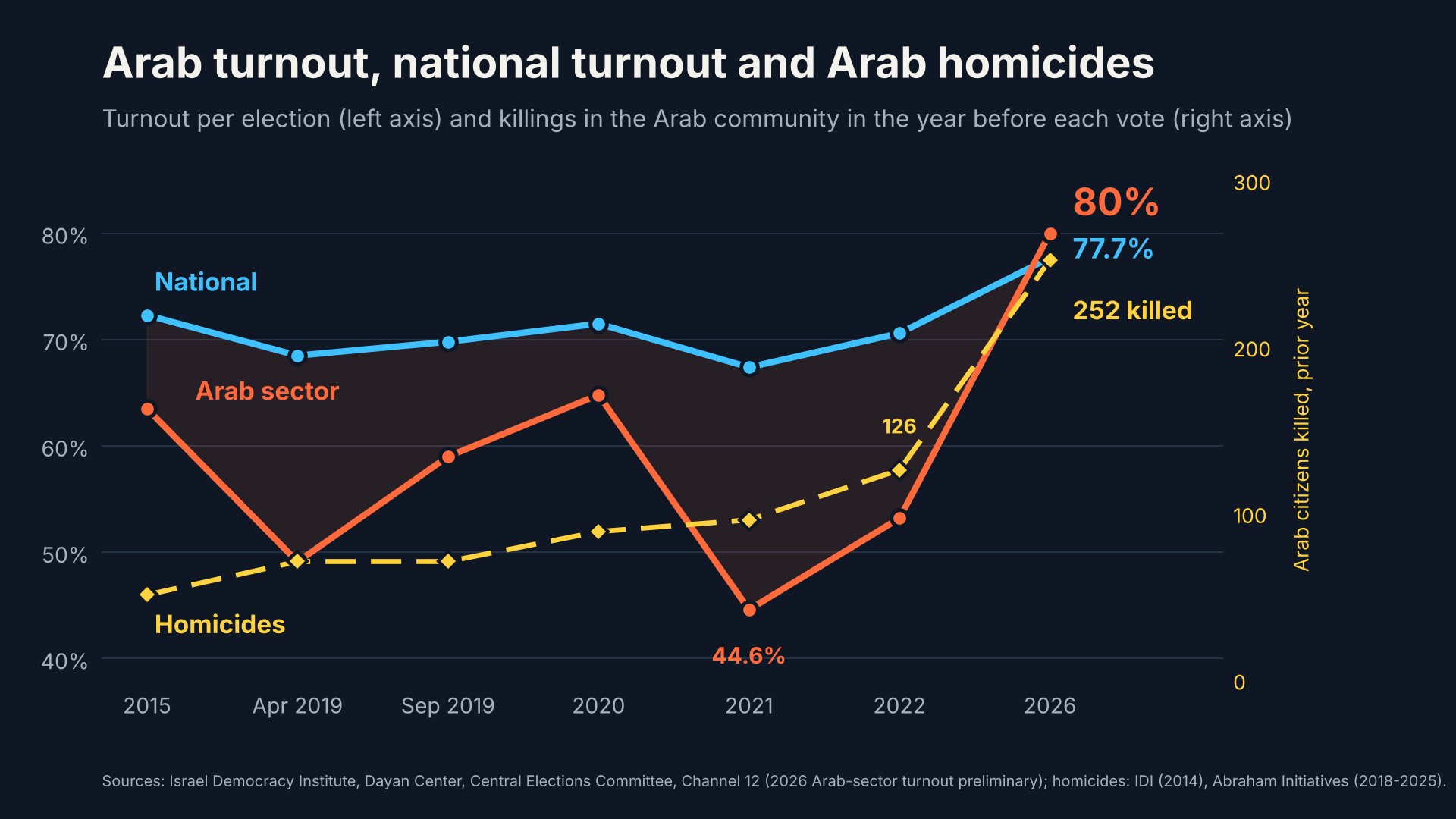
For the first time in Israel’s history, Arab citizens appear to have voted at a higher rate than the country as a whole.
On October 27, national turnout reached 77.7 percent, the highest since 1999. Preliminary figures suggest that Arab turnout surpassed the Jewish rate for the first time. Early estimates put it at about 80 percent, up from 53.2 percent in 2022.
The Joint List and Ra’am, the two Arab-led lists, won a combined 19 seats, the largest Arab representation the Knesset has ever had. Prime Minister Benjamin Netanyahu’s bloc stopped at 53, eight seats short of a majority.
On election day, Itamar Ben Gvir, the national security minister and leader of Otzma Yehudit, recorded a video at the entrance to Kafr Qasim, an Arab city, urging his supporters to vote and counter what he called a “crazy voting rate.” By 8 p.m., turnout in Kafr Qasim had reached 81.3 percent.
Within a day, Likud was calling the election stolen. Justice Noam Sohlberg, chairman of the Central Elections Committee, asked the Shin Bet to examine suspicions of foreign interference, allegedly by Qatar. Doha called the claim ridiculous and dangerous.
Was the 80 percent bought from abroad, or produced by something else?
Three separate accusations are now circulating, each resting on very different evidence.
The first is fraud at the ballot box. Likud says it gave the police, the Shin Bet and the election committee hundreds of testimonies, including alleged double voting and mismatches between the number of voters and the number of ballot envelopes. Dean Livne, acting director general of the Central Elections Committee, replied in writing that the election was conducted lawfully and that he knew of no basis for claims of systematic violations. A police source said there was no investigative or intelligence foundation for the claim that the election was stolen.
The second is vote buying, and here there are arrests. Police have detained seven people since election day in an investigation linked to Ra’am, among them three school principals from Bedouin communities in the south. Investigators say they found cash, envelopes and Ra’am ballot slips. One suspect says the envelopes held charitable donations from the Islamic Movement. All of them deny wrongdoing. Likud wants new votes held at the affected polling stations, but it does not claim that ballots were forged or totals altered.
The third is foreign money. The Shin Bet is examining whether funds from abroad, possibly from Qatar and Turkey, were sent to raise Arab turnout. Both governments deny it. Ynet reports that no connection has been established between the suspected transfers and the Ra’am bribery case. The Shin Bet itself described its inquiry as limited in scope and warned that it should not be used to cast suspicion on a community that voted democratically and lawfully.
Israeli law asks a narrow question in cases like this. An election appeal goes to the Jerusalem District Court within 14 days of the final results, and the court can annul votes at a single polling station or across the country. A proven offense is not enough. The judges must find that it could have affected the outcome. No Israeli court has ever annulled a national election. In 1988, a court ordered new votes at three polling stations because a seat hinged on fewer than three dozen ballots. The result did not change.
Applied to the turnout data, that standard is demanding.
The rise was not confined to one region. By 8 p.m. on election day, Umm al-Fahm had gone from 38.3 percent in 2022 to 70.1 percent. Nazareth went from 48.3 to 70. Shefa-Amr went from 51.5 to 72.5. In the Negev, Rahat climbed from 60.6 to 79.8 and Hura from 49 to 76.3. The bribery arrests concern Bedouin communities in the south. The increases in the Galilee and the Triangle, where no one has been detained, were of the same size.
The seat count is consistent with that pattern. Ra’am, the only party tied to the bribery investigation, went from five seats in 2022 to eight. In 2022, Hadash-Ta’al won five; this year the revived Joint List, which also includes Balad and is not part of that investigation, won 11.
Then there is the timing of the intelligence. The Shin Bet says it informed Sohlberg before election day, and Channel 13 reported that the agency held information about possible unlawful money transfers. On election day itself, Shin Bet director David Zini said the vote was being conducted properly.
None of this rules out foreign money. Funds can reach a country and still fail to move an election. Proving that the money arrived would answer the first question. The court would still have to answer the second.
If foreign money cannot explain a jump of this size and breadth on its own, something else must have changed between 2022 and 2026.
Arab turnout in Israel has always moved with events. It reached about 75 percent in 1999 and fell to 19 percent in 2001, after 13 Arab citizens were killed in clashes with the police in October 2000. Over the past decade it rose when the Arab parties ran together and fell below 50 percent when they split. In 2026 they ran as two lists, the same arrangement that produced the lowest Arab turnout on record in 2021.
The 2022 election was held before the killings in Arab communities doubled. According to the Abraham Initiatives, which tracks Arab victims of homicide, 116 Arab citizens were killed in 2022. In 2023, Ben Gvir’s first full year in charge of the police, the toll passed 240. It was 230 in 2024 and 252 in 2025, the highest on record. In the first half of 2026, killings rose another 15 percent. Badi Hasisi, a Hebrew University professor who studies crime in Arab society, has cited indictment rates below 20 percent in the Arab community, compared with roughly 60 to 70 percent among Jewish Israelis.
Arab voters said what they were voting about before a single ballot was counted. In a survey for the Konrad Adenauer Program at the Moshe Dayan Center, 74 percent named violence and crime as their main concern; 7.6 percent named the Israeli-Palestinian conflict. In an Israel Democracy Institute poll in early September, 68 percent of Jewish Israelis and 32 percent of Arab Israelis said October 7 was a central factor in their vote.
That distribution creates a problem for the foreign-money hypothesis. A campaign financed by a state that hosts Hamas’s political leadership would most plausibly mobilize voters around Gaza. Arab citizens said, weeks before the vote, that their first priority was their own safety.
In Rahat on election day, Bedouin voters named home demolitions, gun violence and the cancellation of funds and agreements reached under the Bennett-Lapid government, the first to include an Arab party. Ra’am placed Yoav Segalovitz, deputy minister for national security in that government, second on its list.
Arab voters could deny Netanyahu’s coalition a majority. Securing a role in the next government was beyond their reach.
Gadi Eisenkot, the former military chief whose Yashar party leads the opposition bloc, has pledged repeatedly not to govern with the Arab parties, whether in a coalition, a minority government or with their support from outside. Naftali Bennett and Avigdor Liberman have made the same commitment. The Joint List has offered to back an Eisenkot government from outside, without ministers, in exchange for a serious effort against crime and an end to home demolitions in Bedouin towns. Those are the same two demands voters in Rahat named at the polls.
Arab citizens did not vote for Eisenkot. They voted for their own lists, knowing that the most likely alternative to Netanyahu was a former chief of staff who had refused to govern with them. For those who listed crime as their first concern, keeping the coalition that controls the national security ministry from returning may have been reason enough. The Joint List’s offer to back Eisenkot from outside points to one more possibility: that many of those voters would have accepted a Zionist government, as long as its minister of national security treated the killings in Arab towns as his own responsibility.
This analysis does not anticipate the Shin Bet’s findings, which the agency was asked to deliver within a week. If it finds nothing, the suspicion will still have shaped the first weeks of coalition talks.
Qatari interference or homicides? Perhaps both. The killings, and what Arab voters said about them before the election, are already on the record. What the Shin Bet will have to establish is whether foreign money also played a part, and the courts, whether it could have changed the outcome.