
Archaeology of a Libel: How the Genocide Charge Against Israel Emerged
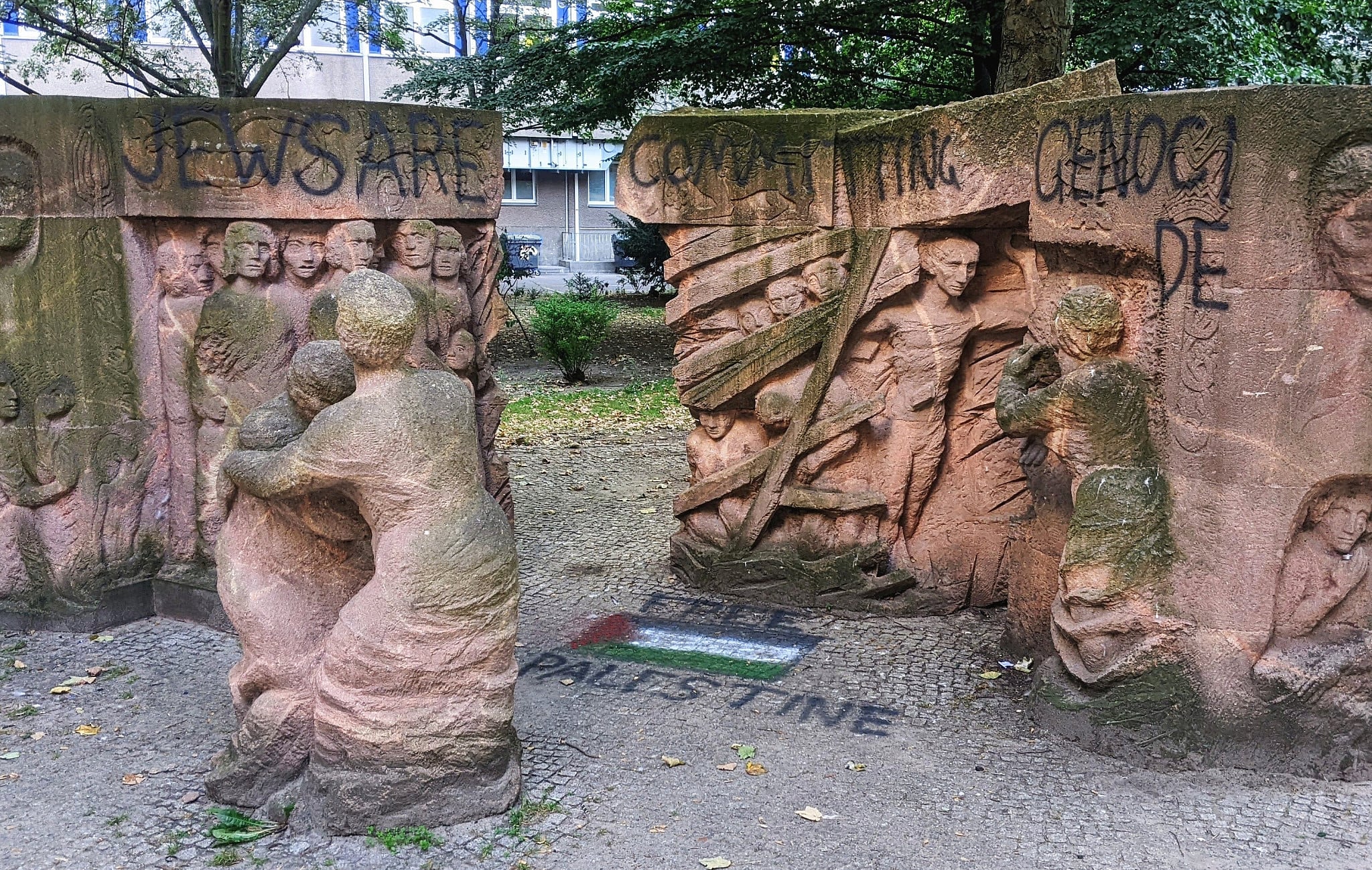
Is Israel committing genocide in Gaza? While experts and legal scholars around the world debate this question, anti-Israel activists and commentators have long since delivered their verdict in a blind reflex. Setting aside potentially legitimate criticism of Israeli policy, a factual review reveals the frailty of the genocide accusation. So why does the rhetoric of “genocidal Israel” find such a willing audience? Tracing the intellectual history of the genocide charge leads us back to ancient narratives of Christian anti-Judaism, which carry a deeply unsettling resonance to this day.
From the very beginning, the Christian world depicted the Jews as inherently murderous. The Pauline epistles lament that they “killed the Lord Jesus and the prophets.” The “men of Israel,” according to the Acts of the Apostles, “crucified and killed” Christ “by the hands of lawless men.” In this structural framing, the Jews appear as puppet masters, executing their plan “by the hands of” the Romans—using them only as instruments. Add to this the infamous thirty pieces of silver and the conspiracy of Judas with the Jewish authorities: Translated bluntly into political terms, these Christian scriptures present the plot of an influential Jewish network acting as the hidden hand, using money and conspiracy to manipulate a world empire in order to destroy its enemy.
Once Jesus was worshipped as God, the charge escalated to deicide. Logically, such a monstrous crime required a pact with the Devil. Thus, the myth of the cosmic and diabolical omnipotence of the Jews was born.
From these scriptures, Christian society wove legends of host desecration and ritual murder, portraying both as cultic re-enactments of the crucifixion of Jesus. Time and again, these rumors sparked violent pogroms—most recently in 1946 in Kielce, Poland.
Amid the epochal crises of the 14th century, this deicidal delusion escalated with the advance of the plague, the “Black Death”: The Jews, it was claimed, had not only crucified Christ but had now formed an international conspiracy to exterminate all of Christendom by poisoning the wells. Because they were believed to possess the diabolical power to murder God, they were deemed capable of this monstrous act as well. In 1349, the city council of Schlettstadt reported that a convert had “confessed” that “the Jewry intended to ruin Christendom with poison.” In the 15th century, the monk Albert noted: “Many say this pestilence is the result of a corruption of the air, but others say the Jews wanted to wipe out all of Christendom with a terrible poison and had poisoned the springs and wells all over the earth.”
The Black Death pogroms of 1348–1351 marked the most devastating anti-Jewish violence prior to the Nazi era. Though occasionally instigated by bishops, they were predominantly driven by guilds, the lower clergy, and the broader populace. Hundreds of Jewish communities—among them every major settlement in what would later become Germany—were eradicated. Tens of thousands of Jews were burned at the stake or broken on the wheel, while countless others were driven into exile. Even converts were frequently shown no mercy. One contemporary chronicler emphasized that the mobs would not rest “until the entire race of the Jews has been wiped out.”
Although rooted in the charge of deicide, the well-poisoning legends marked a qualitative escalation in anti-Jewish hatred. Whereas ritual murder legends had revolved around isolated, local incidents, this period saw the first articulation of a global Jewish conspiracy aimed at the physical annihilation of entire societies. Henceforth, Jews were perceived not merely as a religious menace, but as a political threat—as potential genocidaires. This trope has endured across the centuries, right up to the present day.
Martin Luther, for instance, declared that the Jew sought to “kill Christians wherever he can.” Two centuries later, the theologian Johann Eisenmenger wrote that the Jews intended to “exterminate and eradicate all of Christendom.”
Modern antisemites later hallucinated not merely a Jewish plot to exterminate Christians, but an impending genocide against all non-Jews. The notorious forgery The Protocols of the Elders of Zion, for example, asserted that the Jews must “destroy all other religions.”
In Mein Kampf, Adolf Hitler wrote that they sought the “annihilation of all non-Jewish peoples.” In his speeches, he obsessively ranted about a Jewish plan for the “poisoning of the people” (Volksvergiftung), the “extermination of peoples” (Völkerausrottung), the “annihilation of populations” (Völkervernichtung), and a “war of annihilation”—even raving about an “international world poisoning.” Hitler’s imagery exposes the well-poisoning legends as the very root of this delusion: In Mein Kampf, he branded the Jews as “bacillus carriers of the worst kind” who were engaged in the “pestilential infection of our blood”; their cultural influence, he claimed, was a “pestilence, a spiritual pestilence, worse than the Black Death of old.” In 1939, he spoke of a Jewish “global well-poisoning,” and as late as early 1945, he still referred to Bolshevism as a “Jewish plague.”
The Nazi tabloid Der Stürmer likewise claimed that through the Jews, “Christianity is being exterminated in a ghastly and thorough manner.” Editor Julius Streicher asserted that the Jews intended to commit “the greatest ritual murder of all time” against the German people. On the occasion of an alleged ritual murder in Haifa in 1936, Der Stürmer fantasized about a “people-devouring Jehovah” and the “blood of ritually murdered individuals and nations.” Over twenty years, the paper mentioned Judas or the ‘thirty pieces of silver’ 173 times.
Even the denunciation of “racial defilement” (Rassenschande) was interpreted as the destruction of Germans through “blood poisoning.” A book published during the Nazi era by Wilhelm Matthießen bears the disturbingly familiar title Israel’s Secret Plan for the Extermination of Peoples (Israels Geheimplan der Völkervernichtung).
Thus, the Nazis also imputed genocidal intent to the Jews. This delusional dogma formed a central ideological foundation of the Holocaust, which was subsequently imagined as an act of self-defense against a Jewish threat.
The caesura of the Shoah did not extinguish this archaic trope. It survived the rubble of 1945, adapted to new realities, and found new vessels.
Led by the Jesuit Joaquín Sáenz y Arriaga, opponents of the Second Vatican Council’s proposed decree on the Jews (which later evolved into Nostra Aetate) distributed a pamphlet to the approximately 2,500 Council Fathers in 1962 that once again imputed genocidal intent to the Jews. Their goal, the text claimed, was to “destroy not only the Catholic Church but the entire Christian civilization,” to “disrupt Christian society and prepare its destruction,” and to pursue the “enslavement and destruction of the Holy Church of Christ and of mankind.” In the face of fierce resistance—including from Arab delegates at the Council—Nostra Aetate was ultimately finalized in a much vaguer form than originally intended.
Decades later, the very same ideological current that opposed Nostra Aetate resurfaced, merging the narrative structure of the Black Death myths with modern conspiracy theories. During the COVID-19 pandemic, a group of ultra-conservative Catholic prelates—led by Archbishop Carlo Maria Viganò, a fierce adversary of the Second Vatican Council who was recently excommunicated for schism—conjured the threat of an “invisible enemy.” Relying on classic antisemitic dog whistles, they warned of interference by “foreign powers,” claiming that society must not allow “centuries of Christian civilization to be erased under the pretext of a virus.”
Far-right ideologues use ciphers like the “Great Replacement” to conjure a Jewish-masterminded “annihilation of peoples through racial mixing.” The notorious German Holocaust denier Horst Mahler, for instance, smeared the Jews as “propagandists of genocide,” who sought to destroy the German nation through “ethnic replacement” (Umvolkung) and “miscegenation” (Vermischung). In a 2014 speech to the European Parliament, British neo-Nazi Nick Griffin declared that an “unholy alliance of leftists, capitalists and Zionist supremacists” was using “mass non-white immigration” to orchestrate “the biggest genocide in human history, the final solution to the Christian European problem.”
The perpetrators of the Pittsburgh (2018) and Poway (2019) synagogue attacks both blamed the Jews for the crucifixion of Jesus while hallucinating a demographic annihilation. The Poway shooter raved about a “meticulously planned genocide of the European race,” and the Pittsburgh attacker, also a white supremacist, accused Jews of “committing genocide to my people.” Similarly, the perpetrator of the 2019 Yom Kippur terror attack in Halle, Germany, viewed Jews as the primary architects of “white genocide,” claiming that feminism was merely one of their tools. Finally, the chart-topping German singer Xavier Naidoo hallucinated a “small, rootless international clique,” dubbing it “Zion,” that was supposedly plotting the “annihilation of the white race.”
When Mahmoud Abbas addressed the European Parliament in 2016 and claimed that Israeli rabbis were “demanding their government […] to poison the water of the Palestinians” in a “clear incitement to the mass murder of the Palestinian people,” not a single parliamentarian challenged him. No one left the chamber in protest; in fact, Parliament President Martin Schulz even praised the “inspiring address.” Abbas’s slander resonated with his audience because it tapped directly into the deep-seated trope of the well-poisoning Jew—a motif still inscribed in the collective memory of mainstream society. The libel thus feels intuitively plausible, devoid of any factual evidence. (Abbas later retracted the claim, admitting the allegations were “baseless.”)
From its very creation, the Jewish state has been accused of genocide. Virtually every Israeli military operation is ritually met with charges of genocide. In leveling these charges, antisemites not only reactivate ancient libels, but simultaneously project their own genocidal ambitions onto Israel—ambitions they have repeatedly invoked since the state’s founding and brutally executed on October 7. The Catholic Polish nationalist Ludwik Bielski even accused Theodor Herzl of plotting a “gigantic genocide.” The Palestinian Christian historian Nur Masalha has framed the events surrounding the 1948 War of Independence as a form of cultural genocide, while sociologist Martin Shaw recast them as a “foundational genocidal event.”
Following 1967, the Soviet Union joined the chorus, accusing Israel of a “policy of genocide against the Arab population.” In 1982, Yasser Arafat alleged that Israel was perpetrating a genocide in Lebanon. And a mere three days after the October 7 massacre, while Israel was fighting for its survival under heavy rocket fire, a statement by Ghent academics condemned “the genocide and ethnic cleansing committed against the civilian population of Gaza,” failing to even mention the Israeli victims—many of whom were, at that very moment, languishing in Hamas’s underground terror dungeons.
History does not repeat itself, but its echoes resonate profoundly through the corridors of our modern discourse. The charge of genocide against the Jewish people carries the weight of a seven-century-old tradition. Long before the dawn of the Israeli-Arab conflict, it was born of the depths of sheer antisemitic delusion. The poison motif of the Middle Ages endures as the biopolitical indictment of the modern era. Ultimately, the contemporary accusation of genocide against Israel reveals itself as the latest culmination of a deeply archaic pattern. That such an accusation still sets off so few alarm bells lays bare a glaring—and tragic—ignorance about the true essence of antisemitism.
Antisemitism is, essentially, the delusion of being the victim of Jewish aggression. And on a global scale today, antisemites once again frame the Jewish state as the puppet master, manipulating the dominant power—today not the Romans, but the United States.
Reflexively imagining the Palestinians merely as the latest victims of this omnipotent “Jewish evil” without dismantling the historical libels of Jews as “God-killers”, “child-killers”, and “killers of peoples” results in narrative complicity. To break this complicity, we must finally confront the very religious roots of antisemitism—in Christianity, in Islam, and in the post-Christian West itself.
Then—to echo Herzl—if we will it, even peace may be no dream.