
Thinking about 'Resilient Zionism'
Are Pre-Election Promises Bankable?
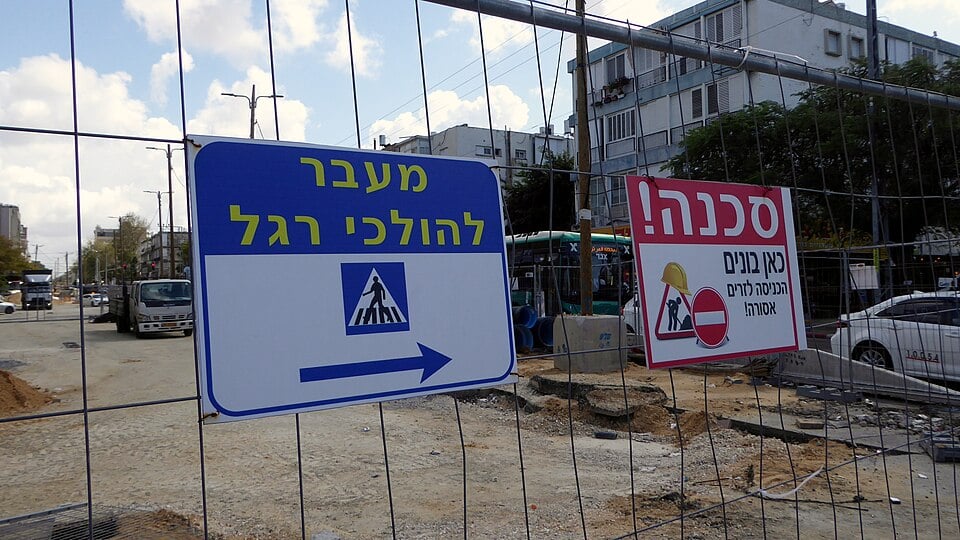
Infrastructure construction Holon
There is something deeply moving about celebrating life in Israel while the country is still carrying the weight of war.
Recently, I had the privilege of attending the wedding of the son of an old and close friend. Standing around the chuppah and later on the dance floor, I was struck by the young generation surrounding us — “kids,” many of whom chose to make Aliyah and serve as lone soldiers in the IDF, who over the last three years have moved in and out of active field and reserve combat service, somehow squeezing in pockets of dating, socializing, university courses and the fragile routines of “normal life.”
At the wedding, there was also a relatively large contingent of family and friends who had come from Australia to celebrate, some of whom had not been in Israel for quite some time. What struck them was not only the pain, trauma and raw civic emotions exacerbated by the upcoming elections. It was also the cranes in the air, the overflowing restaurants and the new roads and neighborhoods being built.
Even now, Israel is building.
That image stayed with me, because it points to one of the central questions now facing the country: how do we turn the instinct to build into a disciplined national financing strategy?
In recent months, Israel has seen major budget allocations framed around regional development, settlement, rehabilitation, security and resilience. When such allocations are announced close to elections, the public response is often cynical. Are these strategic investments or political gestures? Long-term planning or short-term electoral signaling?
Those are fair questions. But they are not the only questions.
A more constructive question is this: can pre-election budget allocations be made bankable? In other words, can a government allocation become more than an expenditure line in a national budget? Can it become the foundation of a capital stack that attracts catalytic, philanthropic, private and eventually institutional capital?
This is the logic of blended finance. Public money should not simply be spent. It should be structured to mobilize additional capital.
A government allocation can serve as first-loss capital. It can fund planning risk, feasibility studies and early infrastructure. It can provide guarantees, outcome payments, interest-rate support or viability-gap funding. It can absorb the risks that private investors are not yet ready to take.
But for that to happen, allocations must be designed with bankability in mind. They must be tied to measurable economic, social and environmental outcomes such jobs created, homes built, businesses financed, farms strengthened, roads completed, renewable energy produced and families retained. These outcomes must be transparent, ring-fenced and professionally governed and independently measured. Investors will not build around political promises, but they may build around committed, measurable and well-managed funding streams.
These outcomes must also be multi-year and stakeholders must be attuned to the longer time horizons. Infrastructure, housing, agriculture, tourism, energy and regional employment all require time. Bankability begins when capital can see a predictable runway. This is especially relevant for Israel’s periphery — the Negev, the Galilee, the Gaza envelope, the northern border communities and emerging new communities. These are not only social-policy geographies, they are national resilience geographies.
Too often, Israeli public life treats a budget allocation as the finish line. A minister announces, a headline appears and the political system moves on. But an allocation should be the starting line. The real test should be: what does this budget line make possible? How much additional capital can it mobilize? What risks does it reduce? What outcomes does it purchase? What long-term economic base does it create? If a NIS 100 million allocation remains NIS 100 million of spending, it may do good. But if it becomes the catalytic layer in a NIS 500 million capital stack, it can change the trajectory of a region.
Not every governmental budgetary allocation will be bankable. Some will undoubtedly remain purely political and others will be too vague, too short-term or too poorly governed. But the answer to cynicism cannot be paralysis. The answer must be better structuring.
At that wedding, watching young people dance, contemplating a new home being formed in Israel and watching friends from abroad marvel at a country still building in the shadow of war, I was reminded that Israel’s greatest asset has always been its refusal to wait for perfect conditions. Now we need to finance that instinct with greater humility and maturity.
If Israel can turn budget allocations into blended-finance platforms, public money will not merely be spent, it will be multiplied. It will become the anchor for resilient Zionism — not as a slogan, but as an investable strategy.
Related Topics
Related Posts