


Change The World
Are We Against Something… or For Something?
We’ve mastered the language of opposition — and forgotten how to speak for what we believe in.
There’s a fundamental moral difference between opposition and advocacy. Opposition is about what you reject. Advocacy is about what you build. One tears down. The other creates. Both are necessary — but only one leads anywhere.
Too often today, in our communal and civic life, we’ve become fluent in the language of opposition and nearly illiterate in the language of advocacy.
Worse, we’ve begun to use advocacy as another form of opposition. We know what we’re against. We rarely articulate what we’re for. That distinction isn’t semantic — it’s existential.
Take the Boycott, Divestment, Sanctions (BDS) movement. To most Jews, BDS is repugnant — a moral and political cudgel that seeks to isolate Israel and delegitimize its very existence. But to its supporters, BDS isn’t “anti” anything — it’s for justice, equality, and human rights. They may be wrong in method or motive, but they see themselves as agents of positive change.
The Jewish response, however, has been almost entirely oppositional. We’ve built “anti-BDS” coalitions, passed “anti-BDS” legislation, held “anti-BDS” conferences. All defensive. All framed in the negative. But where is the positive counter-narrative? Where are the movements for coexistence, for partnership, for shared innovation, for mutual dignity? And yes, I know — no one’s listening. And yet, if our entire vocabulary is “No,” we cede the moral high ground to those who say “Yes,” even when their “Yes” leads to harm.
In New York, we saw a similar dynamic around Mayor-elect Zohran Mamdani — a progressive Muslim voice with a deep hostility toward Israel. The Jewish communal establishment mobilized against him — rightly, in my opinion, given his rhetoric and alliances. But there was no positive alternative on offer. No effort to define what kind of representative we want to support, what kind of shared civic agenda we could pursue with our Muslim neighbors, what common good we could advance together.
We were against Mamdani. But not for anything bigger than his defeat. And in politics, as in life, when you define yourself only by what you oppose, you eventually disappear when the opponent does.
This problem extends far beyond the Jewish world. American politics has become addicted to negation. We are “Anti-Trump” or “Anti-Biden,” “Never this” or “Never that.” Movements rise not because they inspire, but because they enrage. It’s easier to mobilize anger than imagination. But societies built on resentment eventually hollow out from within.
Even righteous causes stumble when framed as opposition alone.
The call to “Defund the Police” began as an urgent plea for justice — but collapsed under the weight of its negative language. The slogan told us what to oppose, not what to create. It alienated allies who might have joined a movement for community investment, for safety, for reform. The difference between subtraction and construction is everything.
The same dynamic plays out in our culture wars. We “cancel” offenders but rarely teach, rehabilitate, or reintegrate. We boycott corporations without building better ones. We denounce misinformation without investing in truth literacy. We swipe, block, and move on — leaving a moral vacuum where understanding might have grown.
Opposition provides the moral adrenaline. Advocacy requires the moral endurance. One makes headlines. The other makes history.
Our own tradition understands this tension deeply. Psalm 34 teaches: “Turn away from evil, and do good.” Not just turn away. Our moral grammar is incomplete without the second clause. The Talmud calls us rodef shalom — pursuers of peace. Not merely opponents of violence, but active seekers of reconciliation. That’s the difference between defense and purpose, between surviving and leading.
If we truly believe in tikkun olam — repairing the world — then our task isn’t merely to protest what’s broken, but to advocate for what could be whole.
Imagine if the same energy spent on “anti-BDS” were invested in business ventures between Israelis and Palestinians. If “anti-antisemitism” campaigns were matched by Jewish confidence and allyship programs that celebrate the humor, creativity, and moral imagination of Jewish life. If political movements built platforms for democracy, fairness, and decency — not just walls against their rivals. If corporations stopped issuing statements about what they oppose and started building ecosystems for what they believe in.
It’s easy to be against something. It takes courage to be for something. But only the latter ever moves us forward.
Opposition protects. Advocacy creates. We need both — but we need to restore the balance. Otherwise, we risk becoming a culture of permanent “no,” allergic to vision, addicted to outrage, and unable to imagine a better “yes.”
The world doesn’t change because people say what they hate. It changes when people build what they love.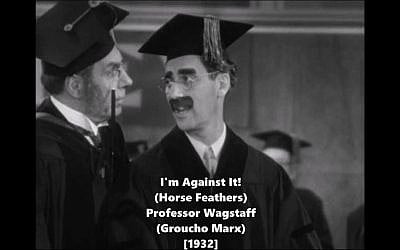
Back in 1932, Groucho Marx summed it up with perfect absurdity:
“I don’t know what they have to say, it makes no difference anyway — I’m against it.”
It was a joke then. It shouldn’t be our anthem now.