


Are You an Ark Person or a Tent Person?

From Noah to Abraham: Two ways of confronting life’s storms.
The transition from Parashat Noach to Parashat Lech Lecha introduces us to two biblical figures who face a troubled world in radically different ways. Noah retreats into an ark. Abraham sits at the entrance to his tent. Two responses to adversity, two approaches to life, and perhaps two stages in the evolution of pain.
Noah is commanded to build an ark, shut himself inside, and wait for the flood to pass. Outside, the world is collapsing. Inside, his family is protected. His task is to survive.
Abraham represents an entirely different approach. His tent opens outward. He welcomes strangers, encounters unfamiliar ideas, challenges the conventions of his time, and even argues with God. He does not wait for the world to become safe before engaging with it.
Noah protects himself from the world. Abraham chooses to participate in it.
Yet I believe these two approaches are not necessarily opposites. The order of the Torah portions suggests a process, almost an evolution of pain.
When catastrophe strikes, we need Noah’s ark. We withdraw, protect ourselves, gather strength, and wait until we can face the world again. There is wisdom in retreat, particularly when we are too vulnerable to withstand another storm.
But the ark is meant to be temporary. Eventually, the very walls that protected us may become the walls that imprison us.
For three years, Israeli society has been living, in many ways, inside Noah’s ark.
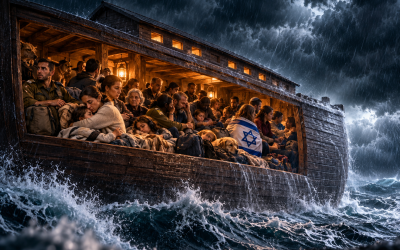
Since October 7, we have been struggling to survive, protecting our families, mourning our losses, and defending ourselves against very real threats. We have demonstrated extraordinary resilience. But resilience is a survival mechanism, not a vision for the future.
As we gain some distance from the initial catastrophe, the challenge changes. We must begin moving from Noah’s ark toward Abraham’s tent. From protecting ourselves against everything outside to finding the strength to engage with it again.
This does not mean abandoning caution or ignoring danger. Abraham himself knew how to fight when necessary. But he also knew how to welcome strangers, challenge injustice, and look beyond his immediate circle.
There is a particularly revealing difference between the two men. When Noah learns that God intends to destroy the world, he builds an ark. When Abraham learns that God intends to destroy Sodom, he argues for the lives of its inhabitants.
Noah teaches us how to survive a catastrophe. Abraham teaches us to take responsibility for the world beyond it.
Israel cannot remain indefinitely in survival mode. A society governed by fear will eventually struggle to distinguish between enemies and critics, between necessary protection and destructive isolation. The walls we build against external threats must not become walls between ourselves, or between us and the rest of humanity.
The Torah’s progression from Noah to Abraham offers a powerful lesson: we need the ark to recover our strength, but we need the open tent to reclaim our future.
Perhaps the real measure of recovery is the moment when we are strong enough to open the door again.
May we have the strength to weather life’s storms, the wisdom to recognize when shelter is necessary, and the courage to emerge from it. May the pain we have endured deepen our humanity, and may we find our way from the safety of Noah’s ark to the openness of Abraham’s tent.
Shabbat Shalom.