
Chair, Hadassah American Affairs Advocacy, Hadassah Writers' Circle
Are You Feeling Lucky?
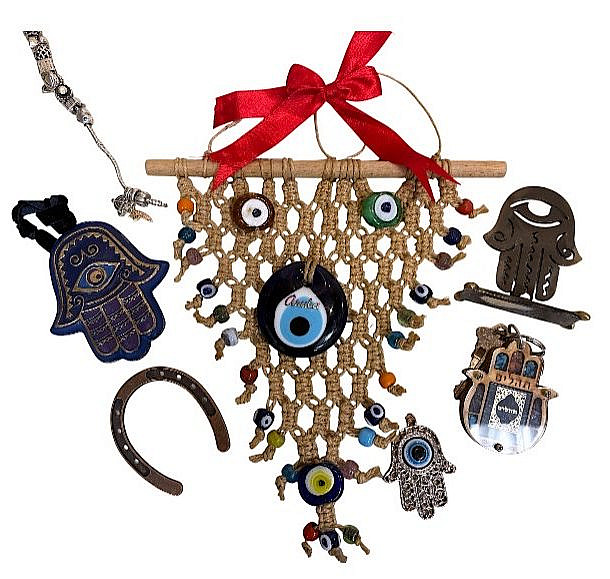
Image courtesy of the author.
Do you think Jewish people, more than those in other cultures, have trouble with good news? In my family, every time something good happened, my grandmother would say “poo poo poo,” with a spitting-on-the-ground motion. I wondered why.
For all the good we may experience in our day-to-day lives, Jews have always been plagued with a nagging concern that something could go wrong at any moment; that someone “out there” is nisht farginen, begrudging us our success or simcha (happiness). Often, those negative feelings can overshadow the good.
So how do we cope? Many seek extra protection from harm by carrying or wearing a good luck charm. For some, it is a Hamsa – a healing hand. For others, it is an evil eye, either worn or placed prominently in their home.
In my family, it was the all-powerful red ribbon — almost guaranteed to ward off evil spirits, jealousy and threats to our safety. When we wear such items, recite certain phrases or perform specific acts, what are we hoping for? My simple answer would be peace; we are hoping we can live happily day-to-day without negativity hovering around us. These days, this is not something Jews can take for granted.
In ancient times, people believed that evil and magical spirits lurked everywhere. During the Middle Ages, many Europeans believed in the existence of wood spirits, where knocking on wood would provide protection. Similar beliefs were found throughout the Middle East. You probably are aware that Jews wear a red string bracelet for protection and good luck, but did you know that people of Hispanic and Mexican cultures do the same? They wear it to ward off “el mal de ojo” (the evil eye) or negative energy. The same is true for Christians and Catholics. There are even references to the red string as far back as Genesis. Chinese and Hindu cultures believe the color red brings good luck and keeps negative vibes away. It is common practice for a baby to be protected with a red ribbon on her wrist.
Superstitions are widespread. One might think that the more educated people are, the less they rely on inanimate objects or small superstition rituals to feel secure. Not so.
Many superstitions have become family traditions that are passed down through generations and taken quite seriously. A black cat crossing your path can mean good or bad luck, depending on your culture. For Christians, walking under a ladder that is leaning up against a wall forming a triangle may be interpreted as “breaking” the Holy Trinity.
Some believe the devil is left-handed and they won’t step into a house with their left foot. Others won’t put shoes on a bed.
If you spill salt, do you throw some over your shoulder to avoid bad luck? If you drop silverware on the floor, do you expect company? Does an itchy nose mean a fight is brewing? Will breaking a mirror cause seven years of bad luck?
In my family, we still follow some superstitions first taught by my grandmother, then my mother and, later, my mother-in-law. Some superstitious rituals feel silly, but we still observe them, while others reassure us as we venture into the world. While superstitious acts may not guarantee safety or success, my Dad would say, “What is the harm if they make people feel better?”
Another factor is the sense of dread: What might happen if we don’t perform these rituals? Do we walk around with a serious concern that something awful will befall us? How much does that mindset affect our daily lives and choices? It is said that superstitious rituals can give people a sense of positivity and confidence that their day will go well. Carrying a lucky charm or evil eye amulet can enhance that positivity.
At home, I always walk around barefoot or in socks. But, because walking in stocking feet is associated with sitting shiva (the formal Jewish mourning practice for the dead that lasts seven days), my mom would say: “I am not dead yet; put on slippers!” So, we are left with the choice of upsetting someone we love by not following superstitions or continuing these practices as part of our own family rituals.
Can superstitions cause conflict? You betcha. The day we brought our first son home from the hospital my mother and mother-in-law were bickering rather loudly in the living room. When I asked why they were arguing, I found out that my mother was explaining to my mother-in-law why a red ribbon should be placed on the baby’s crib to prevent the evil eye (kinahora). My mother-in-law countered with the importance of the Sephardic blue evil eye amulet. I smiled at their mutual concern for their grandson’s well-being. This was the easiest fix ever; we put both items on the crib and, from that day forward, we began using both for good luck when and where we feel the need. That made everyone happy.
In my Hadassah chapter, one memorable program we held involved asking everyone to bring an article of Judaica that held special significance for them. Sitting in a circle, we shared wonderful stories about where these items originated, many handed down by grand and great-grandparents. They were believed to make our homes happier and healthier. Whether candlesticks, keychains, challah plates or Israeli jewelry, those objects with their touching memories made us all feel more connected.
Today, the Jewish community sorely needs that feeling of connection. Expecting the worst has been less of an irrational fear and more of a daily reality. Many of us had thought the worst aspects of antisemitism were behind us. But with every passing day, it is clear that, as a people, we are hated by many and that hatred is pervasive around the world. We continue to wonder why. What did the Jewish people do throughout history to deserve such hatred? For centuries, Jews have been hard-working, placing a high value on education. We made countless contributions to mankind. We have stood up when others were oppressed. So why is this level of vitriol so pervasive?
Is there any antidote? Could one small answer be the Hamsa Hand, often still worn by Muslims and Jews? Would wearing a chai (life) charm around your neck or a red string on your wrist or placing a mezuzah on your front door post make you feel more centered?
Whichever ones you prefer, if they bring a sense of identity, calm, good fortune or peace, then I say, “Enjoy them!” Perhaps noticing how diverse cultures observe similar meaningful superstitions will bring people closer together. As my dad said, “What is the harm?”
Debby is a member of the Hadassah Writers’ Circle, a dynamic and diverse writing group for leaders and members to express their thoughts and feelings about all the things Hadassah does to make the world a better place. It’s where they celebrate their personal Hadassah journeys and share their Jewish values, family traditions and interpretations of Jewish texts. Since 2019, the Hadassah Writers’ Circle has published nearly 500 columns in The Times of Israel Blogs and other Jewish media outlets. Interested? Please contact hwc@hadassah.org.
Related Topics