Are You With Israel?: Courage in the Skies, Responsibility on the Ground
On October 7th, 2023, Odaya and Dolev Swissa, together with Amer Abu Sabila, a Bedouin construction worker from Be’er Sheva who was trying to help them, were brutally murdered by Hamas terrorists on the streets of Sderot as they attempted to escape the attacks of that horrific morning. Their daughters, Romi (6) and Lia (3), were sitting in the backseat of their car.
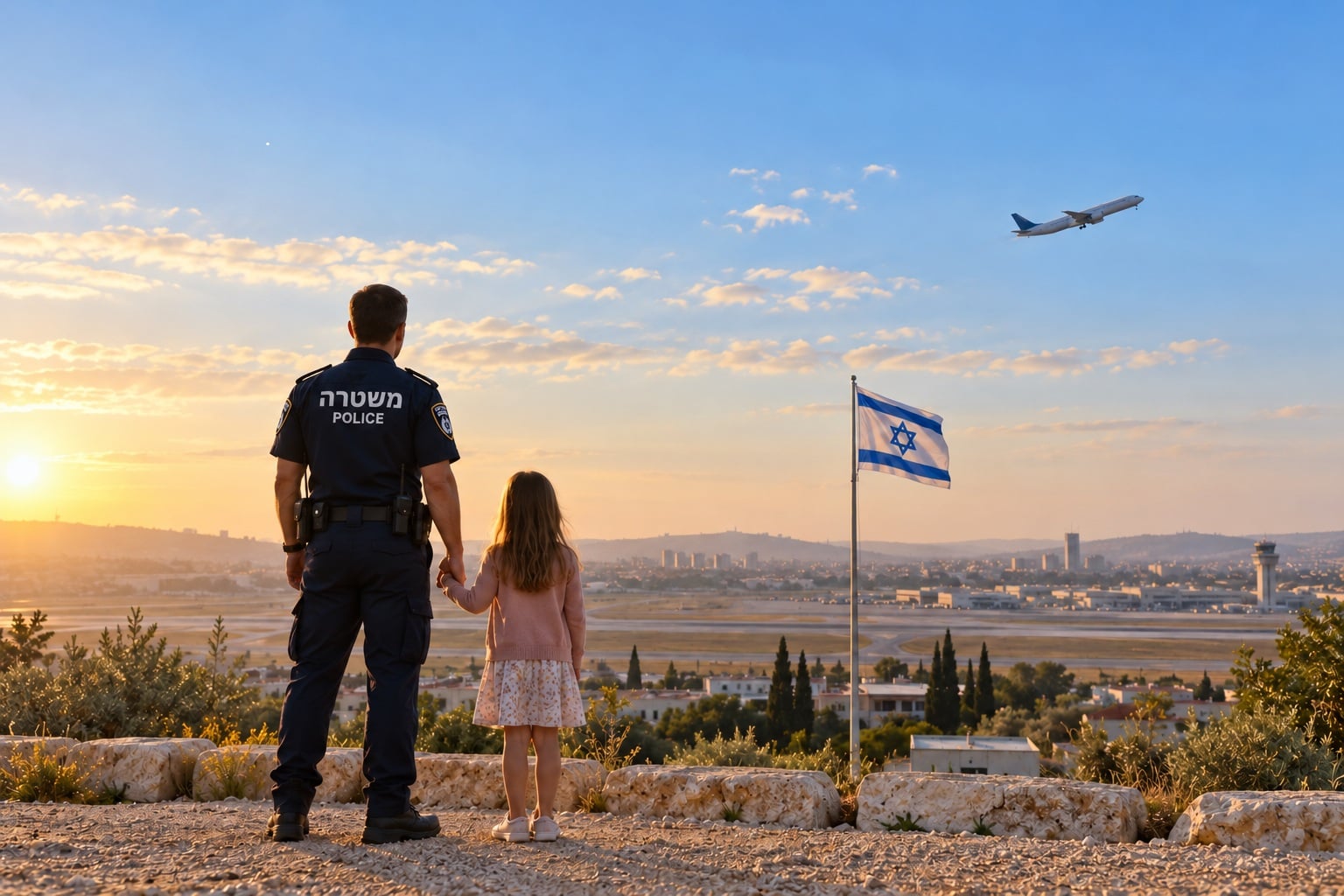
Under heavy terrorist gunfire, police officers approached the vehicle to rescue the girls. When the first officer shouted, “Police! Police! Police!” Romi responded in a frightened, quivering voice: ״אתם של ישראל?״ — “Are you with Israel?”
“Yes, sweetheart,” the officer reassured her. “We’ll take you.”
Under intense terrorist gunfire, those brave officers brought the girls to safety. Romi’s words captured something profound: the desperate need for security, reassurance and belonging in a moment of unimaginable terror.
A shared culture, language and civic identity define what it means to be Israeli. But to be with Israel is something deeper. It is a moral commitment, a sense of responsibility and a willingness to protect others, even at great personal risk. It transcends politics, geography and military service. It means recognizing a brother or sister in need and answering the call.
Those officers did not merely answer Romi’s question with words. They answered with action.
Over the past three years, we have encountered countless soldiers, reservists, first responders and ordinary civilians who have answered that same question with courage, conviction and extraordinary sacrifice.
And the answers are not confined to the ground. They can also be found in the skies.
On October 1st, an Israeli plumber, banker, insurance agent and dentist, together with fellow passengers and the courageous Captain Smit Machchhar, stood as the firewall between 174 passengers and a potential mass-casualty terrorist attack.
Faced with mortal danger, these seemingly ordinary citizens did the extraordinary. Their selfless actions aboard Flydubai Flight FZ1073 provided another answer to Romi’s question: ״אתם של ישראל?״
But they were hardly the first to answer that call in the skies.
On September 11th, 2001, Daniel Lewin was aboard American Airlines Flight 11, the first aircraft hijacked and flown into the World Trade Center. A former captain in Sayeret Matkal, Lewin had co-founded Akamai Technologies two years earlier after developing groundbreaking technology to optimize internet traffic.
According to the official 9/11 Commission Report, Daniel Lewin may have attempted to stop the hijackers seated in front of him, unaware that another terrorist was sitting directly behind him. That terrorist stabbed and killed Lewin. Although the precise circumstances of his final moments remain uncertain, the Commission’s account raises the possibility that Lewin’s instinct was to confront danger rather than submit to it — a sense of a responsibility no doubt nurtured and honed during his IDF service.
His legacy was one of innovation, courage and responsibility.
Roni Zukerman’s life offers another expression of that same spirit. The granddaughter of Tzivia Lubetkin and Yitzchak (Antek) Zukerman, leaders of the Warsaw Ghetto Uprising, Roni was raised on Kibbutz Lohamei HaGeta’ot, founded by holocaust survivors.
In 2001, she became Israel’s first female F-16 fighter pilot, carrying forward a family legacy of Jewish courage and determination — from resistance in the Warsaw Ghetto to the cockpit of an Israeli fighter jet.
Yet Roni was not the first woman to fly for the Israel Air Force. That distinction belongs to Yael Rom, who co-piloted an IAF C-47 that dropped Israeli paratroopers into the Sinai during the 1956 Suez campaign.
In the mid-1950s, while Western governments were still debating legislation on gender equality, Yael Rom was evidently a few chapters ahead. While others debated where women stood in terms of pay equity, she was figuring out where the paratroopers aboard her aircraft would land.
The call to protect lives in the skies does not always require taking flight. In 1986, an El Al security agent at London’s Heathrow Airport prevented what could have been one of civil aviation’s deadliest terrorist attacks.
Anne Marie Murphy, a pregnant Irish national, was preparing to board El Al Flight 016 to Tel Aviv, carrying luggage packed by her fiancé, Nezar Nawwaf al-Hindawi, who had secretly concealed 1.5 kilograms of Semtex explosives and a timed detonator inside.
During routine questioning, the security agent sensed that something was wrong. Despite an initial screening that failed to reveal the threat, the agent persisted. Further inspection uncovered the bomb, averting a potential catastrophe for the 375 passengers and crew.
No fighter jet. No battlefield. Just instinct, persistence and an unwavering sense of responsibility.
A decade earlier, in July 1976, that same sense of responsibility was demonstrated on an extraordinary scale at Entebbe, Uganda. When terrorists hijacked an Air France flight and held the passengers hostage, separating Jewish and Israeli passengers from the others, Israel faced an agonizing choice: negotiate with terrorists or attempt a seemingly impossible rescue thousands of kilometers away. In a daring overnight operation, Israeli commandos flew into Entebbe and rescued 102 hostages, at the cost of the lives of three hostages and the operation’s commander, Yoni Netanyahu. The message was unmistakable: Jewish lives would not be abandoned simply because they were far from home.
Although six-year-old Romi could not have known it, her question echoes across Jewish history.
From an airstrip in Entebbe to a C-47 over Sinai; from an F-16 cockpit to a security counter at Heathrow; from American Airlines Flight 11 to Flydubai Flight FZ1073; and, tragically, to an intersection in Sderot — the question has been asked, and courageous individuals have answered.
The officers who rescued Romi and Lia, the heroes of FZ1073, Daniel Lewin, Roni Zukerman, Yael Rom, the vigilant El Al security agent and countless others whose names and stories we may never know all understood this fundamental truth: responsibility is not merely something we feel. It is something we do.
In 1942 – 34 years before Entebbe – a ten-year-old Jewish boy named Aaron Elster fled the Sokołów Ghetto and sought refuge in the Polish countryside. Desperate for food and shelter, he offered a farmer jewelry his mother had given him.
The farmer’s family initially fed and sheltered him but, fearing for their own lives, eventually returned the jewelry and sent him away with devastating words: “There is no more future for people like you.”.
History proved them wrong.
Aaron was eventually taken in by another family and survived the Holocaust, built a family and established a successful life in America. But at that desperate moment in 1942, when he needed protection and hope, he was turned away.
After centuries of dependence on the goodwill and protection afforded by others, the Jewish people have a sovereign state with the strength, resolve and responsibility to provide a different answer.
An answer backed not merely by promises, but by the courage, determination and sacrifice of those willing to act.
Yet that strength carries responsibility. Being with Israel is not simply a matter of identity or geography. It is a collective obligation — one that belongs to Jews in Israel and throughout the world, particularly when so many others choose to stand aside.
Today represents a first in my life. It will be the first time that I enter a polling station in Israel and exercise one of the most extraordinary privileges of Jewish sovereignty: the right to help shape our own future. For me, this represents an opportunity of being with Israel in the most concrete way I can imagine – with my vote. My vote will be an expression of something greater than a political preference. It will be an affirmation of my responsibility for the future of a country whose very existence has transformed the course of Jewish history.
A vote for a future in which no Israeli child must ever ask ״אתם של ישראל?״ out of fear, desperation or uncertainty but rather a future in which those words are spoken instead with confidence, pride and hope.
Our collective responsibility is to ensure that the State of Israel that Romi, Lia and so many others who have suffered over these past three years inherit will be one that where the question “Are you with Israel?” is
asked not out of fear but rather as an invitation to step up and take their rightful place in continuing to build something extraordinary.
To transform ״אתם של ישראל?״ from a plea for protection into an invitation to greatness.
That is the future Romi, Lia and so many others deserve.