Editor
Ariel Shenhav on performance, movement and bringing Israeli artistry to LA
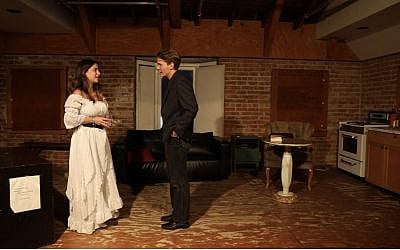 Ariel Shenhav’s career has taken shape across more than one country, one medium and one definition of performance.
The Israeli actress and multidisciplinary performer has worked across film, television, theater, dance, music, choreography, directing and performance education, building a career that moves between Israel and Los Angeles. Along the way, she has increasingly expanded beyond interpreting other people’s work to creating projects of her own.
“I would describe myself as an artist who really loves to create my own material, not only perform other people’s work,” Shenhav said. “I love taking something that comes from my heart or from my own experiences and finding a way to turn it into a story that I can share with other people.”
That impulse is reflected in NO(v)A & LIA, a short film Shenhav co-created about the Nova Music Festival and the events of October 7. The film was officially selected and screened at the Lee Strasberg Theatre & Film Institute’s 3×5 Film Festival in Los Angeles.
For Shenhav, bringing the project into an international artistic setting carried particular significance.
“As an Israeli, it was really important for me to bring that story into an international environment,” she said, “and to use art as a way of showing people something about what we experienced.”
The project also reflects the direction in which Shenhav’s career has been moving. In addition to acting, she has written and developed her own material and is currently writing her first feature film.
“I think that’s the kind of artist I want to be,” she said. “Someone who can perform, but who can also create her own opportunities and tell stories that genuinely mean something to her.”
An artistic foundation built in Israel
Shenhav began performing at an early age in Israel.
She started dancing at 3 and singing at around 5, and spent years performing in a choir while also pursuing acting and movement. Her first lead role in a full stage production came in elementary school, when she played Peter Pan.
By the time she was 18, Shenhav had begun working professionally on screen. One of her early television credits was a supporting role in the Israeli series Taagad (Charlie Golf One), a drama centered on military life.
The experience came shortly before Shenhav herself entered the Israeli military.
Over the years, the lines between her artistic disciplines remained deliberately blurred. Acting was central, but music and movement continued to shape the way she approached performance.
“I didn’t come into the industry through acting alone,” Shenhav said. “I arrived with years of experience across music, dance, live performance and Israeli storytelling.”
That background later expanded through professional training in Los Angeles.
Finding a new approach at Lee Strasberg
Shenhav had first encountered the work of Stanislavski and Lee Strasberg while studying theater in high school in Israel.
Years later, while working as a flight attendant, she used time off to travel to Los Angeles and take an introductory workshop at the Lee Strasberg Theatre & Film Institute.
Her first reaction to Method Acting was not immediate reverence.
“I remember walking into the Method class, sitting in the relaxation chair, and watching everyone doing the relaxation work and making all these sounds,” she said. “My first thought was, ‘These people are crazy!’”
What caught her attention, however, was the concentration in the room.
She eventually enrolled at the Institute, where she studied Method Acting as well as scene work, movement, improvisation, voice, text analysis and acting for film and television.
Shenhav said the training changed the way she prepares for roles.
“Today, when I receive a role, I almost approach the script like a surgeon,” she said. “I take it apart line by line, work on the subtext, and ask myself what I need in order to really understand and enter that character’s world.”
She has since performed onstage at the Institute, including as Nina in The Seagull.
Her time at Strasberg also became part of a larger period of creative development in Los Angeles, where she began working on short films and developing original projects.
Moving from performer to creator
Several of Shenhav’s recent projects have allowed her to take on responsibilities beyond acting.
She has held lead roles in The Wife’s Gambit, Why Me? and Who Would She Choose?.
On Why Me?, Shenhav also wrote the film, playing the lead character Michaela while simultaneously shaping the story from the page.
That dual role reflects a growing interest in creating her own material rather than waiting exclusively for opportunities to arrive through traditional casting channels.
She has also explored directing and performance development through The Voices of the Heart, where her work has included acting, singing, choreography, coaching and live performance.
For a production of The Little Mermaid, Shenhav directed while also participating as a performer. Her responsibilities included casting, developing scenes, teaching musical material, creating choreography and helping performers integrate acting, singing and movement.
“I don’t see acting, singing and movement as separate things,” Shenhav said. “When I create choreography, I’m not only thinking about the steps — I’m thinking about what the character is feeling and what the movement is communicating.”
Music, she said, is approached the same way.
“With a song, I want the performer to understand what they are saying and why they are singing it, rather than simply focusing on singing the notes correctly.”
Shenhav has also previously served as Head of the Theater Department at a JCC in Brooklyn, adding another dimension to her work with young and developing performers.
Building complete performers
That cross-disciplinary approach is central to Shenhav’s current work at D Dance Spot, where she was selected to design and deliver a Performance Arts Program.
The program is structured around developing students not only as dancers, but as performers capable of communicating character, emotion and story through movement.
Shenhav works with younger students in ballet and with older students across styles including theater dance and hip-hop.
Her role includes developing the performance component of the program and adapting the work for different ages and experience levels.
“With younger students, that may begin with ballet, musicality and learning how to express themselves through movement,” she said. “As they get older, we can explore theater dance, hip-hop, acting exercises, character work and more advanced performance skills.”
For Shenhav, the goal is not simply technical proficiency.
“I want them to understand how to tell a story through movement, how to use facial expression and emotion, how to develop stage presence, and how to understand the character or intention behind what they are performing.”
Her own background in acting, dance, choreography and performance coaching informs the program’s structure.
“The goal is to help these students become performers who don’t just execute choreography,” she said. “They understand what they are communicating when they step onstage.”
From traditional screen work to vertical drama
Shenhav’s screen career has developed alongside her work in live performance and education.
In the released vertical drama The Wife’s Gambit, she played Ruby, a company shareholder and close friend of one of the story’s central characters.
Ruby becomes increasingly important as the story reaches its climax and allegations of betrayal, infidelity and financial misconduct begin to reshape the relationships around her.
For Shenhav, the character’s emotional arc centered on trust.
“She defended him because he was her dear friend, and she didn’t want to believe the accusations until she was confronted with the evidence herself,” Shenhav said.
The role required her to move from loyalty to disillusionment while helping reveal key information that drives the story toward its conclusion.
The project was also Shenhav’s first experience working in the vertical drama format, a form of short, mobile-focused storytelling that has expanded rapidly in recent years.
“I was used to traditional film, television and stage work, and vertical storytelling has its own rhythm, energy and way of connecting with an audience,” she said.
After the production was released, Shenhav said viewers began contacting her through Instagram to discuss the story and characters.
“I could actually see the audience responding to the work,” she said.
The experience introduced her to a new format while reinforcing an idea that has followed her across different forms of performance: the medium may change, but the underlying task remains storytelling.
A career between two artistic worlds
Shenhav continues to maintain professional ties to Israel.
She recently completed filming an Israeli project centered on a love story set before the establishment of the State of Israel. She also works as a casting assistant in Israel, an experience she says has given her a different understanding of actors and the casting process.
Working on both sides of the industry has affected the way she views performance.
It has also kept her connected to Israeli stories, history and culture while she continues developing her career in Los Angeles.
“I grew up performing in Israel, and I continue to work professionally here today,” she said. “I naturally bring that perspective with me when I work in Los Angeles.”
For Shenhav, that cultural background is not something separate from technique. It is part of the perspective she brings into a rehearsal room or onto a set.
The same is true of music and movement.
“Music gives me rhythm and emotion, movement helps me understand how a character exists physically, and my own experiences and cultural background give me a perspective that I can bring into stories written by other people,” she said.
Leading roles ahead
Shenhav has already been selected for several upcoming lead roles.
She is set to appear in leading roles in Five Kings and Book of Joshua with PartingSeas Productions.
She has also been selected to play Paula, the lead role in Randy Vinneau’s upcoming Hanging Tree.
The latter places Shenhav in a Western-style story and introduces Paula as a hostage before gradually revealing that the character is far more capable and consequential than she initially appears. Paula returns during the film’s final moments as part of its closing twist.
Shenhav said the role appeals to her precisely because it differs from much of her earlier work.
“These projects are exciting because they allow me to show different sides of myself as a performer,” she said.
She also views leading roles as carrying responsibilities beyond simply having more screen time.
“I see it as a responsibility to help carry the emotional journey of the story, understand the character beyond what is written on the page, and bring something truthful and personal to the role while still serving the director’s vision.”
That approach has already affected the way filmmakers respond to her work.
Shenhav recalls one director telling her that he had originally imagined a character very differently. After seeing her audition, he reconsidered his own understanding of the role.
“He told me that I had understood something in the character differently from the way he originally imagined it,” she said, “and that after seeing my interpretation, he felt I had to play her.”
It is the kind of moment Shenhav says she hopes to keep pursuing: entering someone else’s story while finding something personal within it.
Telling stories from a personal place
Although Shenhav’s work now spans multiple forms, she resists treating those disciplines as separate careers.
Acting remains at the center, but dance, singing, choreography, directing, writing and teaching all feed back into the same underlying interest.
Storytelling.
“I want to bring myself into the characters I’m trusted with — my Israeli background, my music, my movement, my training, and the way I see the world — while still honoring the writer’s story and the director’s vision,” she said.
At the same time, she wants to continue creating original work, particularly stories connected to experiences and subjects that feel personally significant.
That path has already taken her from Israeli television to Los Angeles training, from the stage to vertical drama, from singing and dance to directing, and from interpreting characters to writing them herself.
For Shenhav, the next stage is less about narrowing those interests than allowing them to continue intersecting.
“Ultimately, I just want to keep acting, creating and telling stories that make me feel something and hopefully make other people feel something too,” she said.
“I think that’s why we do what we do.”
Related Topics